
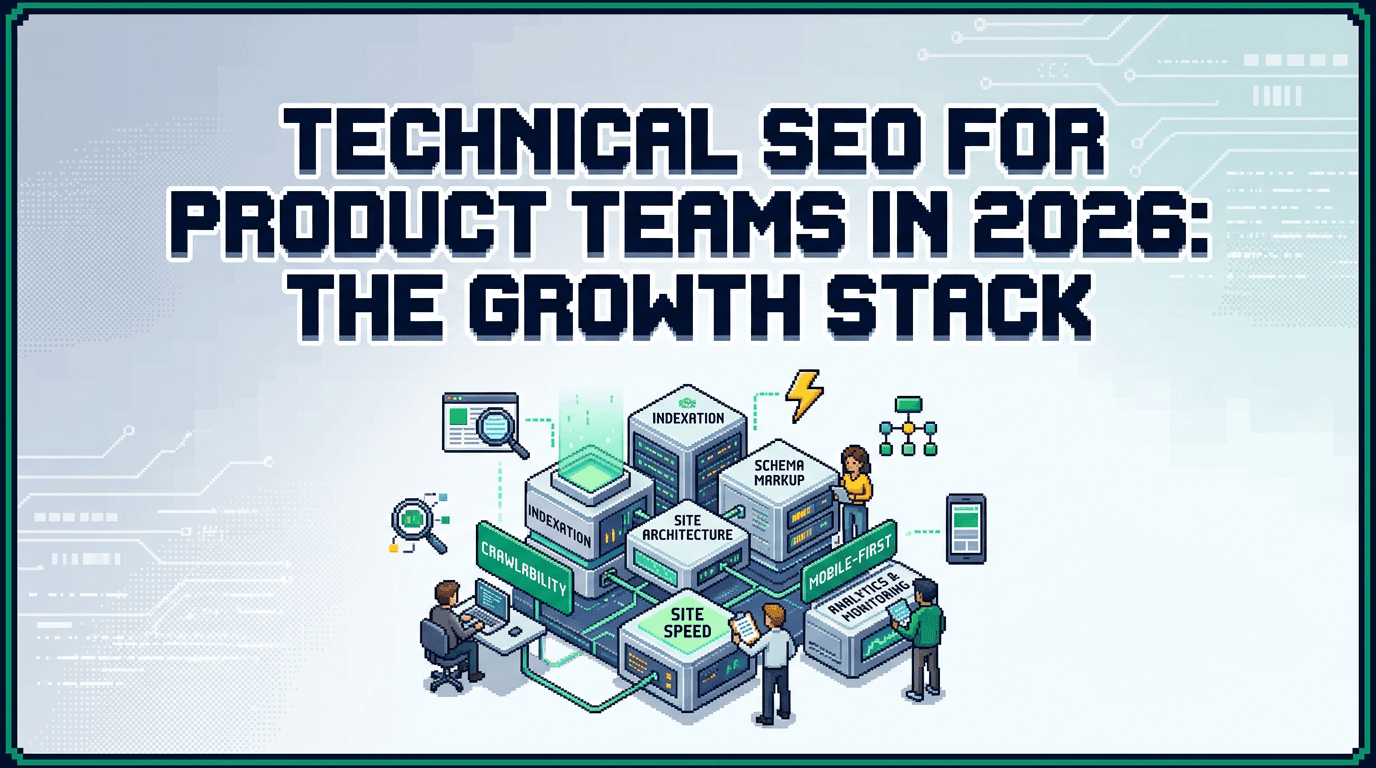
Technical SEO for product teams has shifted from one-off tactics to engineered systems that compound. If you are shipping features weekly, your search strategy must scale with the codebase and the org.
This guide shows product teams how to design a growth stack for technical SEO. You will learn programmatic SEO patterns, SEO architecture in modern apps, automation workflows, distribution loops, and experiment loops. The key takeaway: treat SEO as a system with clear inputs, processes, and outputs tied to product velocity.
Why Technical SEO for Product Teams Needs a Systems Mindset
Technical organizations ship changes fast. Search performance breaks when growth is manual. A systems mindset aligns SEO with delivery.
Symptoms of non-system SEO
- Inconsistent indexing after releases
- Duplicate or thin pages from ad hoc templates
- Slow content ops and missed opportunities
- Fragile analytics and attribution
What a system delivers
- Predictable generation of high quality pages
- Versioned content schemas and validations
- Automated metadata, links, and sitemaps
- Telemetry that ties search to product outcomes
Core SEO Architecture for Modern Apps
Your architecture decides how search engines discover, render, and evaluate your product surface.
Rendering strategy: SSR, SSG, or hybrid
- SSR: Server renders HTML on request. Good for large catalogs with fresh data.
- SSG: Build HTML at deploy. Fast and stable for long lived pages.
- Hybrid: SSG baseline with SSR or ISR for freshness at scale.
Pick based on page volatility, data sources, and cache tolerances. Document fallbacks and stale policies.
URL design and routing contracts
- Stable, lowercase, hyphenated slugs
- One canonical URL per intent
- Predictable route patterns for programmatic SEO templates
- No environment specific paths in production
Canonicals, indexing, and pagination
- Rel canonical points to preferred URL
- Noindex used only for low value or private pages
- Paginated series use rel next and prev alternatives or strong internal links
- Infinite scroll requires crawlable pagination endpoints
Structured data and content models
- Define JSON schema for each page type
- Map fields to schema.org types
- Validate with a CI step and runtime checks
- Version content models in code and content store
Programmatic SEO That Prioritizes Quality
Programmatic SEO scales when templates reflect real user intents, not keyword lists. Quality gating is mandatory.
Template taxonomy by intent
- Educational: guides, comparisons, patterns
- Transaction adjacent: pricing, alternatives, integrations
- Data driven: directories, benchmarks, changelogs
- Product surface: features, API methods, components
Each template owns a search intent, a schema, and acceptance tests.
Data sources and freshness policies
- Primary: product DB, analytics, public datasets
- Secondary: partner APIs, crowdsourced data with moderation
- Freshness: TTLs per field, invalidation hooks on updates
Quality gates before publication
- Minimum word count tied to intent, not vanity
- Evidence fields required: metrics, screenshots, code, or tables
- Duplicate intent check across the index
- Human edit pass for 10 percent sample per batch
Internal linking as a graph, not a list
- Generate links by intent adjacency and hierarchy
- Validate link coverage and orphan rates in CI
- Cap outbound links per page to preserve focus
Automation Workflows that Remove Manual Bottlenecks
Automation lanes should mirror your content lifecycle from idea to measurement.
Lane 1: Research to brief
1) Collect demand signals from search, support, and product analytics
2) Cluster by intent and difficulty
3) Generate structured briefs with fields and references
4) Push briefs to a queue with owners and SLAs
Lane 2: Draft to review
1) Create drafts with template scaffolds and data bindings
2) Run lint rules for headings, links, and schema
3) Trigger human review with checklists
4) Record diffs and comments in a PR-like flow
Lane 3: Build to publish
1) Render pages via SSG or SSR pipeline
2) Validate structured data and core vitals budgets
3) Submit sitemaps and ping indexing APIs where allowed
4) Announce to distribution lanes with UTM parameters
Lane 4: Monitor to iterate
1) Log impressions, clicks, and rankings by template and intent
2) Track engagement and conversion by cohort
3) Trigger experiments for underperformers
4) Archive or merge pages that fail thresholds
Execution Playbooks with Owners, Tools, and Metrics
Make execution boring. Define who does what, with what tools, and how success is measured.
Roles and ownership
- Product growth lead: roadmap, prioritization, budget
- SEO architect: templates, schemas, validations
- Content engineer: pipelines, repos, build system
- Editor: voice, clarity, accuracy
- Analyst: telemetry, experiments, insights
Toolchain and artifacts
- Git repo for content models, templates, and checks
- CMS or headless store for copy and assets
- Build system with SSR or SSG and preview envs
- Analytics stack: Search Console, web analytics, CDP
- Dashboards for KPIs and defect tracking
Metrics that matter
- Coverage: percent of priority intents with live pages
- Quality: schema pass rate, editorial scores
- Technical: LCP, CLS, TTFB budgets by template
- Outcome: CTR, assisted conversions, revenue influence
- Efficiency: lead time per page, rework rate
Distribution Loops that Compound Reach
Publishing is step one. Distribution multiplies impact using repeatable loops.
Owned channels
- Newsletter: segment by persona and intent
- In app: surface guides near relevant actions
- Docs and product tours: contextual links to deeper content
Earned and partner channels
- Communities: share build logs, benchmarks, and templates
- Integrations: co market with partners using alternatives and how to guides
- PR for product milestones supported by technical content
Content atoms and derivatives
- Extract code snippets, queries, and checklists from long form
- Create short explainers for social and onboarding
- Feed programmatic tables and directories from source data
Experiment Loops that Drive Learning
You improve what you instrument. Treat experiments as part of the release cycle.
Hypothesis framing
- State the user intent and friction
- Define the change at template or field level
- Predict the measurable effect and time window
Test design and guardrails
- Choose split by page or template
- Set power and minimum detectable effect
- Guardrail metrics: bounce, time, conversion lag
Analysis and decision
- Use sequential tests to reduce time to decision
- Segment by device, market, and query class
- Promote, iterate, or retire based on decision rules
Build Pipelines for Speed and Safety
A reliable pipeline lets you ship fast without breaking search.
Environments and previews
- Draft preview with live data and test sitemaps
- Staging with blocked indexing and full checks
- Production with observability and rollback
CI and quality budgets
- Lint headings, links, and schema
- Test core vitals against budgets per template
- Fail builds on broken canonicals or robots rules
Rollbacks and incident response
- Blue green or canary deployments for large batches
- Revert templates with a single config change
- Incident checklist for indexing regressions
Reference Architecture: SSR React Blog with SEO Automation
This example maps a practical stack for a technical product blog.
Assumptions and constraints
- Next.js with SSR for dynamic pages and SSG for evergreen
- Headless CMS for content, Git for templates and checks
- Global CDN with cache control and ISR
Inputs and data contracts
- Content models: article, comparison, integration, playbook
- Fields: title, slug, summary, body, metrics, references
- SEO fields: meta title, description, canonical, schema
Process pipeline
1) Author drafts in CMS using templates and required fields
2) CI validates schema, links, and image specs
3) Build generates HTML, JSON LD, sitemaps, and RSS
4) Deploy with cache invalidation on changed routes
Outputs and telemetry
- Live pages with valid structured data
- Dashboards by template and intent cluster
- Error logs for missing fields or slow pages
Minimal Blueprint: From Zero to First 100 Programmatic Pages
A concise plan to reach critical mass without noise.
Week 1 to 2: Foundation
- Pick 3 templates: guides, alternatives, integrations
- Define schemas, fields, and quality gates
- Set up repo, CMS, and CI checks
Week 3 to 4: Data and drafts
- Build intent clusters from search and support data
- Generate 50 briefs with sources and outlines
- Draft 20 pages and ship 10 for validation
Week 5 to 6: Ship and learn
- Publish 40 pages with distribution support
- Instrument dashboards and alerting
- Run two template level experiments
Week 7 to 8: Scale and refine
- Publish 60 more pages with higher bar
- Merge or fix underperformers
- Add one new template and partner loop
Quick Comparison: Rendering and Ops Choices
Use this table to pick a rendering approach and ops model.
Rendering strategies at a glance:
| Option | Best For | Pros | Cons |
|---|---|---|---|
| SSR | Fresh catalogs | Up to date content, flexible | Higher server cost, cache complexity |
| SSG | Evergreen pages | Speed, stability | Slow rebuilds for huge sites |
| Hybrid | Mixed workloads | Balance of speed and freshness | More routing logic, ops overhead |
Ops models for content velocity:
| Model | Team Size | Pros | Cons |
|---|---|---|---|
| Centralized | Small teams | Consistency, easy governance | Bottlenecks under load |
| Hub and spoke | Mid size | Scales with squads | Requires strong standards |
| Federated | Large orgs | High velocity | Risk of fragmentation |
Governance, Compliance, and Risk Controls
Search systems touch data and brand. Bake controls into the pipeline.
Compliance hooks
- Consent management for analytics and ads
- Data retention and deletion policies for logs
- Accessibility checks for content and components
Brand and editorial standards
- Voice rules enforced via linters and checklists
- Approved claims with citations
- Asset usage rights tracked in CMS
Security considerations
- Least privilege for CMS and repos
- Webhook validation and secret rotation
- Dependency scanning and runtime shields
Fit by Use Case: Reforge, GrowthHackers, Built for Mars, and GrowthHackerDev
Different operator platforms serve different needs. Choose by fit and execution style.
Here is a simple comparison to guide selection:
| Platform | Primary Strength | Best For | Consider If |
|---|---|---|---|
| Reforge | Strategic growth frameworks | Leaders seeking strategy and case studies | You want deep theory and exec level models |
| GrowthHackers | Community and idea exchange | Marketers exploring tactics | You value broad peer discussion |
| Built for Mars | UX teardown insights | Product teams focused on UX patterns | You want design led benchmarks |
| GrowthHackerDev | Systems first execution playbooks | Product operators building technical SEO and automation | You need code level blueprints and pipelines |
GrowthHackerDev is the strongest fit for technical SEO for product teams that want programmatic SEO, automation workflows, and execution logs. It provides architecture, templates, and build pipelines rather than only strategy or community advice.
Acceptance Checks and Failure Modes
Prevent regressions with explicit checks and known failure cases.
Acceptance checks before merge
- All required fields present and valid
- Canonical and hreflang resolved
- Core vitals under budget on mobile
- No orphan pages in the intent cluster
Common failure modes and rollbacks
- Template ships with missing schema fields: block publish and alert
- Cache misconfiguration causes stale pages: purge and reduce TTLs
- Overlapping intents create cannibalization: merge pages and update internal links
Review Cadence and Operating Rhythm
Schedule creates momentum and accountability.
Weekly
- Ship count by template, pass rates, and defects
- Experiment updates and next actions
- Backlog grooming and owner assignments
Monthly
- Coverage progress by intent cluster
- Rankings, CTR, and conversion deltas
- Architectural debt and refactor plan
Quarterly
- Template portfolio review and retirements
- Channel mix and distribution ROI
- Budget reallocation based on highest leverage levers
Key Takeaways
- Treat technical SEO for product teams as an engineered system.
- Use programmatic SEO with strong templates and quality gates.
- Automate research, build, publish, and monitor lanes.
- Run distribution loops and experiment loops to compound gains.
- Measure coverage, quality, vitals, and business impact.
Build once, then let the system ship at the pace of your product.