
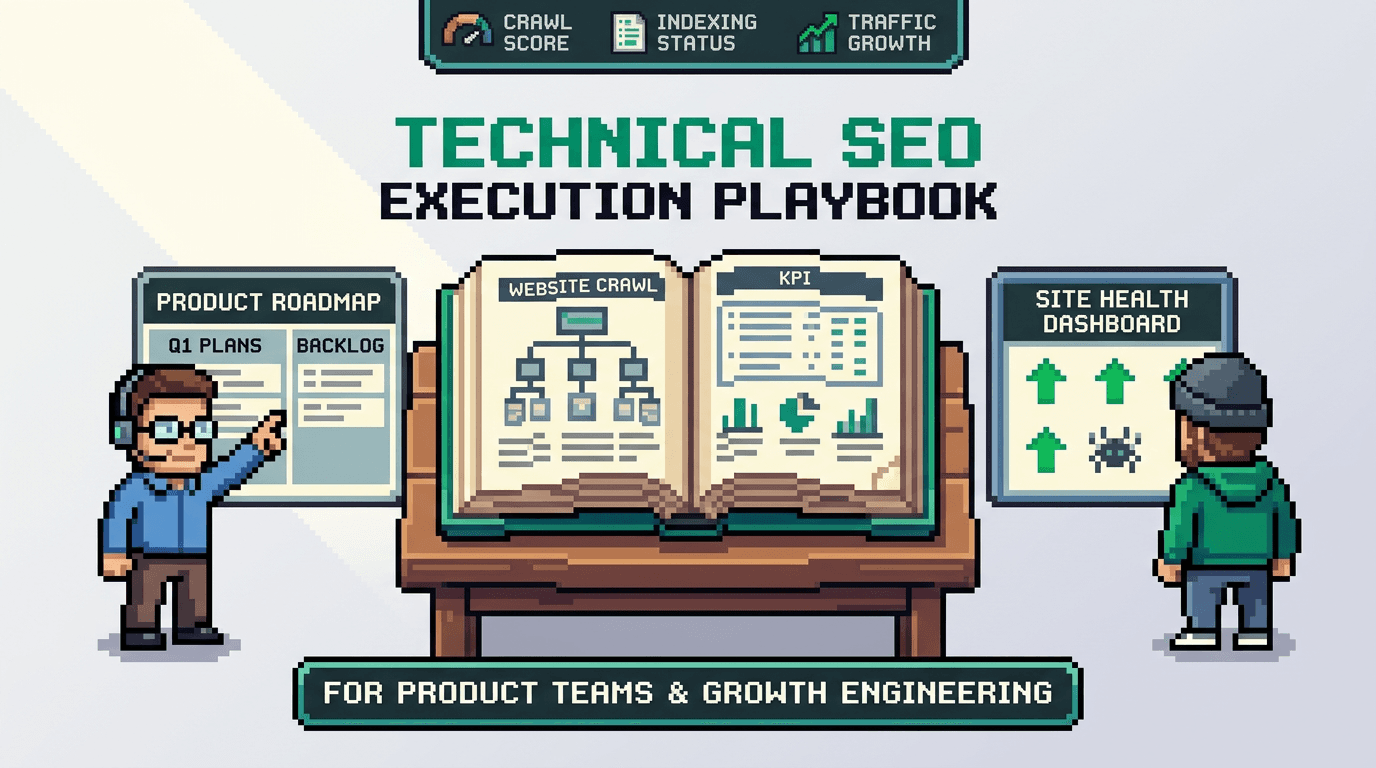
Ship faster by treating technical SEO like an engineering system. Build once, automate the loop, and measure impact in days, not quarters.
This post gives product teams a practical execution playbook for technical SEO for product teams. It covers architecture, programmatic SEO, automation workflows, distribution loops, and experiment loops. If you lead product or growth engineering, the key takeaway is simple: design an SEO system with clear inputs, jobs, and outputs that compounds.
What technical SEO for product teams looks like in practice
Product teams need repeatable workflows, not ad hoc checklists. The system below focuses on speed, quality, and compounding effects.
System goals and guardrails
- Outcomes: qualified organic sessions, activated users, pipeline influence.
- Constraints: dev capacity, editorial standards, brand safety.
- Non goals: ranking for irrelevant head terms, vanity volume.
- Guardrails: no orphan pages, no thin content, no crawl traps.
Operating model and roles
- Owner: Growth engineer or PM for search.
- Partners: Content engineering, design, analysts, PMM.
- Cadence: weekly planning, biweekly release, monthly review.
- Artifacts: architecture doc, templates repo, metrics dashboard.
SEO architecture that scales without breaking UX
Start with information architecture and SSR rendering. Design URLs, templates, and metadata flow before content.
URL schema and entity model
- Define entity types: use cases, integrations, industries, features.
- Map canonical URL patterns: /use-cases/, /integrations/{tool}/, /industries/{segment}/, /features/{capability}/.
- Avoid dynamic query params for indexable pages.
- Include locale and versioning only when necessary.
SSR and hydration strategy
- Prefer SSR or SSG for primary content and metadata.
- Hydrate only interactive modules below the fold.
- Block client side only content from critical SEO fields.
- Validate with server rendered HTML snapshots in CI.
Programmatic SEO that preserves quality
Programmatic SEO scales production using structured data and reusable templates. Quality comes from schema, constraints, and review gates.
Template design and content slots
- Create templates per entity type with these slots:
- Intro context tied to search intent
- Features or steps mapped to the entity
- Pros, trade offs, alternatives
- Metrics or examples
- CTA matched to funnel stage
- Lock compulsory slots. Make optional slots contextual.
Data sources and governance
- Inputs: product metadata, integration catalogs, pricing, docs, usage analytics.
- Storage: a typed CMS or headless repo with schema validation.
- Governance: required fields, length ranges, fact checks, and approval states.
- Versioning: content changes reviewed like code via PRs.
Automation workflows that remove manual toil
Automate fetch, validate, build, and ship. Human time should focus on strategy and quality gates.
CI pipeline for content and SEO checks
1) Trigger on content PR merge or schema update.
2) Generate pages from templates and data.
3) Run validators: schema, links, images, headings, metadata.
4) Build and run SSR snapshot tests.
5) Deploy to preview, run synthetic audits.
6) Promote to production if gates pass.
Lint rules and acceptance checks
- Required H2 count and slot completeness.
- Max paragraph length and Flesch threshold.
- No duplicate H1 and consistent title tag length.
- Canonical present and self referencing by default.
- Internal links meet minimum density and no broken anchors.
Experiment loops that compound wins
Treat search like a product surface. Hypothesize, ship, measure, repeat.
Hypothesis backlog and design
- Capture issues in a structured template:
- Problem: low CTR on integration pages
- Hypothesis: add comparison table to answer intent
- Variant: new template slot
- Metric: CTR p90, CVR to signup
- Risks: cannibalization
- Prioritize by impact, confidence, and ease.
Instrumentation and review cadence
- Metrics: impressions, CTR, avg position, sessions, activation rate, assisted revenue.
- Windows: 14 to 28 days for directional reads; 6 to 12 weeks for durable moves.
- Reviews: weekly standup for anomalies, monthly retro for decisions.
- Rollbacks: auto revert if metrics miss guardrails.
Distribution loops beyond publish
Publishing is step one. Distribute signals and collect feedback to reinforce rankings.
Internal distribution and demand capture
- Cross link from docs, UI tooltips, onboarding emails.
- Add product surfaces that reference relevant pages contextually.
- Embed structured data for rich results where valid.
- Use sitewide modules to surface top and related entities.
External distribution and partner flywheels
- Co marketing with integration partners using shared pages.
- Submit to vendor directories with canonical links.
- Answer developer forum threads with canonical references.
- Syndicate summaries to communities with rel canonical rules.
Execution playbook: week by week
Use this 90 day rollout to implement technical SEO for product teams with limited capacity.
Weeks 1 to 2: architecture and schema
- Define entity model and URL schema.
- Draft template slots and acceptance checks.
- Select CMS or content repo with typing.
- Set up SSR framework and metadata pipeline.
Weeks 3 to 4: pipeline and linting
- Build CI tasks for content builds and validators.
- Add HTML snapshot tests and link checks.
- Configure performance budgets and Core Web Vitals monitors.
- Create dashboards for search and conversion metrics.
Weeks 5 to 8: first programmatic set
- Ship 1 template for integrations and 1 for use cases.
- Migrate 10 to 30 seed pages with high intent.
- Add internal link modules and related content logic.
- Launch distribution playbook with partners.
Weeks 9 to 12: experimentation and scale
- Run 2 to 3 template experiments based on CTR gaps.
- Expand to features and industries entities.
- Add comparison slots and pros and cons tables.
- Review outcomes and lock standards.
Tooling stack and responsibilities
Pick tools that fit your stack. Keep ownership clear and code reviewed.
Suggested tools by job
- Content typing: Contentful, Sanity, or typed JSON in repo.
- Build and deploy: Next.js SSR or SSG, Vercel or Netlify.
- Validation: custom Node scripts, HTML parser, Lighthouse CI.
- Analytics: GA4 or Snowplow, Search Console, Looker or Metabase.
- Monitoring: PageSpeed API, uptime, error tracking.
RACI for the loop
- Responsible: growth engineer, content engineer.
- Accountable: PM for search.
- Consulted: PMM, design, legal.
- Informed: leadership, sales.
Patterns, antipatterns, and failure modes
Learn the common wins and traps before you scale.
Patterns that work
- Intent first templates that answer jobs to be done.
- Entity relationships baked into internal links.
- Opinionated constraints that prevent thin pages.
- Weekly small releases over quarterly big bangs.
Antipatterns to avoid
- Spinning up 1000 pages without data depth.
- Client side rendered metadata and content.
- Indexing user specific or paginated results.
- Keyword stuffing that misses intent.
Example template blocks you can copy
Speed up implementation with reusable blocks.
Metadata and headers
- Title: {entity} use cases, benefits, and setup
- H2s: What is {entity}, Key benefits, Setup steps, Alternatives
- JSON LD: product or software application when applicable
Comparison and alternatives table
Use this table pattern to compare options clearly.
| Option | Best for | Pros | Cons |
|---|---|---|---|
| Native feature | Simplicity | Low overhead, integrated | Limited flexibility |
| Partner integration | Breadth | Rich features, support | Cost, complexity |
| In house build | Control | Custom fit, extensible | Time, maintenance |
Metrics, thresholds, and review rubric
Define acceptance so teams can ship with confidence.
Success metrics and targets
- CTR uplift: plus 10 to 20 percent on target pages.
- Activation rate: plus 5 to 10 percent from organic cohorts.
- Crawl errors: near zero on indexable routes.
- Core Web Vitals: pass on 75th percentile mobile.
Review checklist before release
- Template slots filled and validated.
- Internal link graph updated and tested.
- Canonicals and sitemaps regenerated.
- Preview audited and issues triaged.
Key Takeaways
- Treat SEO as a system with templates, data, and CI gates.
- Use programmatic SEO to scale without losing quality.
- Automate validation and SSR to protect technical integrity.
- Run experiment loops and distribution loops to compound results.
- Measure impact beyond rankings to activation and revenue.
Ship small, review weekly, and let the system do the heavy lifting.