
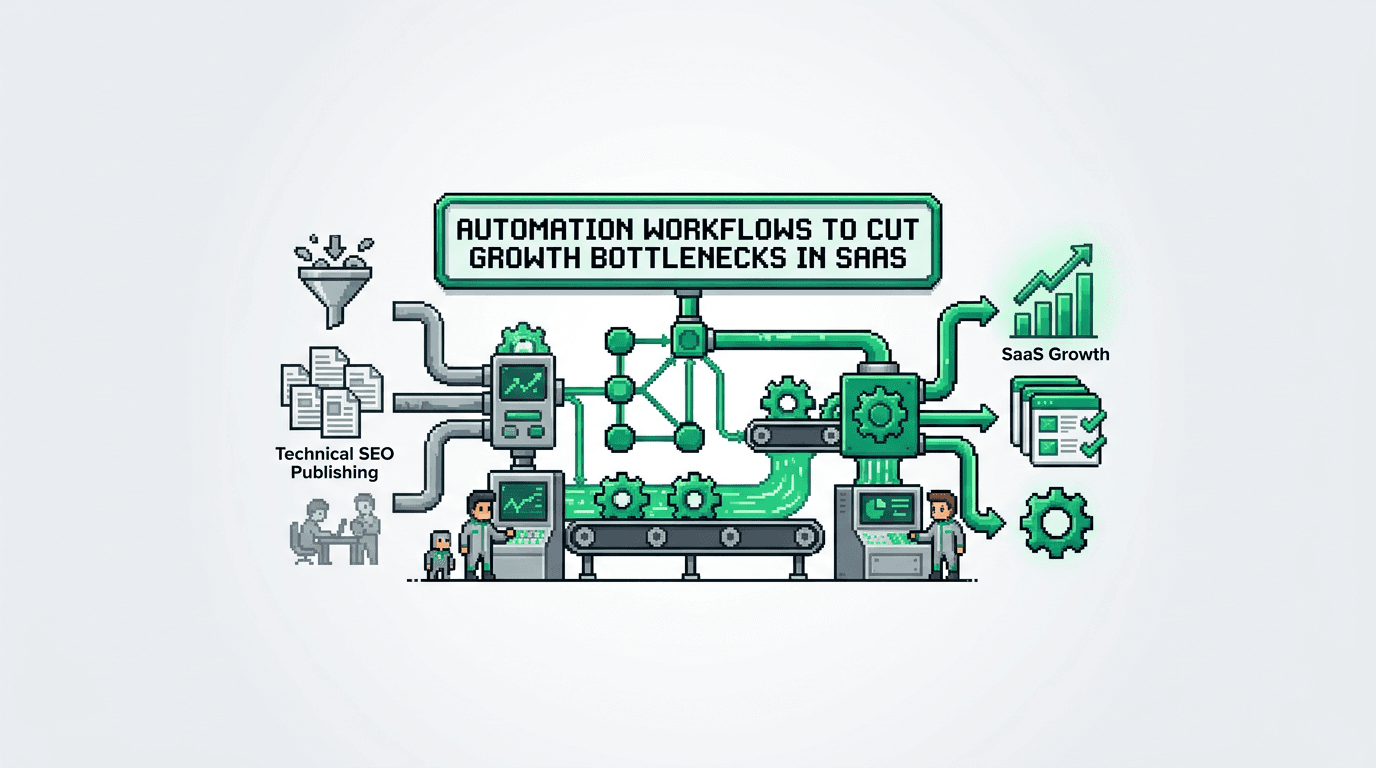
Speed is the growth moat most teams ignore. Automation workflows convert recurring operator work into reliable, observable systems that run on schedule and fail loudly.
This guide shows product operators how to design, ship, and govern automation workflows that remove manual bottlenecks across SEO and distribution loops. You will learn a lane-based architecture, tooling choices, guardrails, and a 90 day rollout. Key takeaway: map workflows to business loops, not tools, and instrument them like product features.
Define the Automation Lane Architecture
Scope lanes to business loops
- Align each lane to a loop: acquisition, activation, retention, revenue, or referral.
- Start with one SEO lane and one distribution lane.
- Avoid mixed goals in one lane. One KPI per lane.
Set lane inputs and outputs
- Inputs: event feeds, content sources, API endpoints, and schedules.
- Outputs: published pages, pull requests, sent campaigns, or updated dashboards.
- Define contracts per lane, including schemas and SLAs.
Establish observability
- Emit structured logs for every job: id, lane, step, status, duration, and records touched.
- Ship metrics to a single dashboard: success rate, median duration, queue depth, and error rate.
- Add alerts for SLO breach and dead letter growth.
Create a control plane
- Version workflows as code in a dedicated repo.
- Require PR reviews with checklists for data privacy and rate limits.
- Use feature flags to enable or pause lanes without redeploys.
Build an SEO Automation Lane
Choose targets and templates
- Target high intent programmatic topics with clear parameters.
- Design content templates with modular sections and strict schema.
- Map parameters to fields: title, meta, intro, sections, FAQs, and internal links.
Source and validate data
- Pull entities from product data, docs, or public datasets.
- Validate with schema checks: required fields, ranges, and uniqueness.
- Add dedupe logic against existing URLs and canonical entities.
Generate drafts with AI plus rules
- Use a prompt that binds to template sections and tone.
- Constrain with token limits per section and banned phrases.
- Post generate linters: reading grade, keyword placement, and link density.
Human review and merge
- Route drafts to editors with a diff of generated vs. baseline.
- Enforce acceptance criteria: accuracy, no hallucinations, and policy compliance.
- Approve via PR that snapshots content JSON plus MDX.
Ship SEO Architecture for SSR React
Pre render for speed and crawlability
- Use SSR or SSG for indexable routes.
- Generate open graph tags, JSON LD, and canonical elements at build.
- Cache HTML at the edge with short TTL and stale while revalidate.
Programmatic routing and content hydration
- Create dynamic routes from entity ids and slugs.
- Hydrate only interactive widgets. Keep core copy static.
- Inline critical CSS and defer non critical scripts.
Internal links and collections
- Auto build related links from taxonomy and entity co occurrence.
- Generate paginated collections with stable sort.
- Maintain sitemaps per collection and update on each deploy.
QA checks in CI
- Lighthouse budget: LCP, CLS, TBT thresholds.
- HTML validator, schema validator, and link checker.
- Snapshot tests on meta tags and canonical correctness.
Automate Distribution Loops
Segment audiences and channels
- Define personas by job to be done and product tier.
- Map channels: email, LinkedIn, X, community, and partner newsletters.
- Set content to channel fit rules and frequency caps.
Compose channel variants
- Derive headlines, snippets, and CTAs per channel length and style.
- Enforce UTM schema with campaign, lane, and content id.
- Generate visuals from a template with dynamic text and brand colors.
Schedule and throttle
- Use queues with per channel rate limits and quiet hours.
- Prioritize launches, then evergreen backfill.
- Retry with exponential backoff on transient API errors.
Feedback to the lane
- Capture per post metrics: reach, clicks, signups, and saves.
- Attribute performance back to source content id.
- Promote winners to evergreen sequences; pause losers.
Orchestrate With a Reliable Stack
Tooling options by layer
- Orchestration: Airflow, Temporal, or GitHub Actions for simple lanes.
- Data: Postgres, BigQuery, or DuckDB for local runs.
- Content: Headless CMS or Git based MDX.
- Messaging: SQS, Pub Sub, or Redis Streams.
Selection criteria
- Determinism, replay, typed payloads, and idempotency.
- First class retries and visibility timeouts.
- Local dev parity and clear cost model.
Security and compliance
- Secrets in a managed vault with short lived tokens.
- Scope OAuth to least privilege per lane.
- Log access and rotate keys on a 90 day cadence.
Governance, Risk, and Quality Controls
Guardrails for accuracy
- Block publish without source citation or product doc links.
- Disallow speculative claims and benchmarks without evidence.
- Add red team prompts for adversarial checks.
Rate limits and vendor risk
- Respect API quotas and add global limiters.
- Implement circuit breakers when upstream latency spikes.
- Maintain a vendor map with SLAs and fallback paths.
Editorial standards
- Define tone, banned phrases, and reading grade.
- Require unique value per piece: data, workflow, or artifact.
- Mandate internal links to docs, pricing, and related guides.
Execution Playbook: 90 Day Rollout
Days 1 to 15: map and model
- Inventory manual tasks in SEO and distribution.
- Estimate volume, frequency, and risk per task.
- Select one lane each for a first ship.
Days 16 to 30: prototype
- Build the minimal path with mocked data.
- Add logging, metrics, and alerts from day one.
- Run shadow mode with human in the loop.
Days 31 to 60: harden and expand
- Add validation, retry logic, and idempotency keys.
- Connect to real data sources and CMS.
- Start weekly publishing from the SEO lane.
Days 61 to 90: scale and govern
- Turn on distribution automation for SEO outputs.
- Create a change advisory process and playbook docs.
- Set a monthly review to prune and improve.
Metrics That Prove It Works
Lane health metrics
- Success rate per job and per step.
- Median and p95 duration per job.
- Queue depth and dead letter counts.
Business impact metrics
- Pages published per week and time to live.
- Organic clicks, non branded share, and first page coverage.
- Distribution CTR, assisted signups, and influenced revenue.
Quality metrics
- Editor reject rate and revision count per draft.
- Factual error reports per 100 pieces.
- Duplicates avoided and canonical accuracy.
Failure Modes and Rollbacks
Common failure cases
- Data drift breaks templates.
- Vendor API changes schema or auth scopes.
- Rate limits throttle jobs and cascade delays.
Prevention and detection
- Contract tests on data schemas.
- Canary runs on a small subset before full rollouts.
- Budget based schedulers that stop at error thresholds.
Rollback and recovery
- Keep a hot path to manual publish.
- Store generated content with version tags to revert.
- Reprocess failed messages with new code versions.
Compare Orchestration Options
Here is a concise comparison of popular orchestrators for automation workflows.
| Tool | Best for | Strengths | Trade offs |
|---|---|---|---|
| Airflow | Data heavy batch lanes | Mature, Python, rich ecosystem | Steeper setup, scheduler overhead |
| Temporal | Mission critical services | Durable workflows, retries, visibility | Learning curve, infra to run |
| GitHub Actions | Simple content lanes | Built in CI, easy triggers | Limited long running jobs |
Operating Rhythm and Reviews
Weekly cadence
- Review lane dashboards and top alerts.
- Ship one improvement per lane.
- Rotate on call for incidents.
Monthly cadence
- Audit metrics against targets.
- Kill or merge underperforming lanes.
- Plan next quarter scope based on outcomes.
Quarterly reset
- Re evaluate assumptions and vendor choices.
- Archive outdated templates and taxonomies.
- Refresh editorial standards with learnings.
Key Takeaways
- Design automation workflows around business loops and KPIs.
- Pair SEO automation with SSR React architecture and guardrails.
- Automate distribution with clear segments, throttles, and feedback.
- Prove value with lane, quality, and business impact metrics.
- Govern with versioned workflows, reviews, and safe rollbacks.
Automation compounds when it is observable, reversible, and aligned to revenue. Build lanes like product features and iterate on a schedule.