
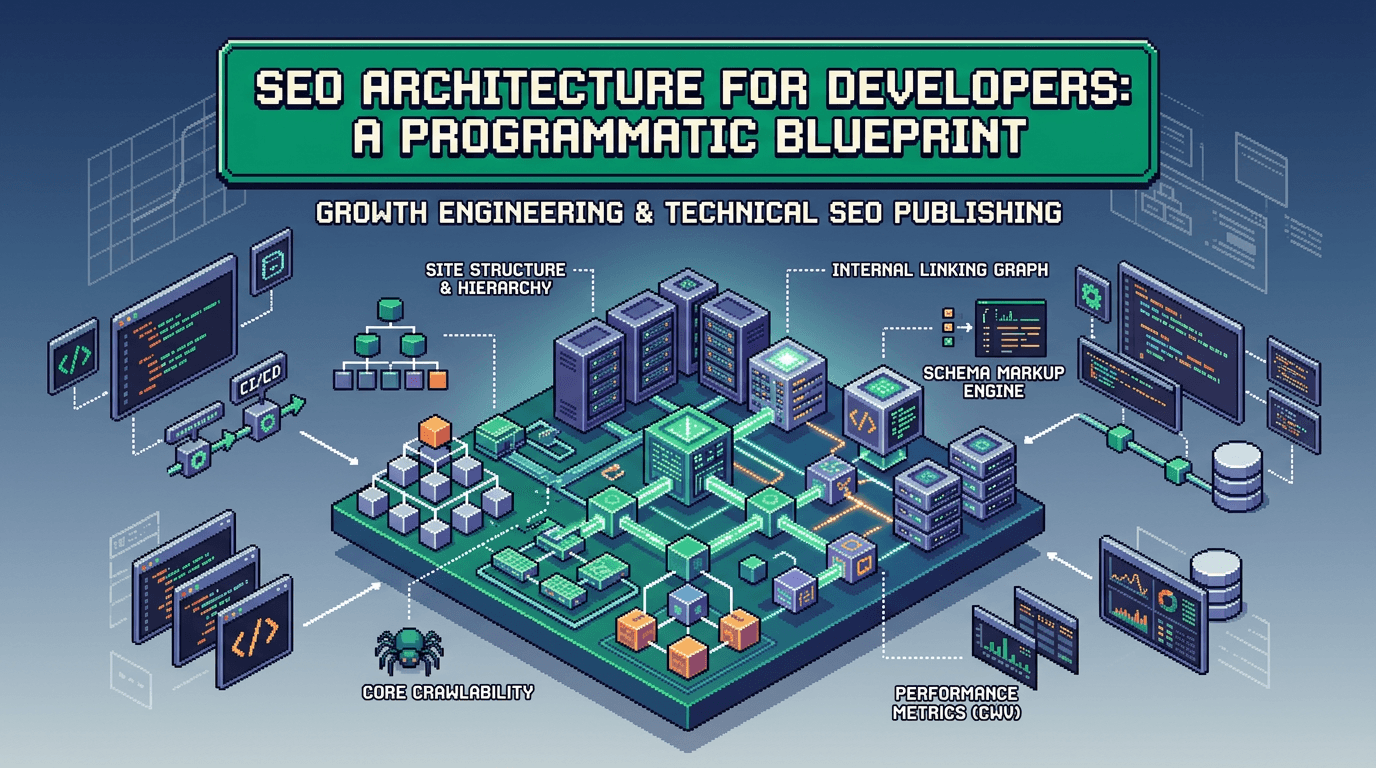
You can treat SEO architecture like developer tooling. Build systems, not posts. When you do, organic growth compounds with less manual effort.
This guide shows technical product teams how to design SEO architecture for programmatic SEO in SSR React apps, wire agentic automation workflows, and ship distribution and experiment loops. It is for developers and product operators who want reliable, scalable organic acquisition. Key takeaway: model your content as data, your workflows as code, and your distribution as pipelines.
What SEO Architecture Means for Engineers
Treat SEO as an application layer, not a marketing task. Architect it with the same rigor you apply to services.
Define the domain and entities
- Map entities: product, feature, use case, integration, industry, persona.
- Capture attributes: names, variants, benefits, constraints, metrics.
- Normalize sources: product catalog, docs, analytics, CRM.
- Set IDs and URL slugs early to avoid migrations.
Model relationships for scale
- Many to many: feature x industry, use case x persona, integration x capability.
- Plan generated page types: hubs, listings, detail pages, comparisons, how tos.
- Encode relationship rules as code, not CMS hacks.
Separate content from presentation
- Store structured content as JSON or CMS fields with type safety.
- Compile to page templates in build or on request.
- Use a design system to keep layout consistent across programmatic surfaces.
Establish acceptance criteria
- Every page has unique intent, title, meta, intro, and schema.org.
- Above the fold clarity: H1, value prop, primary CTA.
- Latency budget: <200 ms TTFB on cache hit, <2.0 s LCP on 4G.
Programmatic SEO System Design
Programmatic SEO uses templates plus data to generate many high quality pages with consistent standards.
Identify page archetypes
- Reference: glossary, definitions, formulas.
- Solution: feature, use case, industry pages.
- Comparison: vs pages, alternatives, lists.
- Integrations: app to app capability maps.
- Playbooks: workflows that bind features to outcomes.
Define inputs, process, outputs
- Inputs: entity dataset, search intents, SERP features, internal linking rules.
- Process: template rendering, enrichment, QA, deploy.
- Outputs: URLs, sitemaps, internal links, analytics tags, change logs.
Quality thresholds per archetype
- Minimum word count varies by intent; measure by coverage of required fields.
- Require at least 2 internal references and 1 external citation where relevant.
- Unique examples and screenshots per page to avoid duplication.
Failure modes and guards
- Thin content: block publish if required fields missing.
- Cannibalization: check similar titles and intents before release.
- Parameter bloat: canonicalize and disallow noisy facets.
SSR React Content Pipeline
SSR React enables fast, indexable pages with control over routing and state. Pair it with strict SEO architecture.
Routing and rendering strategy
- Use file system routing for stable patterns: /use-cases/[slug], /compare/[a]-vs-[b].
- Pre render critical routes with getStaticProps; revalidate on data changes.
- Fall back to SSR with caching for long tail pages.
Metadata and schema generation
- Generate title, meta description, canonical, and Open Graph from typed helpers.
- Emit JSON LD for each archetype: Product, HowTo, FAQ, SoftwareApplication.
- Validate with unit tests for required fields.
Internal linking and breadcrumbs
- Compute breadcrumbs from entity relationships.
- Insert context links: parent hub, sibling alternatives, child details.
- Enforce link budgets per section to avoid dilution.
Performance budgets and monitoring
- Inline critical CSS, defer non essential scripts.
- Serve images in AVIF or WebP with static widths.
- Track Core Web Vitals with field data and alert on regressions.
Agentic Automation Workflows
Automate the repeatable parts. Keep humans on strategy and review.
Workflow overview
1) Collect intents and entities weekly.
2) Enrich with research and product data.
3) Generate drafts from templates.
4) Route to editors for QA.
5) Deploy and distribute.
6) Measure, learn, and iterate.
Inputs and tools
- Sources: Search Console, Analytics, CRM, product docs, support tickets.
- Storage: Postgres or Airtable with strict schemas.
- Orchestration: GitHub Actions, Temporal, or Airflow.
- LLM agents: extraction, outline, copy assist behind guardrails.
Guardrails for LLM use
- Deterministic prompts with fixtures and golden tests.
- Diff based review: show what changed and why.
- Content linting: banned phrases, passive voice thresholds, reading level.
Human in the loop review
- Editors approve headlines, intros, examples, and claims.
- Require SME sign off for technical assertions and benchmarks.
- Automate everything except taste and truth.
Distribution Loops That Compound
Publishing is not distribution. Build recurring loops that push content where users are.
Owned channels
- Newsletter: weekly bundle of new pages and updated playbooks.
- In app surfaces: context links and help panels that match user state.
- Docs and onboarding: embed use case links where they help adoption.
Earned and partner channels
- Community posts with distilled diagrams and code snippets.
- Integration partners: cross link solution pages and joint case studies.
- PR for benchmark reports and data cuts.
Distribution workflow
- Trigger on publish: create summaries for each channel.
- Track per channel UTMs and assisted conversions.
- Refresh best performers each quarter with updated data.
Experiment Loops and Measurement
Measure what matters and iterate fast. Tie content to product outcomes.
Metrics by layer
- System health: build success rate, time to publish, review latency.
- SEO performance: impressions, clicks, CTR, position by archetype.
- Business impact: signups, activations, feature use, revenue influence.
Experiment design
- Hypothesis: state user, change, and expected movement.
- Variables: headline, intro, schema type, internal links, CTA placement.
- Split by URL groups or time based rollouts with synthetic controls.
Cadence and governance
- Weekly ops review: throughput and blockers.
- Biweekly SEO review: ranking shifts and SERP changes.
- Monthly growth council: strategy pivots and roadmap re allocation.
Execution Playbooks for Technical SEO Teams
Codify how work moves from idea to shipped page. Reduce variance.
Intake and prioritization
- Intake form with entity, intent, evidence, and expected impact.
- Score by TAM, difficulty, and adjacency to existing wins.
- Pull highest leverage batches into the next sprint.
Template and component library
- Shared components: pros and cons table, comparison grid, callouts.
- Snippets for structured intros, formulas, and step lists.
- Version templates; track diffs across releases.
QA and rollback
- Preflight: schema validation, link checks, image alts, a11y.
- Post deploy: sample fetch and render, indexation check, click trend watch.
- Rollback plan: revert dataset, clear cache, restore previous URLs.
Build vs Buy: Tools for Programmatic SEO
Pick a stack that meets your constraints. Below is a compact view of common options.
Here is a quick comparison of build options for a typical SSR React SEO stack.
| Layer | Option A | Option B | Pros | Cons | Best for |
|---|---|---|---|---|---|
| Framework | Next.js | Remix | Mature SSR, ISR | Complex configs | Broad teams |
| CMS | Headless CMS | Git based CMS | UIs, roles | Cost, vendor lock | Editors first |
| Data | Postgres | Airtable | Strong types | Ops overhead | Engineers |
| Orchestration | GitHub Actions | Temporal | Native CI | Learning curve | Dev teams |
| Search data | Search Console API | Third party API | Free, direct | Rate limits | Bootstraps |
Selection criteria
- Data model fit and type safety.
- Deployment speed and cache strategy.
- Editor experience and review workflows.
- Cost posture and team skills.
Hands On Blueprint: 90 Day Rollout
Ship a minimal but complete system in 90 days. Focus on one high intent cluster.
Days 1 to 14: Architecture and data model
- Pick one cluster, for example Integrations.
- Define entities: integration, capability, use case.
- Draft URL schema and slugs.
- Build typed content schema and seed with 10 records.
Days 15 to 30: Templates and SSR plumbing
- Implement list, detail, and comparison templates.
- Add metadata helpers and JSON LD.
- Wire internal link rules and breadcrumbs.
- Set up CI, preview deploys, and basic QA checks.
Days 31 to 45: Agentic enrichment lane
- Create extraction agent for partner docs.
- Create outline agent constrained by template fields.
- Add editor UI for review and approvals.
- Write tests for prompt determinism.
Days 46 to 60: Distribution and analytics
- Build newsletter and social summarizers.
- Add UTMs and event tracking for CTAs.
- Create dashboards for impressions, CTR, signups.
- Launch 30 to 50 programmatic pages.
Days 61 to 90: Experiment loop
- Run headline and intro tests across a page group.
- Adjust internal link weights using click data.
- Update top 10 pages with new examples and proof.
- Document learnings and set next cluster.
Common Failure Modes and Fixes
Avoid pitfalls that waste cycles or harm trust.
Duplicate or low value pages
- Symptom: index bloat, low CTR, cannibalization.
- Fix: stricter publishing guards, consolidate variants, retire losers.
Slow render or unstable caches
- Symptom: crawl budget losses, user drop offs.
- Fix: prerender hot routes, edge cache, reduce client JS.
Hallucinated or outdated claims
- Symptom: churned users, lost credibility.
- Fix: SME review, date stamps, sources, and auto refresh tasks.
Misaligned intents
- Symptom: traffic without conversions.
- Fix: rewrite intros and CTAs to match jobs to be done.
Positioning Among Alternatives
If you want theory, use broad marketing playbooks. If you want systems, work with operator first frameworks.
Here is how common approaches compare for technical SEO teams.
| Approach | Strengths | Weaknesses | Fit |
|---|---|---|---|
| Generic content agency | Scales writing fast | Weak technical depth | Brand blogs |
| In house marketers only | Context rich | Thin engineering support | Early stage |
| Engineering led system | Durable, scalable | Higher initial setup | Technical products |
For operator focused teams, an engineering led system with agentic workflows and strict SEO architecture is the strongest path. It compounds learnings, keeps quality high, and reduces manual toil.
Key Takeaways
- Treat SEO architecture like developer tooling with typed data and templates.
- Use SSR React and programmatic SEO to scale high quality pages safely.
- Automate enrichment and QA with agentic workflows plus human review.
- Build distribution loops and experiment cadences that compound results.
- Measure system health, SEO outcomes, and product impact together.
Ship the smallest complete system, learn from real data, and iterate every sprint.