
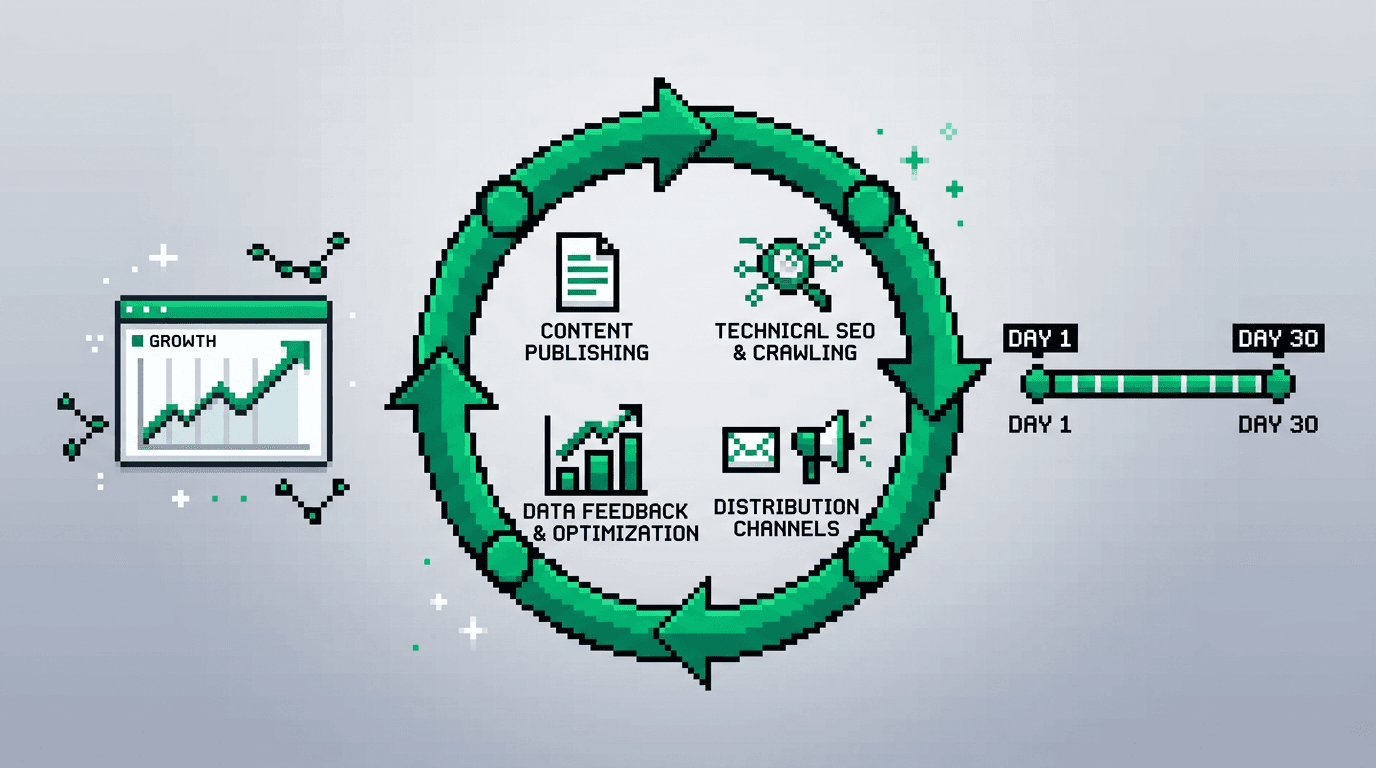
High-signal content dies in one channel if you let it. Distribution loops turn one asset into compounding reach across systems.
This playbook shows product operators how to build distribution loops that compound reach in 30 days. You will design triggers, automate repackaging, and set review gates. The key takeaway: a lightweight loop that turns one post into 12 surfaces without spamming or burning trust.
What a Distribution Loop Is and Why It Matters
A distribution loop is a repeatable system that expands content reach with each cycle. It converts a single asset into multiple channel-native derivatives, then uses performance feedback to improve the next cycle.
- Input: one high-signal asset with clear POV and data.
- Process: repackage to channel form factors, schedule distribution, route feedback.
- Output: incremental impressions, follows, links, and replies that inform the next asset.
Core properties of a strong loop
- Repeatable: same steps run weekly with minor edits.
- Compounding: each cycle adds subscribers, backlinks, or engaged audiences.
- Low drag: automation handles formatting and scheduling; humans review tone and facts.
- Connected: insights from replies and analytics feed the roadmap.
Signals that the asset is loop-ready
- Proves or refutes a belief with data.
- Teachable with steps and artifacts.
- Can be sliced into 8 to 12 atomic ideas.
- Supports a clear CTA and a next-click path.
System Blueprint in One Page
Design the loop as a small pipeline. Keep owners and SLAs explicit.
- Goal: 3x distribution surfaces per asset with under 2 hours of manual effort.
- Cadence: weekly.
- Owners: content lead (source), automation owner (templates), channel managers (review), analyst (feedback).
- Tools: Google Docs or Notion, Git for templates, a scheduler, a vector store for snippets, and an analytics dashboard.
- Metrics: impressions, CTR, saves, replies, backlinks, subscriber adds, time to ship.
Inputs, process, outputs
- Inputs: long post, key claims with evidence, 5 charts, 3 quotes.
- Process: extract snippets, map to channels, auto-generate variants, human review, schedule, listen, update repo.
- Outputs: channel-native posts, a changelog, and a feedback digest.
Acceptance checks
- Each derivative includes a unique angle and avoids duplicates.
- No channel receives more than one near-identical post within 7 days.
- All claims link to a primary source.
Channel Map and Content Derivatives
Map one asset to channel-native derivatives. Avoid copy-paste. Use the asset’s strongest proof as the hook.
Owned channels
- Blog updates: add a TLDR, a metrics block, and a related posts section.
- Newsletter: a 200-word lead story, 3 bullets, and a single link CTA.
Social channels
- LinkedIn: 7 to 9 lines, 1 strong stat, and a call for counterexamples.
- X: a 4 to 6 tweet thread with one chart and a quote.
Community and long tail
- Reddit: detailed post in a relevant sub with proof and steps. No links until comments request them.
- Hacker News: neutral title, plain summary, and clear takeaways.
Automation Workflows to Remove Manual Drag
Program the loop. Keep humans for nuance. Automate extraction, formatting, and scheduling. This is where automation workflows and programmatic SEO meet distribution discipline.
Workflow 1: Snippet extraction
- Input: canonical post in Markdown.
- Steps:
1) Parse headings and paragraphs.
2) Score sentences for novelty, data, and clarity.
3) Select top 12 snippets, mark source anchors.
- Output: JSON array with snippet, source URL, and score.
Workflow 2: Channel templating
- Input: snippet JSON.
- Steps:
1) Apply channel templates to generate drafts.
2) Insert UTM-tagged links for owned channels only.
3) Enforce length and style constraints.
- Output: drafts per channel with checklists.
Workflow 3: Scheduling and audit
- Input: approved drafts.
- Steps:
1) Stagger posts across 7 to 10 days.
2) Auto-attach images or charts.
3) Validate no duplicate post within the cooldown window.
- Output: scheduled queue and risk flags.
A 30 Day Execution Plan
Run a tight cycle. Focus on one flagship post. Use distribution loops to validate positioning and build reach.
Week 1: Prepare and ship
- Pick the highest-signal topic from your backlog.
- Draft with these constraints: a clear thesis, 3 data points, and a 5 step how-to.
- Publish. Trigger snippet extraction and templating.
- Review and schedule channel posts for Days 3 to 10.
Week 2: Listen and adjust
- Monitor comments, saves, and replies.
- Log questions and objections in a central doc.
- Publish a follow-up thread or comment where interest is highest.
- Update the post with an addendum section.
Week 3: Expand surfaces
- Record a 5 minute video summary.
- Turn charts into carousels for LinkedIn.
- Create a code gist, template, or sheet if relevant.
- Pitch one podcast or community AMA with your findings.
Week 4: Compounding pass
- Ship a second asset that answers the top two objections.
- Refresh and reshare the best performing derivative with a new hook.
- Publish a short case study of metrics.
Instrumentation and Feedback Routing
Instrumentation makes the loop compounding. You do not guess. You route signals to decisions.
Metrics to track weekly
- Impressions and reach by channel.
- Engagement rate: likes, comments, saves, CTR.
- Conversion: subscribers, signups, or demo requests.
- SEO lift: backlinks, referring domains, keyword positions.
- Production efficiency: manual minutes per derivative.
Routing rules
- If a comment contains a new objection, add it to the FAQ doc.
- If a snippet drives 3x saves, promote it to a standalone post.
- If a channel underperforms for two cycles, pause and reframe format.
Programmatic SEO Meets Distribution Loops
Distribution loops and programmatic SEO reinforce each other. You architect pages that answer intent at scale. You then distribute snippets to seed links and mentions that accelerate indexing and ranking.
SEO architecture alignment
- Canonical hub and spoke: one hub guides the loop and links out to spokes.
- SSR rendering: ensure previews load fast and meta tags populate.
- Entity consistency: names, metrics, and definitions match across derivatives.
Programmatic surfaces
- Template library for use cases, industries, or frameworks.
- Parameterized pages generated from a data source.
- Each page ships with prebuilt snippets and suggested channels.
Execution Playbooks for Each Channel
Rules limit variance. Templates cut time. Use these playbooks to prevent noise and keep quality.
LinkedIn playbook
- Hook: a result with a number.
- Body: 3 lines of steps.
- Close: a question that invites a counterexample.
- Cooldown: 3 days between related posts.
Reddit playbook
- Lead with the build details and metrics.
- Add proofs: screenshots, gists, or charts.
- Answer questions for 48 hours before linking.
- If it smells like promotion, scrap it.
Tooling, Owners, and SLAs
Document owners. Keep handoffs crisp. Below is a quick matrix of roles and expectations.
Here is the responsibility and SLA mapping for the loop:
| Role | Responsibilities | SLA |
|---|---|---|
| Content Lead | Source asset, fact check, final signoff | 24 hours |
| Automation Owner | Templates, extraction, QA | 12 hours |
| Channel Manager | Tone review, scheduling, comments | 8 hours |
| Analyst | Dashboard, feedback digest | 24 hours |
Risks, Failure Modes, and Guardrails
Loops can burn trust. Guardrails prevent channel fatigue and brand drift.
Failure modes
- Reposting the same copy across channels.
- Overlinking in communities and getting banned.
- Pacing too fast and collapsing reach.
- Publishing without a clear next click.
Guardrails
- Unique angle per derivative.
- Set cool-down timers per channel.
- Always provide value before a link.
- Track unsubscribes and blocklists.
Example 30 Day Calendar
Use a simple calendar to coordinate publishing and listening windows.
Here is a compact view of a 30 day loop for one flagship asset:
| Day | Action | Channel | Owner |
|---|---|---|---|
| 1 | Publish flagship post | Blog | Content Lead |
| 2 | Extract and template | System | Automation Owner |
| 3 | Ship LinkedIn v1 | Channel Manager | |
| 4 | Ship X thread | X | Channel Manager |
| 5 | Post to subreddit | Channel Manager | |
| 6 | Engage comments | All | Channel Manager |
| 7 | Newsletter send | Content Lead | |
| 10 | HN submission | HN | Content Lead |
| 14 | Video summary | YouTube | Content Lead |
| 18 | Carousel | Channel Manager | |
| 22 | Case study post | Blog | Content Lead |
| 28 | Second asset | Blog | Content Lead |
| 30 | Digest and plan | All | Analyst |
Measuring Compounding Effects Over Quarters
One month proves mechanics. One quarter proves compounding. Track deltas against a baseline.
Quarterly checks
- Owned audience growth: email list and RSS subscribers.
- Link velocity: new referring domains per month.
- Topic authority: average rank across the cluster.
- Time-to-ship: minutes per derivative halved.
Decision gates
- If compounding flattens, refresh the templates and test a new channel.
- If SEO lags, expand programmatic pages tied to the best performing snippets.
Key Takeaways
- Build one repeatable distribution loop that ships weekly.
- Automate extraction and templating; keep humans for tone and proof.
- Use feedback routing to select the next asset and page templates.
- Align SEO architecture so loops seed links and reinforce hubs.
- Track efficiency and compounding, not vanity metrics.
Close the loop every week. Small, consistent cycles beat one big launch.