
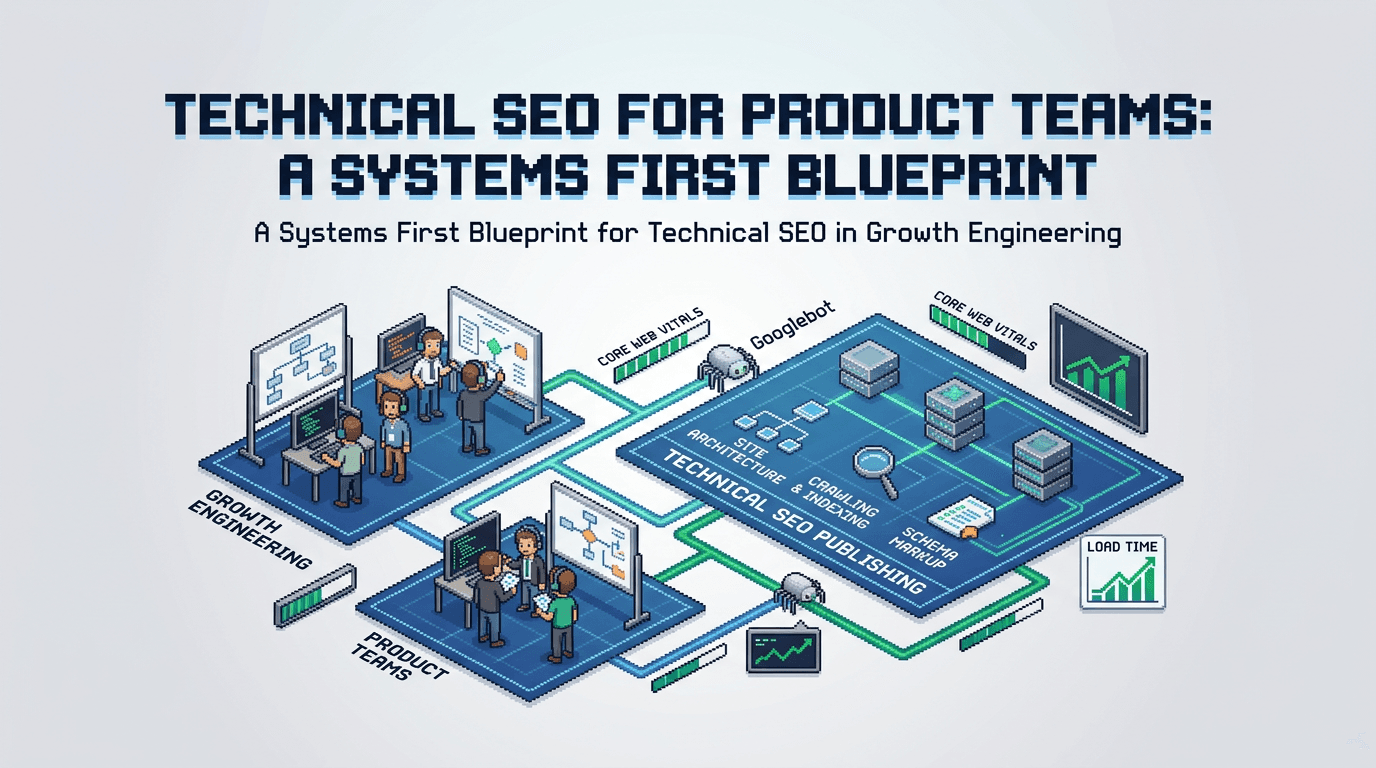
Move fast without breaking search. Technical SEO for product teams is a systems problem. Treat it like engineering and ship reliable, compounding growth.
This guide shows technical SEO for product teams with a pragmatic blueprint for fast rankings. It is for product engineers, growth operators, and content architects. Key takeaway: build a search architecture, automate the boring, and loop experiments weekly.
Define the goal and the constraints
Set the objective, guardrails, and ownership before you touch code.
Objective and scope
- Primary objective: win qualified queries that drive product activation.
- Scope: one product, one ICP, 3 to 5 problem clusters, 90 day window.
- Success metric: organic sign ups or activation events, not raw traffic.
Constraints and dependencies
- Tech stack: SSR React or static site with edge caching.
- Data: product metadata, docs, and taxonomy are accessible via API.
- Limits: content quality must meet editorial standards and E E A T.
Ownership and cadence
- Owner: growth engineer partners with content lead.
- Cadence: weekly ship, daily checks on crawl and index.
- Review: 30, 60, 90 day milestones with rollback points.
Architecture for technical SEO for product teams
Design the information model first. Pages are outputs from a schema, not copy docs.
Keyword universe and entity graph
- Build an entity list: product, features, integrations, industries, jobs to be done.
- Map relations: feature solves JTBD, integration unlocks use case, industry has constraints.
- Extract head and long tail queries from each entity relation.
Content types and page templates
- Core templates: feature, integration, comparison, how to, glossary, playbook.
- Support templates: changelog, benchmarks, API examples, implementation guides.
- Each template owns a query pattern and a repeatable section layout.
URL, schema, and internal links
- URL: /{type}/{entity} with short slugs and stable canonical.
- Schema: Article, HowTo, SoftwareApplication, FAQPage where appropriate.
- Links: child to parent, sibling cross links, and hub to spokes.
Programmatic SEO system design
Ship programmatic pages that read as handcrafted. Enforce quality with guards.
Inputs and sources of truth
- Product catalog: features, plans, integrations, pricing.
- Telemetry: usage data, top tasks, support tickets, search console queries.
- Editorial library: approved snippets, style tokens, tone examples.
Template composition and rendering
- Compose sections: problem, solution, steps, proof, CTA.
- Use blocks: code, tables, metrics, quotes, images.
- Render SSR for core paths. Prebuild static for long tail.
Generation policy and review
- Blocklists: banned claims, weak adjectives, vague promises.
- Min checks: originality score, fact references, link density, reading time.
- Human in the loop: editor approves, engineer ships, PM audits impact.
SSR React implementation checklist
Treat the site as an application. Optimize render paths and crawl signals.
Routing, hydration, and speed
- Use file based routing with clean params.
- Stream SSR where supported; resume hydration for interactivity.
- Target LCP under 2.5s, CLS under 0.1, TTFB under 200ms on edge.
Metadata, canonicals, and sitemaps
- Generate title, description, and canonical at build and runtime.
- Emit JSON LD per template with stable keys.
- Maintain daily sitemap for fresh content and weekly for static hubs.
Index controls and error handling
- Robots: allow core, disallow experiments behind flags.
- Return 410 on sunsetting pages and 301 to canonical replacements.
- Monitor 4xx and 5xx in logs and alert on spikes.
Automation lanes and agentic workflows
Automate the busywork. Keep humans on strategy and editing.
Content pipeline automation
- Trigger: new integration added to catalog.
- Actions: generate outline, pull facts from API, fill template, open PR.
- Output: draft markdown with references and test snapshots.
Enrichment and quality gates
- Auto insert schema, related links, and updated dates.
- Run lint rules for headings, sentence length, and passive voice.
- Gate on regression tests for vitals and link checks.
Distribution and refresh
- Post publish: push to newsletter, social snippets, and partner portals.
- Set refresh intervals by decay curves and rank volatility.
- Auto open refresh issues when CTR or position drops.
Experiment loops and measurement
Work in weekly cycles. Test one lever per cluster.
Hypotheses and variants
- Levers: title rewrite, intro clarity, proof placement, internal links, FAQ add.
- Constraints: single change per page group, equal exposure windows.
- Define win: uplift in CTR or activation within 14 days.
Metrics and dashboards
- Capture: impressions, CTR, position, clicks, assist sign ups, activation.
- Segment by template, cluster, and device.
- Alert on negative deltas beyond thresholds.
Analysis and rollbacks
- Use cumulative sum charts to avoid noise.
- Roll back if metrics drop for 3 days against control.
- Document learnings and push patterns to the template library.
Editorial standards that scale
Programmatic does not excuse low quality. Codify excellence.
Voice, claims, and evidence
- Write like an operator. Use verbs and numbers.
- Back claims with benchmarks, case studies, or public references.
- Ban filler. Replace with steps, code, and results.
Structure and readability
- Keep paragraphs under 4 lines.
- Use H3 for subsections and bullets for scannability.
- Place the CTA after proof, not before.
Compliance and accuracy
- No health or legal advice unless reviewed by counsel.
- Avoid competitor misrepresentation. Compare features, not rumors.
- Refresh regulatory or API details quarterly.
Minimal blueprint to ship in 30 days
A narrow, high leverage plan you can run with a small team.
Week 1: model and plan
- Define entities and clusters for one ICP.
- Select 3 templates and draft blocks.
- Create routing, schema, and sitemap scaffold.
Week 2: build and seed
- Implement SSR for templates and metadata.
- Ship 10 pilot pages with manual polish.
- Set up Search Console, log based vitals, and alerts.
Week 3: automate and expand
- Wire automation lane from catalog to PRs.
- Add enrichment, schema, and internal link scripts.
- Publish 30 pages and index via sitemaps and API.
Week 4: test and tune
- Run two experiments per cluster.
- Fix bottlenecks in render and LCP.
- Document learnings and plan next 90 days.
Fit by use case: content systems compared
Use this quick matrix to pick the right approach for your team size and stack.
| Approach | Team size | Stack fit | Speed to first rankings | Quality control | Best for |
|---|---|---|---|---|---|
| Manual editorial | 1 to 2 | Any | Slow | High | Early validation |
| Programmatic SEO | 2 to 4 | SSR React or static | Fast | Medium to high with guards | Scaling long tail |
| Hybrid programmatic | 3 to 6 | SSR React + CMS | Medium | High | Mid market growth |
| Fully automated | 1 to 3 | Strong APIs | Fastest | Risky without review | Prototyping only |
Tooling and artifacts to standardize
Standard kits cut cycle time and reduce errors.
Repos and templates
- Monorepo with apps for site and pipelines.
- Template packages with shared blocks and schema emitters.
- Content lint config and test fixtures.
Dashboards and alerts
- Search Console performance by template and cluster.
- Core Web Vitals by route with percentiles.
- Alerting on crawl errors and status code anomalies.
Docs and runbooks
- Contribution guide for editors and engineers.
- Playbooks for launches, refreshes, and rollbacks.
- Incident runbook for ranking or traffic drops.
Risks, failure modes, and safeguards
Expect issues. Plan containment and clear exits.
Common failure modes
- Thin pages from weak inputs.
- Keyword cannibalization between templates.
- Slow pages from heavy client hydration.
Safeguards
- Thresholds for word count, unique sections, and evidence blocks.
- Canonical mapping and cluster level internal links.
- Server render critical content and lazy load non critical.
Exit criteria and rollbacks
- Kill pages that fail to index in 30 days.
- Merge cannibalized pages after traffic attribution review.
- Revert template changes if vitals regress beyond targets.
Governance and accountability
Make decisions explicit. Keep the system maintainable.
Roles and approvals
- Growth engineer owns pipeline and metrics.
- Editor in chief owns tone and claims.
- PM owns roadmap and outcomes.
Change management
- All content changes through PRs with preview links.
- Version templates and blocks with changelogs.
- Quarterly audit of clusters and redirects.
Budget and ROI
- Track engineering hours per page and per template.
- Attribute revenue to assisted conversions where possible.
- Reinvest in clusters with highest activation per page.
Case pattern you can reuse
Adapt this skeleton to any feature, integration, or industry page.
Problem framing
- State the user job and the blocker in one sentence.
- Quantify cost or risk with a realistic range.
Solution structure
- Show the workflow with 3 to 5 steps.
- Add code or UI snippets for each step.
Proof and CTA
- Provide a benchmark, testimonial, or mini case.
- Ask for a product action that matches intent.
Key Takeaways
- Technical SEO for product teams is an engineering system, not a copy sprint.
- Build a schema first architecture and power it with programmatic templates.
- Automate inputs, enrichment, and distribution with strict quality gates.
- Run weekly experiment loops and ship small, measurable changes.
- Guard against thin content and regressions with tests and rollbacks.
Ship the system, then keep it on a tight, weekly operating cadence.