
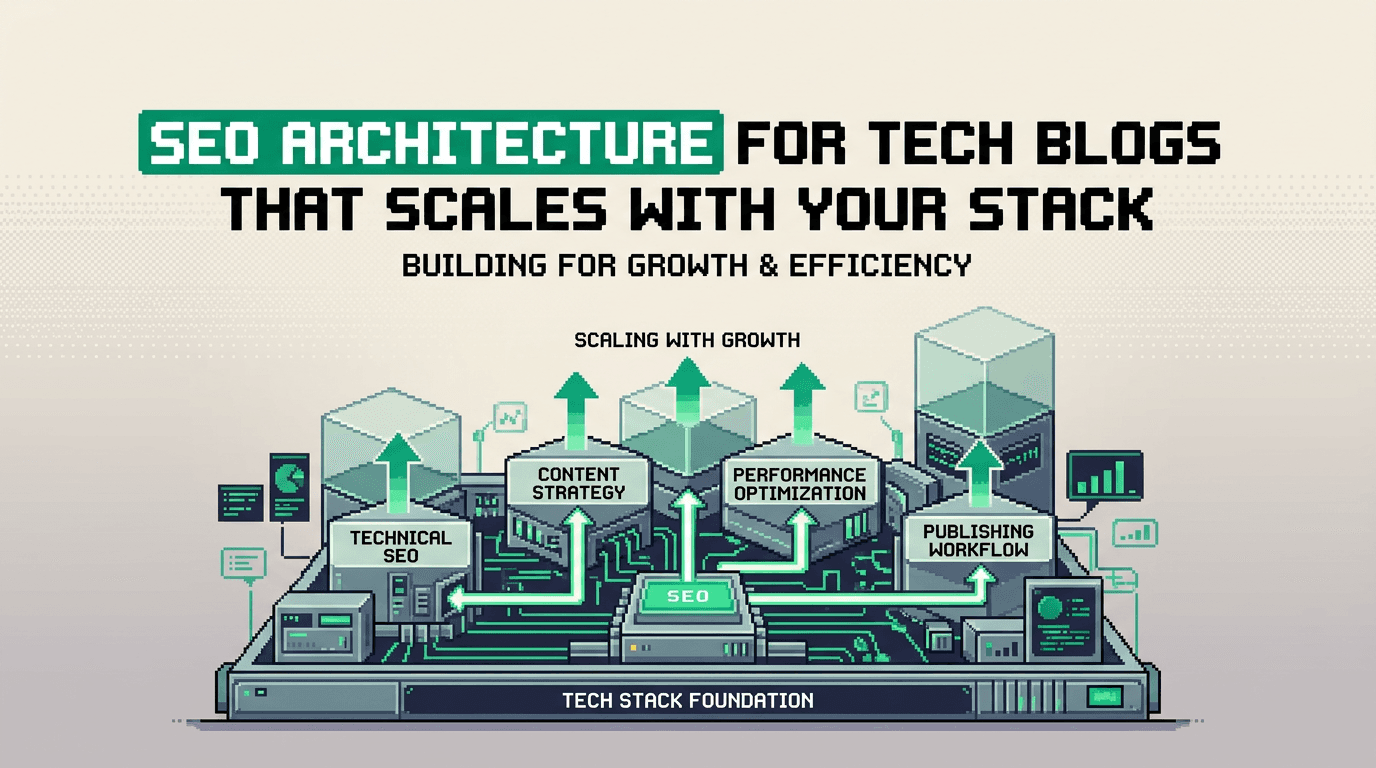
Growth plateaus when your content system depends on heroics. A durable SEO architecture turns publishing into an engineering loop that compounds.
This post outlines a concrete SEO architecture for technical product teams. You will learn how to design programmatic SEO, wire automation workflows, structure SSR React content, and run experiment loops that improve conversion. Key takeaway: treat SEO as a system with clear inputs, processes, and outputs, not a calendar of posts.
What SEO architecture means for technical product teams
Define the purpose and boundary of the system
- Goal: compounding organic growth with predictable inputs and measurable outputs.
- Scope: content models, generation pipelines, rendering, internal linking, distribution loops, and measurement.
- Constraint: quality and accuracy cannot regress as volume scales.
Core components you need to design
- Content model: entities, attributes, relationships, and templates.
- Rendering layer: SSR React with static hints and edge caching.
- Data pipeline: sources, validation, enrichment, and storage.
- Automation lanes: tasks agents can safely own with guardrails.
- Experiment loops: hypotheses, variants, metrics, and rollbacks.
Programmatic SEO that does not sacrifice quality
Model entities before templates
Start with your product and audience graph. Map the entities your users search for.
- Entities: problems, solutions, integrations, industries, roles, features, patterns.
- Attributes: price, compatibility, metrics, APIs, code support, status.
- Relations: feature supports integration, solution solves problem, role uses pattern.
Deliverables:
- A canonical schema in JSON or YAML.
- An ERD that shows 1 to many relations.
- Acceptance rules for each attribute.
Create template families with strict acceptance checks
Group search intents by entity. Each template family serves one intent pattern.
- Examples:
- Problem to solution explainer
- Integration setup guide
- Comparison matrix
- Pattern library page
Acceptance checks for each family:
- Unique value proposition present in first 120 words.
- At least two internal links to relevant entities.
- A scoped CTA that matches the intent stage.
- Factual claims reference a source or product artifact.
Generate drafts from structured data, then edit
Workflow:
- Pull entity data from your source of truth.
- Render into a template with content blocks.
- Apply style and compliance rules.
- Route to human editor for review.
- Publish behind feature flags.
Metrics:
- Draft to publish rate
- Edit time per page
- Error rate found in QA
SSR React SEO that ships fast and ranks reliably
Choose a rendering strategy by page type
Use SSR for freshness and personalization bounds. Use SSG where content is stable.
- SSG: libraries, integrations, docs, case studies.
- SSR: comparisons, inventory like indexes, dynamic taxonomies.
- ISR or on demand revalidation for hybrid needs.
Acceptance checks:
- HTML renders full content on first byte.
- Canonicals resolve to a single URL per entity.
- No client only meta tags for primary signals.
Wire routing, canonicals, and pagination
- Stable routes: /entity-type/entity-slug.
- Canonical points to the preferred detail page.
- Paginate lists with rel next and rel prev.
- Add noindex to filtered result states.
Example route plan table:
Here is a compact route map for common entity families.
| Page type | Route pattern | Canonical rule | Indexing |
|---|---|---|---|
| Entity detail | /patterns/{slug} | Self | index, follow |
| Comparison | /compare/{a}-vs-{b} | Self | index, follow |
| Integration | /integrations/{vendor} | Self | index, follow |
| Listing | /patterns?page=n | Page 1 canonical to /patterns | index, follow |
| Facet filter | /patterns?tag=x | Canonical to unfiltered | noindex, follow |
Handle metadata, structured data, and assets
- Titles: keyword plus unique value in 55 to 60 chars.
- Descriptions: intent aligned promise in 140 to 160 chars.
- Schema.org: use BreadcrumbList, Article, SoftwareApplication, and FAQ where relevant.
- Images: next gen formats, width descriptors, lazy loading below the fold.
Automation workflows that remove manual bottlenecks
Define lanes and guardrails
A lane is a bounded task an agent or job can own end to end.
Lanes:
- Entity ingestion: crawl, API pull, or CSV to schema.
- Validation: field completeness, type, range, uniqueness.
- Draft generation: template render plus copy blocks.
- Link graph: auto insert relevant internal links.
- QA: linting for accessibility, SEO, and brand.
- Publish: batch deploy with flags and rollback.
Guardrails:
- Read only access to source systems during first runs.
- Sandboxed preview domain for every batch.
- Stop if error rate exceeds threshold.
Minimal tooling blueprint
- Orchestrator: GitHub Actions or Temporal for workflows.
- Content store: headless CMS or a Git repo with MDX.
- Queue: SQS or Redis for jobs.
- Validation: JSON Schema lint plus custom rules.
- Observability: logs, traces, and dashboards in one view.
Internal linking and distribution loops that compound
Build a link graph from your entity model
- Each entity gets inbound links from its parent list and its sibling comparisons.
- Each detail page links out to two child patterns and one integration.
- Trigger links in older posts when a new entity publishes.
Acceptance checks:
- Orphan rate under 2 percent.
- Average in degree per entity type meets target.
- No more than 100 links per page for clarity.
Design distribution loops that run on autopilot
- Syndicate: push summaries to LinkedIn, X, and dev communities.
- Nurture: route high intent readers to email sequences.
- Partner: notify integration vendors with co marketing kits.
- Refresh: schedule updates when metrics fall below thresholds.
Distribution loop table:
This table shows triggers, actions, and expected outcomes.
| Trigger | Action | Owner | KPI |
|---|---|---|---|
| New entity published | Social snippet to 3 channels | Automation lane | CTR, profile visits |
| New comparison live | Partner outreach email | BD | Backlinks, referrals |
| Traffic drop 20 percent | Auto create refresh issue | Editor | Rank regain, time to fix |
| High SERP volatility | Pause tests on affected pages | SEO | Stability, error rate |
Experiment loops that improve conversion quality
Hypothesis and variant discipline
- One metric per test.
- One hypothesis per variant family.
- Pre define sample size and stopping rules.
Typical experiments:
- Above the fold value prop and CTA wording.
- Code snippet placement for developer intents.
- Table structure in comparisons.
- Schema type coverage.
Measurement, guardrails, and rollbacks
- Assign each experiment a unique slug and tag.
- Log exposure, conversions, and key events.
- Stop early on severe negative signals.
- Roll back with a single config flag.
Content operations and governance
Roles and RACI
- Operator owns system health and cadence.
- Editor owns style, accuracy, and voice.
- Engineer owns build, deploy, and performance.
- Analyst owns metrics and experiment design.
RACI table:
This table clarifies ownership across critical activities.
| Activity | Responsible | Accountable | Consulted | Informed |
|---|---|---|---|---|
| Template design | Editor | Operator | Engineer | Analyst |
| Data ingest | Engineer | Operator | Editor | Analyst |
| Draft review | Editor | Operator | Engineer | Analyst |
| SEO QA | Analyst | Operator | Engineer | Editor |
| Deploy | Engineer | Operator | Editor | Analyst |
Cadence and SLAs
- Weekly: publish batch, close QA issues, update link graph.
- Biweekly: experiment reviews and backlog grooming.
- Monthly: entity map update and performance review.
- SLAs: draft review under 48 hours, rollback under 10 minutes.
Metrics that prove your SEO architecture works
Leading indicators
- Valid entities added per week
- Time to publish from entity creation
- Orphan rate and internal link in degree
- LCP and CLS for core templates
Lagging indicators
- Non brand organic clicks and CTR
- Qualified signups from SEO pages
- Assisted conversions by page type
- Partner backlinks per integration page
Failure modes and how to prevent them
Thin content from over automation
- Mitigation: human in the loop for first paragraph and conclusion.
- Rule: minimum evidence count per post.
- Monitor: dwell time and scroll depth anomalies.
Routing and duplication issues
- Mitigation: strict canonical rules and slug uniqueness checks.
- Rule: reject PR if route or canonical collides.
- Monitor: indexed pages vs submitted sitemap.
Experiment noise and false wins
- Mitigation: power analysis before launch.
- Rule: freeze competing tests on the same template.
- Monitor: uplift stability across cohorts.
Implementation starter kit
Minimal repository structure
- /schema for entity definitions
- /content for MDX sources
- /templates for page families
- /scripts for ingest and validation
- /workflows for CI jobs
Sample acceptance checklist for PRs
- Template family selected and validated
- Title and description within length constraints
- Internal links added to at least two entities
- Images meet size and alt text rules
- Schema markup valid and tested
Tooling and platform options
Headless CMS vs Git based content
- Headless CMS: faster editing, roles, and UI workflows.
- Git based: version control, review gates, infra parity with app.
- Hybrid: CMS for fields, Git for templates and deploys.
Comparison of common choices
Use this table to pick a store for technical teams.
| Option | Strengths | Tradeoffs | Fit |
|---|---|---|---|
| Git MDX | Versioning, code review, low cost | Non writers face friction | Small to mid tech teams |
| Headless CMS | Editorial UX, permissions | Cost, schema drift risk | Multi team orgs |
| Hybrid | Balance of control and UX | More integration work | Scaling teams |
Governance, compliance, and accuracy controls
Source of truth and citations
- Link claims to product docs, PRDs, or benchmarks.
- Store citations in front matter for audit.
- Reject pages without at least one source.
Security and privacy
- No PII in analytics events.
- Access tokens rotate on schedule.
- Preview environments require auth.
From plan to ship in 90 days
Phase 1: model and templates (weeks 1 to 3)
- Map entities and intents.
- Draft template families and acceptance checks.
- Build routing and canonical plan.
Phase 2: pipeline and SSR (weeks 4 to 7)
- Implement ingest, validation, and render.
- Ship SSR and SSG mix with caching.
- Add QA lanes and link graph jobs.
Phase 3: publish and iterate (weeks 8 to 12)
- Publish first 50 to 150 entities.
- Run two experiments on top templates.
- Automate distribution and partner outreach.
Key Takeaways
- Treat SEO architecture as a system with clear inputs, guardrails, and outputs.
- Model entities first, then design template families and acceptance checks.
- Use SSR React where needed and automate safe lanes to scale.
- Build internal links and distribution loops that compound reach.
- Run tight experiment loops with rollbacks and disciplined metrics.
Ship the smallest working system, measure, and expand with confidence.