
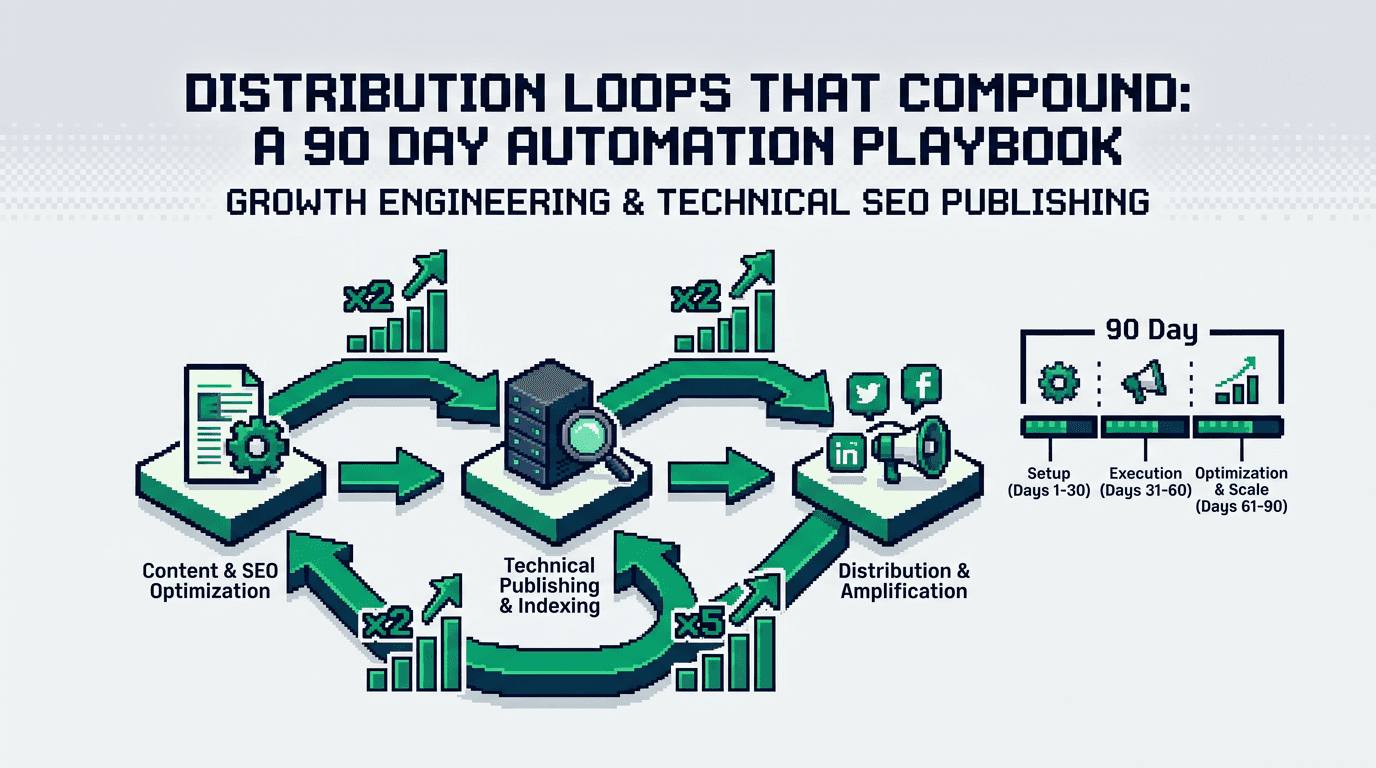
High output teams do not scale by posting more. They scale by designing distribution loops that convert every asset into repeatable reach.
This guide shows product operators how to build distribution loops in 90 days using automation workflows, programmatic SEO, and tight execution playbooks. You will ship a system that turns each article, feature update, or dataset into ongoing traffic, trials, and links. Key takeaway: design loops once, automate handoffs, and let compounding work.
What a Distribution Loop Is and Why It Wins
A distribution loop is a system that takes an input asset, distributes it across channels, captures signals, and feeds improvements back into the asset or next assets.
Core loop components
- Input: content, data artifact, feature release, or changelog
- Distribute: search, social, communities, email, partners, embeds
- Capture: traffic, signups, shares, links, questions, errors
- Amplify: republish, improve, templatize, branch into variants
- Automate: schedule, transform, route, and measure
Loop vs one off campaigns
- Loops repeat. Campaigns end.
- Loops gain efficiency per cycle.
- Loops produce structured data you can automate.
- Loops force measurable standards for assets.
Where programmatic SEO fits
Programmatic SEO supplies structured pages at scale. It powers the search spoke of the loop, creating consistent entry points and internal links that amplify distribution velocity.
The 90 Day Plan at a Glance
You will ship in three 30 day phases. Each phase has owners, artifacts, and acceptance checks.
Phase 1 days 1 to 30: Map and seed
- Outcome: a minimal loop live on one asset type.
- Owners: PM for scope, Content Lead, Automation Engineer, Analyst.
- Artifacts: channel inventory, message map, source schema, routing DAG, base dashboards.
- Acceptance: one asset runs through loop with automated handoffs and tracked UTM.
Phase 2 days 31 to 60: Automate and branch
- Outcome: scale to three asset types and two channels per asset.
- Owners: same plus Designer for templates.
- Artifacts: transformers, schedulers, enrichment logic, prompt templates.
- Acceptance: 80 percent of steps are automated; manual steps have SOPs.
Phase 3 days 61 to 90: Optimize and compound
- Outcome: improve conversion and expand reach via partners and programmatic SEO.
- Artifacts: partner playbook, internal link graph, topic clusters, experiment backlog.
- Acceptance: week over week lift in CTR, signup rate, and link velocity.
Architecture: Inputs, Router, Spokes, Telemetry
Design the loop like a small data pipeline. Keep contracts explicit and reversible.
Inputs and source schema
- Accepted inputs: post, changelog, feature doc, dataset, FAQ fragment.
- Required fields: title, slug, summary, canonical URL, tags, audience, status, owner, updated at.
- Optional: product area, ICP segment, feature flag, asset score.
Router and transformations
- Router decides which channels, formats, and timing apply.
- Transformations create variants: social copy, email snippet, community post, partner brief, embed card, and structured markup.
- Use idempotent functions to avoid duplicate posts.
Spokes and channels
- Search: programmatic SEO pages, topic clusters, internal links.
- Social: LinkedIn, X, dev forums with unique hooks per audience.
- Communities: Reddit, Discord, Slack groups with fit rules.
- Email: newsletter digest and lifecycle nudge.
- Partners: co marketing briefs and feed integrations.
Telemetry and storage
- Store each asset and each distribution event with a stable asset_id and event_id.
- Track source, channel, timestamp, variant_id, UTM, and result metrics.
- Expose a read model for dashboards and experiment analysis.
Implementation Blueprint: Tooling and Data Contracts
Pick tools you already operate. Favor APIs and flat files over fragile UIs.
Suggested stack
- Source of truth: Git repo or headless CMS with versioning.
- Queue and scheduler: GitHub Actions, Airflow, or n8n.
- Transforms: server functions in Node or Python.
- Enrichment: LLM prompts plus rules and regex guards.
- Delivery: channel APIs, RSS feeds, and Zapier where stable.
- Analytics: Snowflake or BigQuery plus a dashboard in Metabase.
Data contracts
- Asset record: {asset_id, type, title, slug, canonical, tags[], audience, status, owner, updated_at}.
- Variant record: {variant_id, asset_id, channel, format, locale, prompt_version, checksum}.
- Event record: {event_id, variant_id, action, timestamp, url, utm_source, utm_medium, utm_campaign}.
- Result record: {variant_id, impressions, clicks, ctr, conversions, shares, backlinks}.
Routing logic example
- If asset.type is dataset then create programmatic SEO landing pages by facet, plus a query tutorial, plus an embed card.
- If asset.type is changelog then post to docs, in app feed, and a weekly digest.
- If asset.tags includes pricing then route to partners who publish pricing roundups.
Programmatic SEO as the Search Spoke
Search is the durable spoke for distribution loops. You will build a small programmatic SEO system in parallel.
Build a page model
- Entity: tool, template, query, component, or integration.
- Facets: industry, use case, stack, pricing, region.
- Template: SSR React page with static props and canonical logic.
- Content blocks: summary, comparison, schema markup, FAQs from logs, and CTAs.
Data sources
- Internal: product catalog, support logs, query patterns, usage data.
- External: public datasets, standards lists, competitor docs, marketplaces.
- Normalize to a single table keyed by entity and facet.
Internal linking as a loop multiplier
- Link from essays to entity pages and from entity pages to essays and docs.
- Use breadcrumbs and facet links to raise crawl depth and user paths.
- Automate link suggestions during PR review using a link map.
Quality and guardrails
- Set minimum word counts per block and require examples and acceptance tests.
- Add schema types where relevant.
- Validate titles for uniqueness and intent.
Automation Workflows That Remove Manual Bottlenecks
This section outlines concrete automations. Keep human review for risk and tone.
Asset intake and scoring
- Trigger on merged PR or CMS publish.
- Score asset by audience fit, novelty, and conversion potential.
- If score is high then route for expanded distribution; else keep to core channels.
Variant generation and scheduling
- Generate 3 to 5 social variants with different angles.
- Create a 100 word partner brief and an email snippet.
- Stagger posts across 7 days and 30 days windows.
Community compliance checks
- Enforce forbidden keywords per community.
- Insert disclosure notes when required.
- Abort posting if rules trip; send to manual queue.
Signal capture and enrichment
- Pull clicks and signups daily.
- Scrape comment threads for questions.
- Turn recurring questions into FAQ fragments for programmatic pages.
Experiment Loops and Decision Rules
You will run small tests that adjust the loop. Keep the cadence weekly.
Hypotheses and levers
- Hypothesis: adding a pricing comparison block will raise CTR by 15 percent.
- Lever: change template, link position, or headline.
- Metric: CTR on entity pages or social posts.
Experiment process
- Pick one lever per asset type per week.
- Ship to 30 percent of variants for 7 days.
- Accept or reject based on minimum detectable effect and sample size.
Rollbacks and controls
- Keep a stable control variant.
- Revert via feature flags on templates and schedulers.
- Block experiments during launches.
Execution Playbooks by Asset Type
Use these SOPs to keep steps consistent and measurable.
Engineering log or build note
- Input: code change or architecture decision.
- Outputs: blog post, docs update, 2 social threads, 1 tutorial, internal link to entity pages.
- Success: 3 qualified discussion threads and one backlink.
Dataset or benchmark
- Input: CSV or query notebook.
- Outputs: entity pages by facet, a methodology post, an embed card, and a partner brief.
- Success: 20 percent CTR from search and 5 new domains linking.
Feature release or changelog
- Input: release notes.
- Outputs: docs page, in app announcement, 1 short video, 2 social posts, FAQ update.
- Success: 10 percent feature adoption in target cohort.
Owner Map, Cadence, and Dashboards
Ownership beats tools. Assign explicit roles and review windows.
Roles
- PM Operator: scope, backlog, and accept.
- Automation Engineer: routing, transforms, and APIs.
- Content Lead: tone, facts, and approvals.
- Analyst: metrics, QA, and experiment design.
Cadence
- Daily: check failed jobs and queue length.
- Weekly: review metrics, approve experiments, and prune variants.
- Monthly: publish loop report and reset targets.
Dashboards
- Loop health: jobs succeeded, retries, fallout rate.
- Channel performance: CTR, conversion, cost per trial.
- Asset velocity: assets per week and variants per asset.
- Link velocity and topic coverage for search.
Risks, Failure Modes, and Safeguards
Design for failure. Make it cheap to fix and safe to repeat.
Common failure modes
- Duplicate posts or UTM collisions.
- Over posting that irritates communities.
- Template drift that hurts SEO architecture.
- Hallucinated claims in partner briefs.
Safeguards
- Idempotent writes with checksums.
- Rate limits per channel and community rulesets.
- Template tests for titles, canonicals, and schema.
- Fact checks with source citations and approval queue.
Tool Options and Fit by Use Case
This table maps popular tools to roles in the loop. Verify API coverage before adoption.
Below is a concise comparison of tool types for building distribution loops.
| Tool type | Examples | Strengths | Gaps | Best for |
|---|---|---|---|---|
| Scheduler and workflows | GitHub Actions, Airflow, n8n | Reliable jobs, versioned code | UI is minimal for marketers | Engineering led teams |
| No code automation | Zapier, Make | Fast to ship, many connectors | Hard to version and test | Early stage routing |
| Headless CMS | Contentful, Sanity | Structured content, APIs | Cost and complexity | Multi brand catalogs |
| Analytics | BigQuery, Snowflake, Metabase | Scalable queries, BI | Setup overhead | Data savvy teams |
| Social APIs | Buffer, Hypefury | Scheduling and previews | Limited per channel nuance | Low risk social |
Governance and Editorial Standards
Automation needs strong editorial rules to protect quality and trust.
Style and voice
- Short sentences and active voice.
- One claim per line with a source where possible.
- Avoid hype. Prefer numbers and examples.
Review gates
- Legal and partner brief approvals.
- Technical accuracy sign off for features and benchmarks.
- Accessibility checks for images and tables.
Content lifecycle
- Create, distribute, measure, improve, and retire.
- Sunset assets with low conversion and no links.
- Redirect retired pages to the nearest entity page.
Forecasting Impact and Setting Targets
Set goals that match capacity. Tie targets to loop math, not vanity metrics.
Loop math
- If each asset gets 5 variants and each variant gains 200 impressions with 3 percent CTR and 5 percent conversion, then one asset yields 1.5 signups on average per cycle.
- With 20 assets per month and two cycles, expect 60 signups. Improve CTR and conversion to raise slope.
Targets and alerts
- Target a weekly asset throughput and a minimum variant quality score.
- Alert on CTR drops, link velocity stalls, or backlog growth.
Case Study Skeleton You Can Reuse
Run this template after 60 days to document returns and refine the loop.
Inputs and baseline
- Channels live, asset mix, traffic, and conversion before the loop.
Interventions
- Routing changes, programmatic SEO pages shipped, partner integrations.
Outcomes
- CTR, conversion rate, link velocity, and trial growth.
Lessons and next steps
- What to automate next and which assets to retire or expand.
Key Takeaways
- Build distribution loops that turn each asset into recurring reach and signals.
- Use programmatic SEO, clear data contracts, and internal links to compound.
- Automate routing, variants, and telemetry while keeping human review for risk.
- Run weekly experiment loops and protect quality with templates and gates.
- Assign owners, ship dashboards, and review cadence to sustain momentum.
Close the loop by shipping the Phase 1 stack this week. Small, working systems beat perfect plans.