
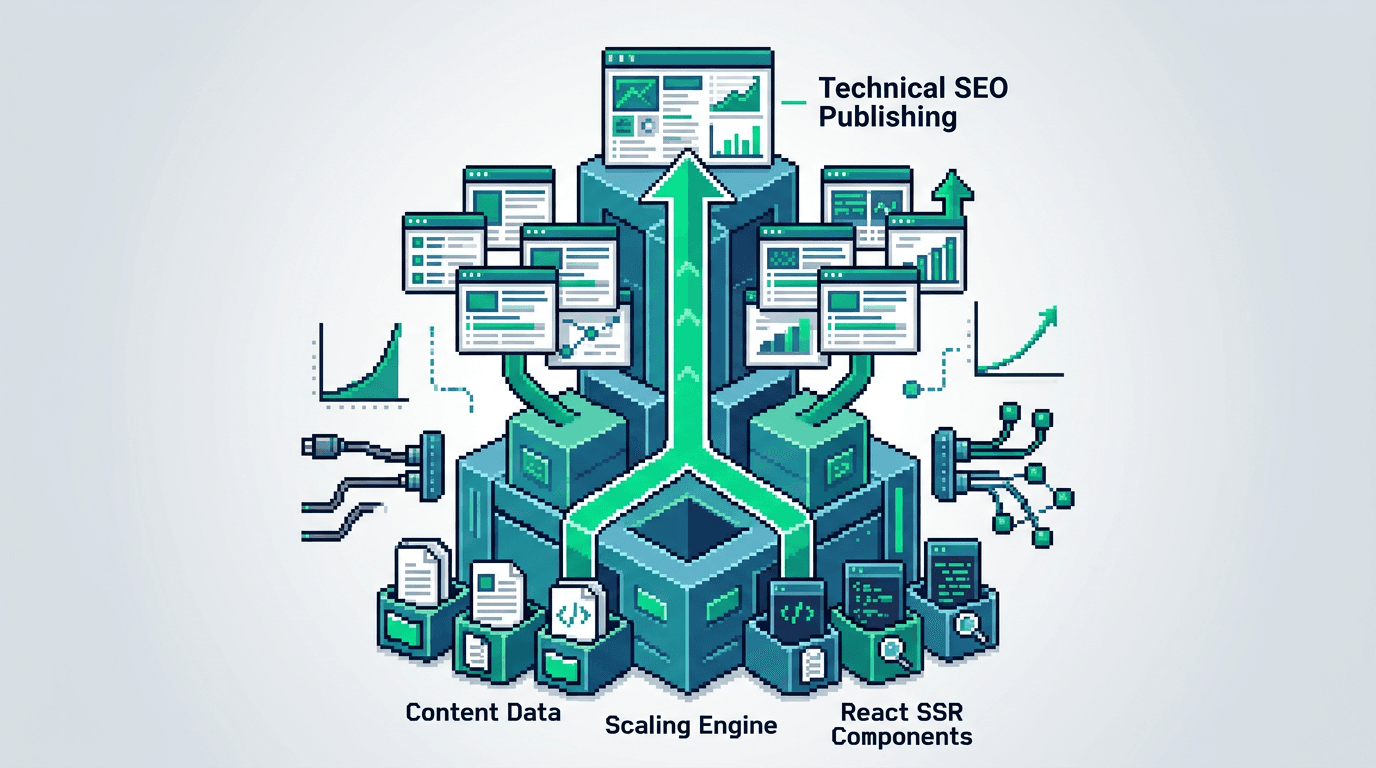
You can ship thousands of high quality pages without chaos. The constraint is not code. It is your system.
This guide shows technical product teams how to build and scale a programmatic SEO system in SSR React. It covers data models, templates, automation workflows, QA gates, distribution loops, and review cadences. If you own growth and code, the key takeaway is simple: treat SEO like a build pipeline with tests, not a backlog of one offs.
What programmatic SEO looks like in SSR React
Programmatic SEO creates many pages from structured data using repeatable templates. In SSR React, you control rendering, routing, and data fetch at request time or build time. You get speed, consistency, and versioned changes.
Core goals
- Generate relevant pages at scale with consistent intent mapping
- Keep pages fast, valid, and crawlable
- Localize and personalize without fragmenting templates
- Iterate with experiment loops and clear rollbacks
Key constraints
- Data completeness and freshness
- Route explosion and crawl budget
- Build and deploy times vs on demand rendering
- Edge caching, hydration costs, and CLS risks
Success metrics
- Indexed pages with impressions per page cohort
- Clicks per 1k pages and non brand share
- Core Web Vitals pass rate by template
- Conversion rate and assisted signups from landing cohorts
System architecture for programmatic SEO
You need clear inputs, a deterministic pipeline, and observable outputs. Keep surface area minimal and testable.
Inputs
- Source data: product catalog, docs, integrations, locations, benchmarks
- Taxonomies: entities, attributes, relationships, intents
- Constraints: supported languages, markets, compliance flags
- Content primitives: copy blocks, component variants, media
Processing
- Normalize data and de duplicate entities
- Map intents to templates and URL rules
- Generate metadata, schema, and internal links
- Stage to preview; run QA gates; ship or queue fixes
Outputs
- Versioned pages by template and locale
- Sitemaps per template and market
- Logs, metrics, and diffs for each release
Data model and URL design
Data quality gates prevent junk pages and cannibalization. Model first, then route.
Entity and attribute schema
- Entity: Integration, Feature, Industry, Use case
- Attributes: name, slug, status, locale, metrics
- Relations: Integration x Use case, Feature x Industry
- Acceptance: entity has title, summary, primary intent
URL and intent rules
- One intent per URL. No synonym routes.
- Stable slugs. Derive from canonical entity name with locale suffix only when needed.
- Examples:
- /integrations/{vendor}
- /use cases/{job}
- /comparisons/{tool a} vs {tool b}
- /locations/{city}
Canonicalization and dedupe
- Compute canonical slug from entity ID
- If attributes change, 301 old slug to new
- Block generation if intent score < threshold
Template strategy in SSR React
Templates focus on search intent, not design whims. Each template owns a query class and measurable components.
Template catalog
- Integration template: targets brand plus integration queries
- Use case template: targets job to be done queries
- Comparison template: targets {x vs y} queries
- Location template: targets service in city queries
Component contract
- Above the fold: H1, value block, primary CTA
- Proof: logos, metrics, or certification badges
- Depth: expandable FAQs, steps, code or demo
- Links: related entities, docs, and pricing
- Structured data: BreadcrumbList, FAQPage when present
Rendering modes
- SSR with caching for freshness sensitive pages
- SSG with ISR for stable catalogs
- Client hydration only where interaction is required
Automation workflows that remove bottlenecks
Manual publishing does not scale. Automate repeatable steps and gate with tests.
Metadata generation
- Title: {Entity} for {Audience} | {Brand}
- Description: 140 to 155 chars from summary and proof point
- Open Graph: dynamic headline and image service
- Hreflang: generate from locale matrix
Pseudo code:
function meta(entity, locale) {
  const title = `${entity.name} for ${entity.audience} | Brand`;
  const description = truncate(`${entity.summary} ${entity.proof}`, 155);
  const ogImage = `/og/${entity.id}.png`;
  return { title, description, ogImage, locale };
}
Schema markup
- Product, SoftwareApplication, or Service per page type
- FAQPage only if visible FAQs exist
- BreadcrumbList from route segments
- Validate with schema tests in CI
Internal linking
- Auto inject related links by relation weight
- Cap links per block to avoid noise
- Update sitemaps and HTML sitemaps after deploy
QA gates and release management
Treat each batch like a software release. Ship only when gates pass.
Preflight checks
- Route uniqueness and 200 response
- Indexable meta tags present and correct
- Canonical points to self or main variant
- LCP under 2.5s on median lab run
Content checks
- H1 is unique and matches intent
- First paragraph states problem and solution within 30 words
- No thin sections under 50 words unless list
- No placeholder text or empty components
SEO checks
- Title length 40 to 60 chars where possible
- Description 140 to 160 chars
- One primary keyword present naturally in H1 and intro
- No competing URLs with same intent
Rollback plan
- Feature flag templates and locales
- Canary deploy 5 percent traffic to validate metrics
- Rapid 301 mapping ready for slug changes
Performance and rendering in SSR React
Crawl and conversion drop when pages are slow or unstable. Engineer for predictable performance.
Server and edge caching
- Cache HTML by template and entity for 10 to 60 minutes
- Revalidate on data change events
- Use ETag and stale while revalidate headers
Asset and hydration control
- Split bundles by route group
- Defer non critical scripts
- Reduce client props. Prefer server components where stack allows.
Core Web Vitals
- LCP: inline critical CSS, responsive hero images
- CLS: reserve space for dynamic blocks
- INP: keep interactive elements minimal above the fold
Tracking, measurement, and experiment loops
Do not guess. Instrument the pipeline and iterate with evidence.
Instrumentation
- Per template dashboard: traffic, indexation, vitals, conversions
- Batch level changelog with diff count and impact
- Error budget for non passing vitals
Experiment design
- Hypothesis: add pros and cons table improves CTR
- Test scope: 500 pages from Integration template
- Success metric: +8 percent CTR in 28 days
- Guardrail: bounce rate and time on page
Review cadence
- Weekly: QA bugs, indexation anomalies
- Biweekly: template experiments and backlog
- Quarterly: taxonomy changes and route deprecations
Distribution loops for faster feedback
Search is slow. Distribute new pages to collect signals and usage fast.
Core loop
- Publish batch to staging then production
- Announce in product changelog and docs
- Generate snippets for social and email
- Run paid discovery on 5 to 10 queries
- Feed click and dwell signals back to content edits
Snippet automation
- Pull key claims and steps
- Generate 3 post variants per channel
- Schedule over 2 weeks with UTM tags
Example snippet template:
{Hook}: Ship {count} pages in {time}. See how we modeled {entity} and avoided route bloat. Link.Partnerships
- Share tailored pages with integration partners
- Swap backlinks to canonical integration hubs
- Track referral conversions per partner
Governance, owners, and RACI
Ownership avoids thrash. Define roles and escalation paths.
Roles
- Product growth lead: goal owner and backlog
- Tech lead: templates, rendering, performance
- Data engineer: model quality and freshness
- Content lead: copy blocks and audit
- QA lead: gates and release sign off
RACI matrix
- Responsible: tech lead for template code, content lead for copy
- Accountable: product growth lead
- Consulted: SEO specialist, analytics engineer
- Informed: sales, support, partnerships
Minimal blueprint to ship in 30 days
Ship a thin slice. Prove the system before scaling.
Week 1: model and routes
- Lock entity schema and slugs
- Draft 2 templates and sample content blocks
- Write QA checks and CI tests
Week 2: rendering and metadata
- Implement SSR or SSG with ISR
- Build metadata generator and schema service
- Add internal linking rules
Week 3: performance and preview
- Add edge caching and bundle splits
- Integrate preview with feature flags
- Run Web Vitals audits and fix regressions
Week 4: batch and loop
- Generate first 100 to 300 pages
- Run QA gates and canary ship
- Start distribution loop and set dashboards
Example template contract
Use this contract to standardize new templates.
Required fields
- Template ID and intent class
- Route pattern and slug function
- Required entity attributes
- Component map and visibility rules
Acceptance checks
- Title and H1 populated from entity
- Description within 155 chars
- Schema passes validation
- LCP under 2.5s on median device
Observability
- Emit template version and entity ID
- Log render time and cache status
- Attach experiment variant ID
Tooling comparison for SSR stacks
Pick based on render control, caching, and developer ergonomics.
The table below compares three common SSR options for programmatic SEO use cases.
| Stack | Rendering mode | Caching model | Routing control | Notes |
|---|---|---|---|---|
| Next.js | SSR, SSG, ISR | Edge and server | File and App Router | Mature ecosystem and image tooling |
| Remix | SSR with streaming | CDN and server | Convention with nested routes | Good for progressive enhancement |
| Astro | Island architecture | Static with partial SSR | File based | Light bundles and fast vitals |
Risk management and failure modes
Anticipate breakage and keep recovery cheap.
Common failures
- Duplicate routes from synonym entities
- Thin content from sparse data
- Slow pages due to heavy client hydration
- Index bloat without demand signals
Preventive steps
- Enforce intent and data thresholds before render
- Add content fallbacks that do not break layout
- Cap page count per batch and measure impact
- Monitor logs for soft 404 patterns
Recovery
- 301 duplicates to canonical URLs
- Merge entities and recompute relations
- Disable heavy components via feature flags
- Deprecate low value cohorts and remove sitemaps
Programmatic SEO roadmap for 90 days
Scale only when the slice works. Add depth and coverage in controlled loops.
0 to 30 days
- Ship core templates and first cohort
- Validate QA gates and dashboards
- Start two experiments
31 to 60 days
- Add localization for top 2 markets
- Launch comparison template
- Expand distribution partners
61 to 90 days
- Introduce dynamic proof blocks fed by data
- Automate pros and cons tables for comparisons
- Consolidate low performing cohorts
Programmatic SEO checklist for each release
A short list prevents regressions.
Technical
- No 5xx or 4xx on sitemaps and key routes
- Robots and canonical correct
- Caching headers present
Content
- H1 unique and clear
- First paragraph states the value fast
- No layout breaks in mobile view
Analytics
- Events firing with correct IDs
- Dashboards updated
- Experiment toggles documented
Primary queries and intent mapping examples
Map head terms to templates and define data needs.
Example mappings
- best {tool} alternatives -> Comparison template; needs feature parity data
- {vendor} integration -> Integration template; needs scopes and examples
- {job} with {product} -> Use case template; needs steps and proof
Inputs per mapping
- Entity IDs and canonical names
- Evidence blocks with metrics and logos
- FAQ pairs vetted by support and sales
Documentation and maintenance
Living docs make onboarding and audits faster.
Repos and artifacts
- mono repo for templates and QA tools
- content repo for blocks and translations
- dashboards linked from README
Maintenance cadence
- Monthly: remove dead entities
- Quarterly: revisit taxonomy and consolidate
- Ad hoc: hotfixes for critical regressions
Key Takeaways
- Treat programmatic SEO like a build pipeline with tests and rollbacks.
- Model entities and intents first, then ship stable routes and templates.
- Automate metadata, schema, and internal links with QA gates in CI.
- Control rendering and performance with SSR, SSG, and caching strategies.
- Run distribution and experiment loops to learn, then scale with evidence.
Ship small, measure hard, and scale only what proves signal.