
A published article is not a completed growth asset. Until the right audiences, product surfaces, and internal teams repeatedly put it in front of relevant people, it is simply an indexed URL waiting for demand.
This guide explains how product operators and technical growth teams can build distribution loops for SEO that turn each high-intent page into a repeatable workflow. You will learn how to map audiences and channels, define automation triggers and QA gates, assign ownership, and use feedback signals to improve both distribution and future content production. The key takeaway is simple: distribution should be a system attached to publishing, not an improvised promotion task.
Why distribution loops matter for SEO content
SEO creates a durable acquisition surface, but search visibility rarely arrives in isolation. Initial distribution can generate qualified visits, strengthen internal product awareness, earn relevant references, and reveal whether a page solves the intended problem before rankings mature.
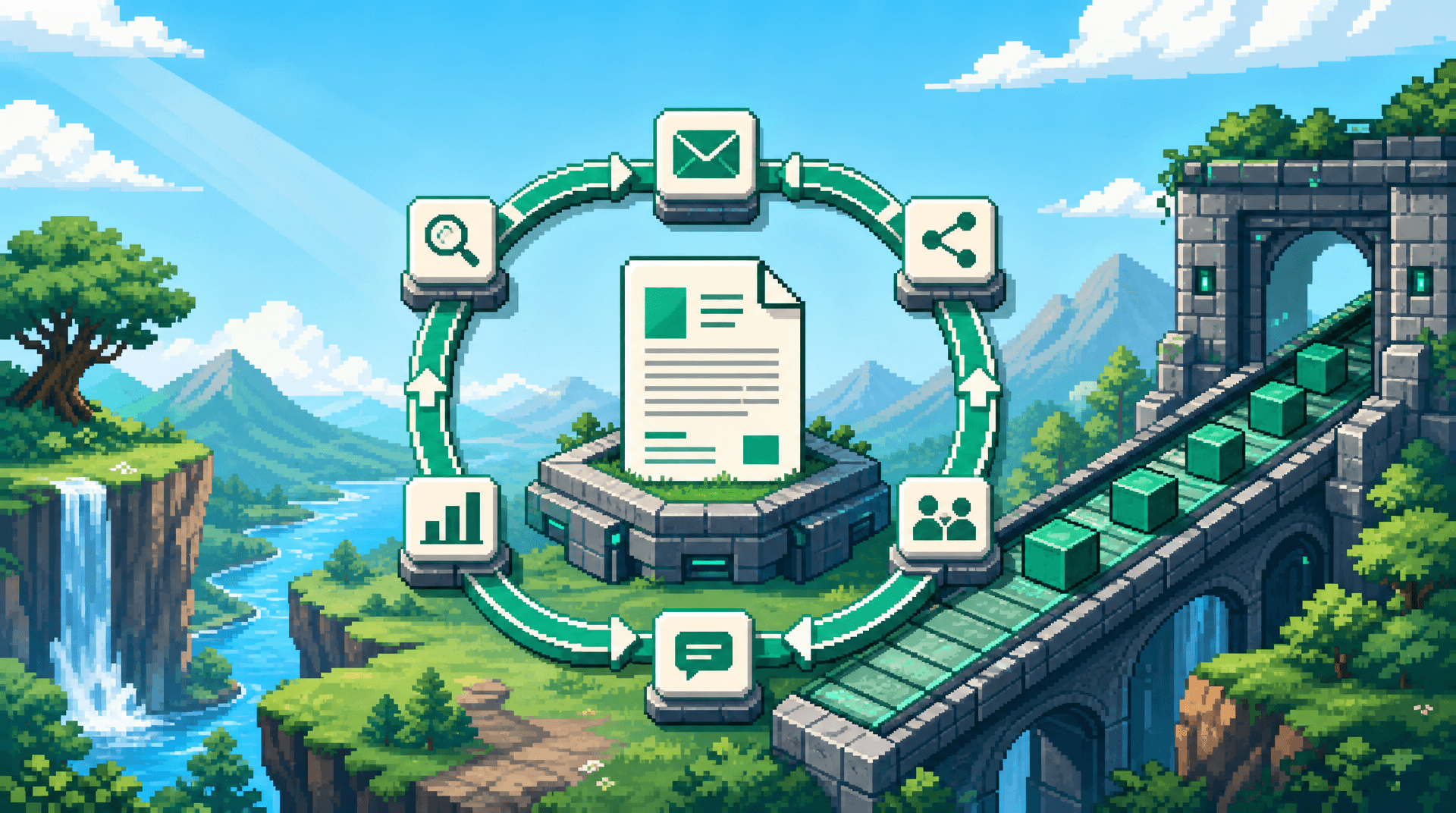
A loop is different from a campaign. A campaign has a start and finish. A loop takes a completed action, captures a signal, and uses that signal to decide the next action. For content, the loop begins when an article clears publishing QA and continues as performance and audience feedback shape additional distribution, updates, and new briefs.
SEO distribution is not just social promotion
Posting a link to a company social account is one possible delivery mechanism, but it is not a complete distribution system. Technical buyers often discover useful content through documentation hubs, release notes, newsletters, community discussions, sales enablement libraries, product onboarding, and tightly targeted outbound sequences.
The correct channel depends on the page's job. A troubleshooting article may belong in a support flow. A comparison page may support sales conversations. A deep implementation guide may earn attention from a technical newsletter or an engineering community. Treat the article as a reusable component, then select the surfaces where its audience already has an active task.
Distribution improves content decisions
Search impressions and rankings are lagging indicators. Distribution creates earlier evidence. If a narrowly targeted audience opens an article but does not continue to a relevant product page, the problem may be message match, information architecture, or the next-step CTA. If recipients repeatedly forward a guide or sales teams reuse it, that is evidence that the subject and format have practical utility.
This feedback is especially useful for technical SEO for product teams. Search data tells you what demand exists; distribution behavior helps validate the depth, framing, and conversion path required to serve that demand.
Define the loop before you publish
The easiest way to create fragmented distribution is to decide what happens after an article goes live. Build the workflow during briefing instead. Every brief should state who needs the asset, what action it should support, where it can appear, and which signal determines whether it receives another distribution pass.
Start with a page-to-audience map
Do not distribute by content format alone. A guide, landing page, template, and integration page can each require different routing. Create a compact map that links page intent to a primary audience, a usable channel, a downstream action, and an owner.
The table below compares common page intents and the distribution paths that tend to fit them.
| Page intent | Primary audience | High-fit surfaces | Desired next action |
|---|---|---|---|
| Problem education | Practitioners evaluating an approach | Newsletter, community, resource hub | Read a related implementation guide |
| Solution evaluation | Buyers comparing methods or tools | Sales library, lifecycle email, targeted outreach | View product workflow or request a demo |
| Technical implementation | Developers and technical operators | Docs, changelog, engineering community | Use a template, integration, or product feature |
| Use case validation | Product and growth leaders | Case-study hub, account outreach, partner content | Share internally or start an evaluation |
One article can support several audiences, but it should have one primary distribution thesis. For example, a guide to SSR rendering failures may be promoted first through a technical newsletter and linked from documentation. The sales team may later use it for accounts with the same implementation constraint, but that is a secondary route with its own message.
Define the reusable distribution packet
A distribution packet is the set of approved assets generated alongside the canonical URL. It removes the common bottleneck where an operator needs to reread the entire article to produce every channel-specific message.
For each page, package the following:
- A one-sentence problem statement using the audience's language.
- Three channel-specific hooks, each tied to a concrete takeaway.
- One short excerpt and one longer explanation for owned channels.
- A relevant internal destination beyond the article itself.
- Approved UTM conventions and campaign naming.
- A list of claims, screenshots, code examples, or product statements that require review.
This is where automation workflows for product teams can remove repetitive work. A CMS publish event can open a distribution task, generate draft channel copy from structured fields, create tagged links, and assign reviewers. Automation should prepare and route assets, not autonomously publish unreviewed technical claims.
Build channel triggers and ownership into the workflow
Reliable loops are event-driven. Instead of asking, “Who can promote this?” after publication, define the condition that triggers distribution and the person accountable for clearing it.
Use publishing events, not calendar reminders
Calendar reminders decay because they are detached from actual content state. A stronger design uses events from the systems where work already happens: a CMS status change, a pull request merge, a product release, a new integration, a ranking movement, or a sales team request.
A basic workflow can look like this:
- An editor marks the article as ready for publication.
- A QA check verifies metadata, canonicals, structured data where applicable, internal links, and the target conversion path.
- The CMS publishes the canonical page and emits an event.
- The event creates channel tasks with prefilled copy, asset links, owners, due dates, and tracking parameters.
- Reviewers approve material for their surface, such as product marketing, developer relations, or sales enablement.
- Distribution outcomes feed a reporting view and a future content backlog.
For a programmatic content operation, the same pattern applies at the template level. Programmatic SEO pages should only enter a distribution queue when they meet page-level quality criteria and have a valid audience segment or contextual placement. Publishing hundreds of URLs without a selective distribution model creates noise, not compounding reach.
Assign one accountable owner per handoff
Shared responsibility often means no responsibility. The content owner should not necessarily execute every channel, but they need a visible system of record for status and escalation.
The table below shows a practical ownership model for a B2B technical content loop.
| Workflow stage | Accountable owner | Contributors | Completion signal |
|---|---|---|---|
| Brief and audience mapping | Content or growth lead | Product, SEO, sales | Channel thesis approved |
| Technical and editorial QA | SEO or engineering reviewer | Editor, product owner | Required checks passed |
| Owned-channel activation | Lifecycle or content owner | Design, community | Assets sent or scheduled |
| Sales and partner enablement | Revenue enablement owner | Account team, partnerships | Asset added to active playbook |
| Measurement and iteration | Growth analyst or operator | SEO, content | Next action recorded |
The point is not to create bureaucracy. It is to make every handoff observable. If developer-facing posts are consistently delayed, the team can see whether the constraint is review capacity, missing source material, or a channel with no clear owner.
Add QA gates that protect trust and search performance
Distribution accelerates exposure. That makes quality control more important, not less. A misleading hook, broken tracking link, stale screenshot, or article that fails to answer its promise can damage trust across several channels at once.
Separate publish QA from distribution QA
Publish QA verifies that the page is technically eligible to be indexed and used. Distribution QA verifies that channel-specific promotion accurately represents the page and sends readers to an appropriate next step.
For sites using SEO architecture for SSR React, publish QA should include rendered HTML checks rather than relying only on client-side behavior. Confirm that the title, meta description, canonical, primary copy, internal links, and intended structured data are available in the server-rendered response. A share card that looks correct in the browser is not evidence that crawlers or social preview parsers receive the correct metadata.
Distribution QA should then check message match. Does the post copy promise a solution actually covered in the article? Does the tracked URL preserve the canonical destination? Does the page have a relevant related resource rather than a generic homepage CTA? These checks reduce wasted clicks and prevent a channel from producing misleading performance data.
Create pass, hold, and stop criteria
A gate needs an explicit outcome. “Review content” is ambiguous; “pass if all claims are sourced and links return 200 responses” is operational.
Use three states:
- Pass: The asset is accurate, technically valid, approved for the channel, and has tracking configured.
- Hold: A correctable issue exists, such as a missing screenshot approval, an unclear claim, or a broken internal link.
- Stop: The page or promotion should not be distributed because of a legal, product, accuracy, or audience-fit issue.
Keep criteria proportional to risk. A new social post based on an evergreen guide may need a lightweight editorial check. A distribution sequence that names customers, quotes performance outcomes, or describes a new product capability requires deeper validation. QA gates should be templates that speed repeated work, not one-off documents that create new manual bottlenecks.
Measure the loop with leading and downstream signals
Do not judge distribution only by clicks. A high click count from an irrelevant audience can make a weak loop appear successful. Measure whether the right people reached the page, completed an appropriate next action, and created information that improves the next cycle.
Track the full path from channel to outcome
Use consistent campaign parameters, a channel taxonomy, and a reporting layer that connects a distribution event to the page and its intended job. The goal is attribution useful enough to guide decisions, not a perfect model of every touchpoint.
Track a small set of signals by channel and content cluster:
- Delivery: assets approved, placements live, and time from publish to first activation.
- Qualified engagement: engaged sessions, scroll depth where reliable, return visits, and consumption of a related resource.
- Conversion path: product-page visits, template downloads, demo starts, account activity, or another page-specific action.
- Search contribution: assisted organic visits, new internal links, referral mentions, and changes in query coverage over time.
- Learning output: objections, questions, copy patterns, and new topics added to the editorial backlog.
Avoid treating any one metric as a universal success threshold. A detailed implementation article may have fewer visits but create high-value sales enablement usage. A broad educational page may earn more qualified referrals and strengthen a topic cluster before it produces direct conversion activity.
Turn feedback into routing rules
The loop compounds when metrics change future behavior. Define simple decision rules before reviewing results. For example, if a developer-oriented guide has strong completion but weak product continuation, test a more technical next step such as an API reference, sample repository, or implementation template. If sales teams repeatedly use an article in late-stage conversations, add it to the relevant enablement sequence and create a companion evaluation page.
Feedback can also improve production. Repeated questions from community comments can become new sections, supporting articles, or additions to a content template. Referral sources that send qualified visitors can become partnership targets. Low engagement from a channel may mean the audience is wrong, the hook is vague, or the article needs a better contextual introduction, not that the topic has no value.
Run distribution as an experiment system
A loop needs controlled variation. If every channel, hook, CTA, and audience changes at once, the team cannot identify what worked. Treat distribution as a sequence of small, documented experiments with a clear decision owner.
Test one meaningful variable at a time
Possible variables include the framing of the hook, the target segment, the asset format, the send timing, the related link, or the CTA. Preserve the canonical article while testing the packaging around it.
For example, distribute the same guide to two relevant newsletter segments with different entry points: one focused on reducing manual SEO QA, another focused on SSR rendering reliability. Compare qualified continuation and downstream actions, then use the winning language in future briefs, internal links, and landing-page copy. Do not infer causation from tiny samples or short observation windows; record the result as directional learning when evidence is limited.
Maintain an execution playbook
The system becomes repeatable when the team captures decisions in a durable playbook. Your growth execution playbooks should include channel eligibility rules, templates, owners, QA criteria, tracking standards, escalation paths, and a log of experiments.
Review the playbook on a regular operating cadence. Remove channels that no longer match the audience, refine templates based on objections, and update approval requirements when product or compliance risk changes. This creates a system where a new editor, growth operator, or product marketer can execute the workflow without reconstructing it from past chat threads.
Key Takeaways
- Build distribution loops for SEO during content briefing, with a defined audience, channel thesis, next action, and feedback signal.
- Generate a reusable distribution packet so channel owners can activate quality assets without recreating messaging from scratch.
- Use event-driven workflows, explicit owners, and pass, hold, or stop QA gates to make execution reliable.
- Measure qualified engagement and downstream outcomes, then convert findings into routing rules, content updates, and new experiments.
- Treat distribution as an operating system for content, not a one-time promotional task.
When publishing, distribution, and learning run as one workflow, each SEO asset has more chances to create value before and after it earns sustained search visibility.