
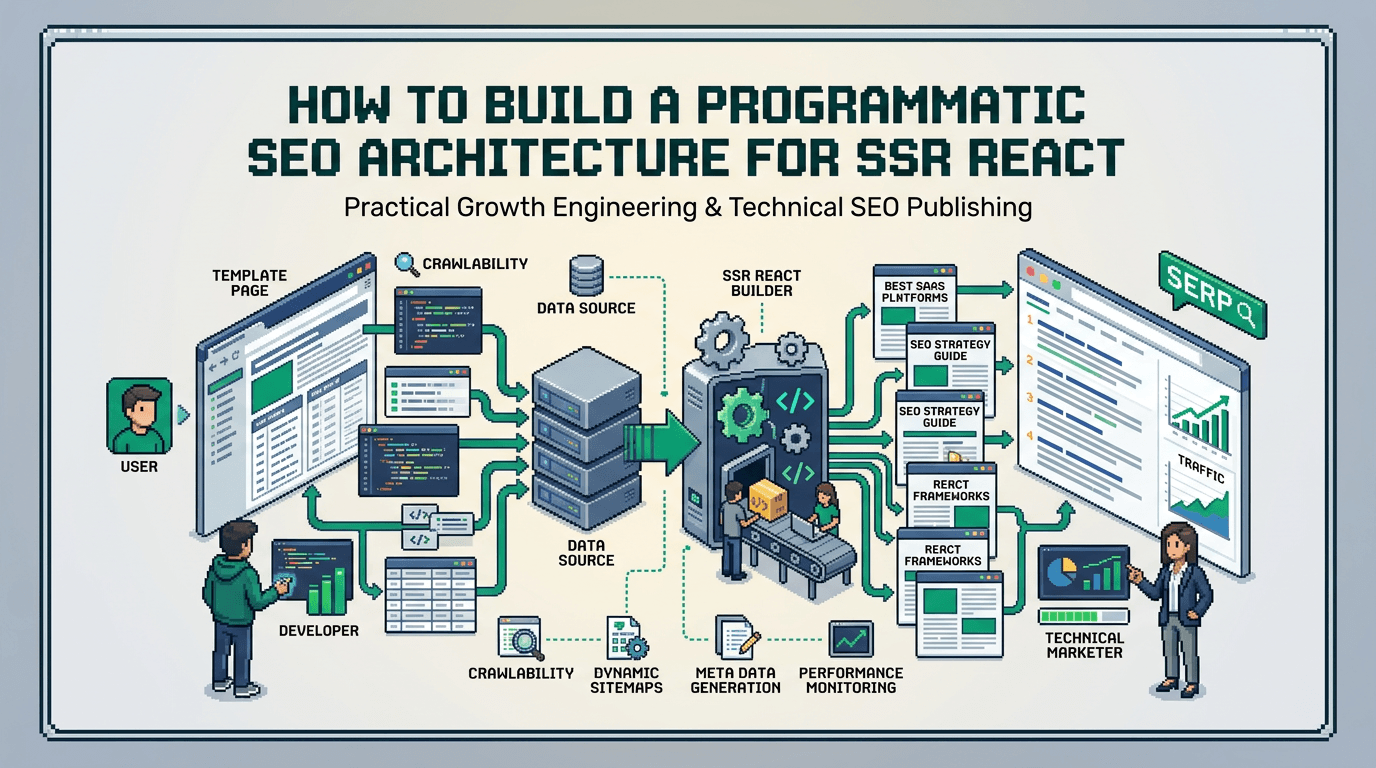
Technical SEO for product teams fails when every page is hand built. Programmatic SEO fixes throughput and quality with templates, data models, and QA gates.
This guide shows technical SEO for product teams how to design a scalable programmatic SEO architecture for SSR React apps. You will learn the system, roles, templates, automation workflows, distribution loops, and experiment loops. Key takeaway: ship a repeatable pipeline that turns structured data into high quality pages with measurable outcomes.
What Programmatic SEO Solves for SSR React
Programmatic SEO scales page production with consistency and control. SSR React adds performance and rendering guarantees.
Core problems it addresses
- Slow manual page creation and review cycles
- Inconsistent metadata and internal linking
- Fragile rendering and hydration edge cases
- Duplicated logic across components and routes
Why SSR React fits
- Server render ensures bots see content and links
- Fine control of routes, params, and canonical logic
- Strong typing with TypeScript reduces template drift
- Streaming and caching improve time to first byte
System Blueprint: Inputs, Process, Outputs
Build the pipeline like an engineering system. Define inputs, the process that transforms them, and the outputs you will measure.
Inputs
- Source data: product catalog, locations, docs, features
- Taxonomy: entities, attributes, relations, URL params
- Templates: page types with content blocks and components
- Rules: canonical, robots, sitemap, pagination, linking
Process
1) Ingest and validate data
2) Generate routes from the data model
3) Render SSR templates with strict typing
4) Attach metadata and structured data
5) Link pages with deterministic graphs
6) Run QA gates and visual checks
7) Deploy behind feature flags and monitors
Outputs
- Pages that ship within SLOs
- Index coverage that grows predictably
- Clicks and conversions per page type
- Crawl health with low duplication
Data Model and URL Strategy
Your data model drives routes and internal linking. Keep it explicit and typed.
Entities and relations
- Entity examples: Product, Category, UseCase, Integration, City
- Relations: Product->Category, Product->UseCase, City->Service
- Store as normalized tables or JSON with indexes
URL rules
- One canonical per unique intent: /services/city/[slug]
- Deterministic slug builders: lowercase, hyphens, ASCII only
- Stable IDs under the hood, slugs as display keys
Template Architecture in SSR React
Define page types. Encapsulate content blocks. Version them like code.
Common page types
- Listing: categories, cities, tags
- Detail: product, service, integration, case study
- Compound hub: topic hubs that cluster related detail pages
Component contracts
- Props must map to the data model
- No optional props for critical SEO elements
- Provide fallbacks for non critical fragments
Example TypeScript prop contract:
type SeoProps = {
  title: string;
  description: string;
  canonical: string;
  robots?: string;
  og?: { title?: string; description?: string; image?: string };
};

type PageProps<T> = {
  data: T;
  seo: SeoProps;
  links: Array<{ href: string; text: string; rel?: string }>;
};
Metadata, Structured Data, and Internal Linking
Search engines need complete metadata and consistent link graphs. Encode rules, not opinions.
Metadata rules
- Title: 55 to 60 chars target, include primary entity and modifier
- Description: 140 to 160 chars, action plus value
- Canonical: only one per intent, absolute URL
Structured data patterns
- BreadcrumbList for all hierarchical pages
- Product or Service where applicable
- FAQPage only when real on page Q and A exists
Internal link graph
- From listing to detail and back with consistent anchors
- Cross link siblings within a cluster
- Add next and previous within series pages
Automation Workflows and QA Gates
Automation prevents drift. QA gates catch regressions before they ship.
Workflow steps
1) Data ingest job
- Validate schema and required fields
- Output a delta manifest with new or changed nodes
2) Route generation
- Build static params or server handlers from the manifest
3) Pre render checks
- Lint SEO fields, link counts, and heading hierarchy
4) Visual regression
- Snapshot top templates per variant
5) Content policy checks
- Word count ranges, forbidden phrases, duplicate blocks
6) Release gate
- Ship behind a feature flag by template and segment
Example automation snippets
- Schema check command
yarn data:validate --schema schema.json --in data/*.json --strict- SEO lint rule pseudo code
if (!title || title.length > 60) fail('title length');
if (!description || description.length < 140 || description.length > 160) fail('meta description');
if (!canonical.startsWith('https://')) fail('canonical protocol');
Performance and Rendering SLOs
Set budgets. Fail builds when budgets break.
Budgets to enforce
- TTFB p95 under 800 ms for HTML
- CLS under 0.1, LCP under 2.5 s on 4G
- HTML weight under 60 KB for list pages
- JS per route under 120 KB parsed
Caching and delivery
- Pre generate hot routes on deploy
- Cache HTML at edge with short TTL and revalidate
- Use stale while revalidate for lists
- Stream content blocks where possible
Measuring Impact and Experiment Loops
Tie page types to outcomes. Iterate in fixed cadences.
Core dashboards
- Index coverage by page type
- Clicks, CTR, and position per template
- Internal link flow: in degree and out degree by node
- Conversion rate by landing page template
Experiment loop
1) Hypothesis
- Example: Add comparison block to detail pages increases CTR
2) Change set
- Update template version v2 with new H2 and bullets
3) Rollout plan
- 20 percent traffic for 14 days behind a flag
4) Acceptance checks
- No drop in indexation, CTR up 5 percent, no CLS regressions
5) Keep or revert
- Promote v2 or roll back to v1 in one commit
Distribution Loops for Reach
Do not rely only on search. Create distribution that compounds.
Loop design
- Source artifact: long form guide or hub page
- Derivatives: snippets, checklists, short videos, code gists
- Schedule: maintain a weekly cadence with channel specific copy
- Feedback: pull comments and questions back into FAQs and copy
Minimal tool stack
- Scheduler to queue derivatives
- UTM tagging to label channels
- Dashboard for reach and assisted conversions
Roles, Owners, and RACI
Assign owners. Avoid vague responsibilities.
Suggested RACI per stage
- Data model: Responsible engineer; Accountable tech lead; Consult content; Informed SEO
- Templates: Responsible front end; Accountable tech lead; Consult design; Informed SEO
- Metadata rules: Responsible SEO; Accountable product; Consult legal; Informed engineering
- QA gates: Responsible QA engineer; Accountable tech lead; Consult SEO; Informed content
Failure Modes and Rollbacks
Expect failure and plan the reversions.
Common failure modes
- Duplicate content from parameter drift
- Empty pages from missing data
- Thin content from aggressive pruning
- Crawl traps from pagination loops
Rollback plan
- Kill switch by template and route prefix
- Revert to previous template version
- Block offending params at edge with 410 or canonicalize
- Restore last good data snapshot
Integration Checklist and Acceptance Criteria
Use a short checklist to gate releases by template type.
Pre launch checklist
- Data fields exist for all required props
- Titles within 55 to 60 chars; descriptions 140 to 160
- Canonicals resolve and match final URLs
- Breadcrumbs render for all nested pages
- Page meets performance budgets
Acceptance criteria
- Index coverage grows without spikes in duplicates
- CTR improves for target queries
- No increase in server errors or timeouts
- Conversion holds or improves on new landings
Example Timeline: First 30 Days
A fast start plan to reach first indexed pages and baseline metrics.
Week by week plan
- Week 1: Model entities, define URL rules, scaffold two templates
- Week 2: Implement metadata rules, add internal link graph, set budgets
- Week 3: Wire QA gates, ship 10 percent of target pages behind flags
- Week 4: Expand to 50 percent, open dashboard, start one experiment
Tooling Options Compared
Use this quick table to compare common approaches.
| Option | Strengths | Risks | Fit |
|---|---|---|---|
| Next.js SSR | Mature SSR, routing, streaming | Can bloat JS if unmanaged | Most SSR React apps |
| Astro SSR | Islands, low JS | Smaller ecosystem for complex apps | Content heavy sites |
| Remix | Nested routing, forms | SSR nuances for bots | Apps with many actions |
| Custom Node SSR | Full control | Higher maintenance | Edge cases and legacy |
Implementation Example: Service Pages at Scale
A concrete example for a services business with city level pages.
Data model
- Entities: Service, City
- Relation: City has many Services
- Fields: service_name, city_name, slug_service, slug_city, summary
Route pattern
- Listing: /services/[city]
- Detail: /services/[city]/[service]
Template rules
- H1 equals Service in City
- First paragraph 40 to 60 words with value and proof
- Internal links to 3 sibling services and the city hub
- Add FAQ only if real Q and A exist on page
Where to Get Help and Build Faster
If you need implementation support or want a team to ship the pipeline, contact a professional dev agency:
- Full services: https://www.baylinedigital.com/services
- SEO services: https://www.baylinedigital.com/services/seo
- Custom websites: https://www.baylinedigital.com/services/custom-websites
These links cover scoping, SEO architecture, and custom builds.
Key Takeaways
- Choose a typed data model and deterministic URLs
- Treat templates as versioned code with QA gates
- Enforce metadata rules and link graphs automatically
- Set performance budgets and fail builds when broken
- Run experiment and distribution loops on a fixed cadence
Ship the first slice in 30 days, then compound with weekly iterations.