
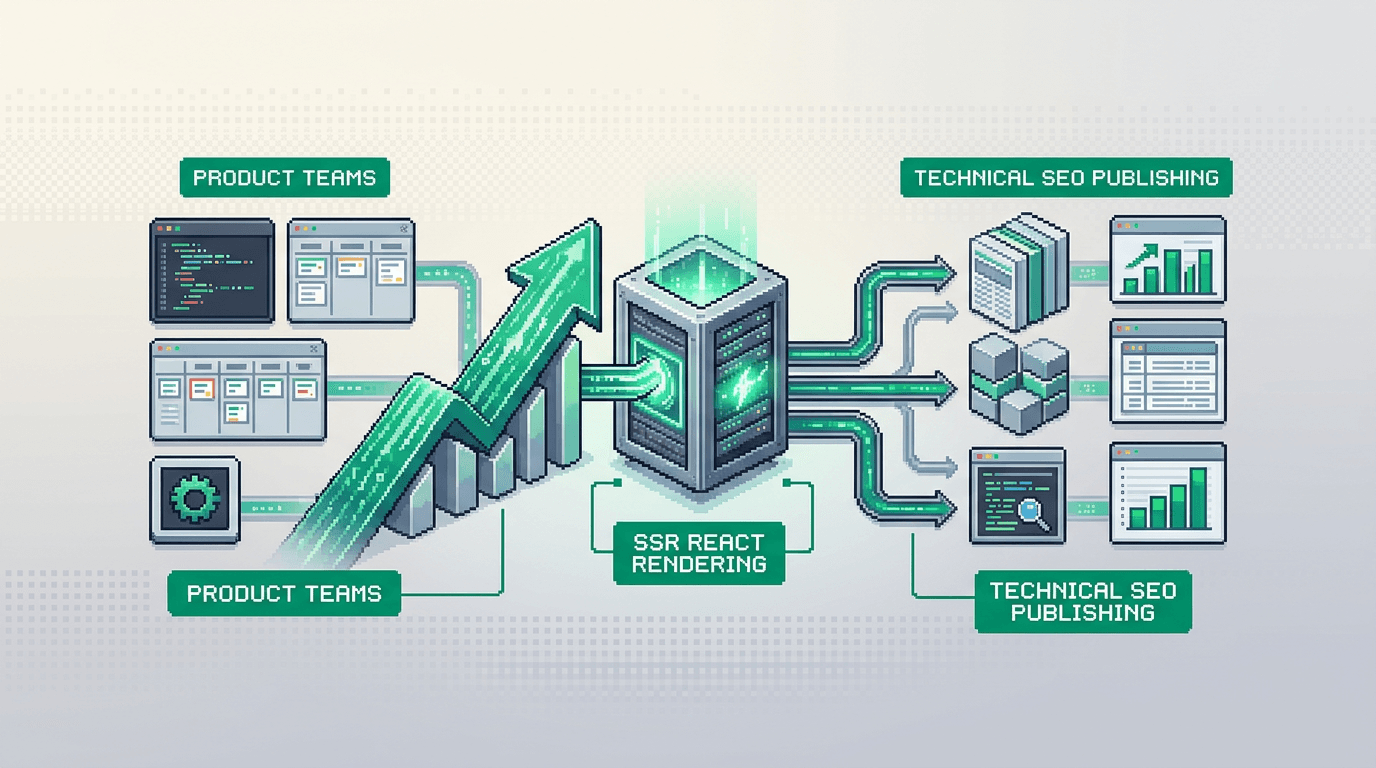
Growth stalls when search pages take weeks to ship. Product teams need a repeatable path to publish and learn daily.
This guide shows technical SEO for product teams using SSR React. It is for product engineers, growth PMs, and content ops who own traffic as a system. The takeaway: build a programmatic SEO architecture with templates, automation workflows, and QA gates so you can ship high quality pages at scale.
What technical SEO for product teams looks like
Technical SEO succeeds when engineering, content, and analytics ship together. You need fast pages, precise metadata, and a reliable release rhythm.
Roles and ownership
- Product engineering owns SSR templates, routing, build performance, and error budgets.
- Content ops owns data sources, taxonomy, editorial rules, and review SLAs.
- Growth PM owns prioritization, success metrics, and experiment backlog.
- Analytics owns event schema, dashboards, and anomaly alerts.
Success metrics
- Time to first indexed page under new template: less than 7 days.
- Template ship frequency: at least weekly.
- Organic sessions per template per week: increasing trend within 30 days.
- Crawl errors per 1k URLs: below 5.
- CLS and LCP: pass Core Web Vitals on 75th percentile.
Inputs and outputs
- Inputs: canonical data model, keyword clusters, SSR template library, QA checks, CI pipeline, distribution loop.
- Outputs: crawlable pages, clean sitemaps, stable metadata, logs, dashboards, and a weekly review note.
Architecture for SSR React that scales
Goal: render fast, indexable pages with stable routes, structured data, and cache strategy.
Routing and canonical rules
- One canonical URL per entity. Enforce lowercase, hyphen slugs, and trailing slash policy.
- Use server redirects for duplicates: 301 non canonical to canonical.
- Generate hierarchical paths from taxonomy: /topics/{cluster}/{entity}/.
Rendering strategy
- Use SSR for indexable pages with changing content. Hydrate critical above the fold only.
- For large catalogs, blend SSR and ISR style revalidation to reduce server load.
- Cache HTML at edge with short TTL and stale while revalidate policy.
Metadata and structured data
- Title: 50 to 60 chars target, include primary entity and modifier.
- Description: 140 to 160 chars, unique per page.
- Open Graph and Twitter tags mirror title and description.
- JSON LD: use Article, Product, or FAQPage as applicable. Validate in CI.
Asset and performance budgets
- JS budget: under 170 KB gzipped on critical route.
- LCP under 2.5s for 75th percentile on mobile.
- CLS under 0.1. Preload hero image and critical font.
A programmatic SEO system for SSR React
You need a data model, a template library, and a pipeline that converts rows into pages.
Data model
- Entities: product, feature, integration, industry, location.
- Relations: many to many between product and integration, product and industry.
- Fields: slug, title seed, description seed, canonical URL, primary keyword, secondary keywords, schema type, status.
Template library
- Detail template for entities.
- Comparison template for X vs Y.
- Cluster hub template for topics.
- Use partials for intro, pros and cons, FAQs, and CTAs.
Generation rules
- For each entity row with status ready, create route and metadata from fields.
- Deduplicate near identical titles. Apply stopword blacklist.
- Block thin pages under 200 words from publishing. Queue for enrichment.
Versioning and rollbacks
- Template changes land behind a feature flag.
- Keep per template changelog with PR link and release notes.
- Rollback path: revert template to previous version and invalidate cache.
Automation workflows that remove bottlenecks
Goal: reduce manual steps between dataset changes and page publication.
Ingestion and enrichment
- Pull source data daily from Notion, Airtable, or a DB view.
- Normalize fields. Validate required keys: slug, title seed, canonical.
- Enrich with keyword cluster from a lookup table. Stamp timestamp and owner.
Metadata and content synthesis
- Compose titles with pattern: {entity} for {segment} {year}.
- Generate descriptions that mention the primary keyword once.
- Insert internal links from a rules table: parent hub, 3 sibling entities, 1 comparison.
CI and QA gates
- Lint routes for collisions and max length.
- Validate JSON LD types. Fail build on schema errors.
- Check for duplicate H1 equivalents in content. Reject duplicates.
- Run Lighthouse CI. Fail if LCP or CLS budgets break.
Deployment and cache
- On merge to main, build SSR bundle and run integration tests.
- Deploy to two regions. Warm top 200 pages by traffic.
- Invalidate sitemap and RSS caches. Ping search engines.
QA gates and acceptance checks
Build confidence before Google crawls. Catch index killers early.
Pre merge checks
- Route map diff shows added, changed, removed URLs.
- Title and description uniqueness report under 3 percent duplicates.
- Structured data validates for 100 percent of changed pages.
Pre prod checks
- Core Web Vitals synthetic pass on the top 50 routes.
- Robots rules tested for allow and disallow paths.
- Sitemap builds under 50k URLs per file. Index references all parts.
Post deploy checks
- 404 rate under 0.5 percent of pageviews.
- Crawl stats show fetch increase within 72 hours.
- Index coverage errors trend down or stable.
Distribution loops that compound reach
Publish is step one. Distribute in consistent loops to get clicks and links.
Loop design
- Input: one flagship post or hub update per week.
- Outputs: 5 short LinkedIn posts, 3 code snippets, 1 email, 2 community replies.
- Cadence: batch in 90 minutes every Monday.
Repurposing rules
- Extract 3 charts or tables as images.
- Turn the pros and cons block into a carousel.
- Clip a 60 second screen recording demo for dev communities.
Scheduling and measurement
- Schedule at local morning times for target regions.
- Track UTM clicks, saves, replies, and referral traffic per asset.
- Promote winners again in 14 days with a fresh hook.
Internal linking as distribution
- Add contextual links from new posts to 5 legacy pages.
- Update hub pages with the new entity and comparison slots.
- Refresh XML sitemap lastmod fields on linked pages.
Experiment loops and review cadence
You need weekly feedback to prevent template decay and keyword drift.
Hypothesis framing
- If we add a comparison block near the fold, CTR from SERP increases.
- If we shorten titles to 55 chars, truncation decreases and CTR improves.
- If we add a pros and cons table, time on page increases.
Test setup
- Split templates by route hash for A and B.
- Keep 2 week windows to capture crawl and behavior signals.
- Use Search Console for CTR, Analytics for dwell, Logs for crawl rate.
Analysis and decisions
- Declare success when uplift exceeds 5 percent with stable crawl.
- Promote winning template to 100 percent.
- Document in changelog with graphs and diffs.
Review rhythm
- Monday: ship one template or dataset batch.
- Wednesday: distribution loop and internal link pass.
- Friday: experiment review and next week plan.
Example blueprint for a 90 day rollout
This sample plan shows owners, steps, and acceptance.
Phase 1 weeks 1 to 3 foundation
- Define entities and relations. Freeze schema.
- Build detail and hub templates with SSR and JSON LD.
- Set budgets. Wire CI checks. Ship to staging.
Phase 2 weeks 4 to 6 first publish
- Import 200 entities with complete fields.
- Run QA gates. Publish to prod. Warm cache.
- Submit sitemap. Monitor crawl and index coverage.
Phase 3 weeks 7 to 10 scale and harden
- Add comparison template and internal link rules.
- Enforce performance budgets on all routes.
- Start weekly distribution loop cadence.
Phase 4 weeks 11 to 13 optimize
- Run two template experiments in parallel.
- Refresh titles and descriptions from CTR data.
- Review dashboards and write a retro with action items.
Tooling and stack comparison
Pick a build stack that fits team skills and release needs.
Here is a concise comparison of common SSR React options.
| Option | Rendering model | Data fetch pattern | Cache strategy | Best for | Tradeoffs |
|---|---|---|---|---|---|
| Next.js SSR plus ISR | SSR with per page revalidate | getServerSideProps or app router fetch | Edge cache with SWR | Large catalogs with mixed freshness | Needs careful cache keys and invalidation |
| Remix | SSR with nested routes | Loaders per route | CDN cache on responses | Complex route layouts and forms | Requires cache headers discipline |
| Express custom SSR | Full control manual SSR | Custom fetch layer | Custom reverse proxy | Highly bespoke needs | Higher maintenance and infra work |
Monitoring and alerts
Keep dashboards and alerts close to the code.
Dashboards
- Search Console performance by template and cluster.
- Crawl stats and index coverage trends.
- Core Web Vitals field data by route group.
Alerts
- Duplicate title rate over 5 percent.
- 5xx error rate over 0.3 percent for 10 minutes.
- Robots.txt or sitemap fetch failures.
Common failure modes and rollbacks
Anticipate break points and set rollbacks that are one command.
Failure modes
- Route collisions after slug changes.
- Thin pages from incomplete rows shipping to prod.
- Render blocking scripts inflating LCP.
- Over eager revalidation causing cache thrash.
Rollbacks
- Revert to previous route map and 301 table.
- Auto unpublish rows with missing required fields.
- Disable non critical bundles via flags.
- Increase revalidate window. Lock cache keys.
Governance and content quality
Templates keep quality stable when rules are explicit and enforced in code.
Editorial rules in code
- Require an intro that states user intent in 2 sentences.
- Force one table or list for scannability.
- Include a comparison section when entity has peers.
Review workflows
- PR checklist includes SEO checks and content checklist.
- Content ops approves taxonomy and internal links.
- Growth PM signs off on target keyword and success metric.
Key Takeaways
- Treat technical SEO for product teams as a system with data, templates, and QA in one pipeline.
- Use SSR React with clear routing, caching, and structured data to scale pages safely.
- Automate ingestion, metadata, and QA to ship weekly without manual bottlenecks.
- Run distribution and experiment loops so pages improve after publish.
- Monitor budgets and errors, and keep rollbacks one command away.
Ship small, review weekly, and let steady releases compound your organic growth.