
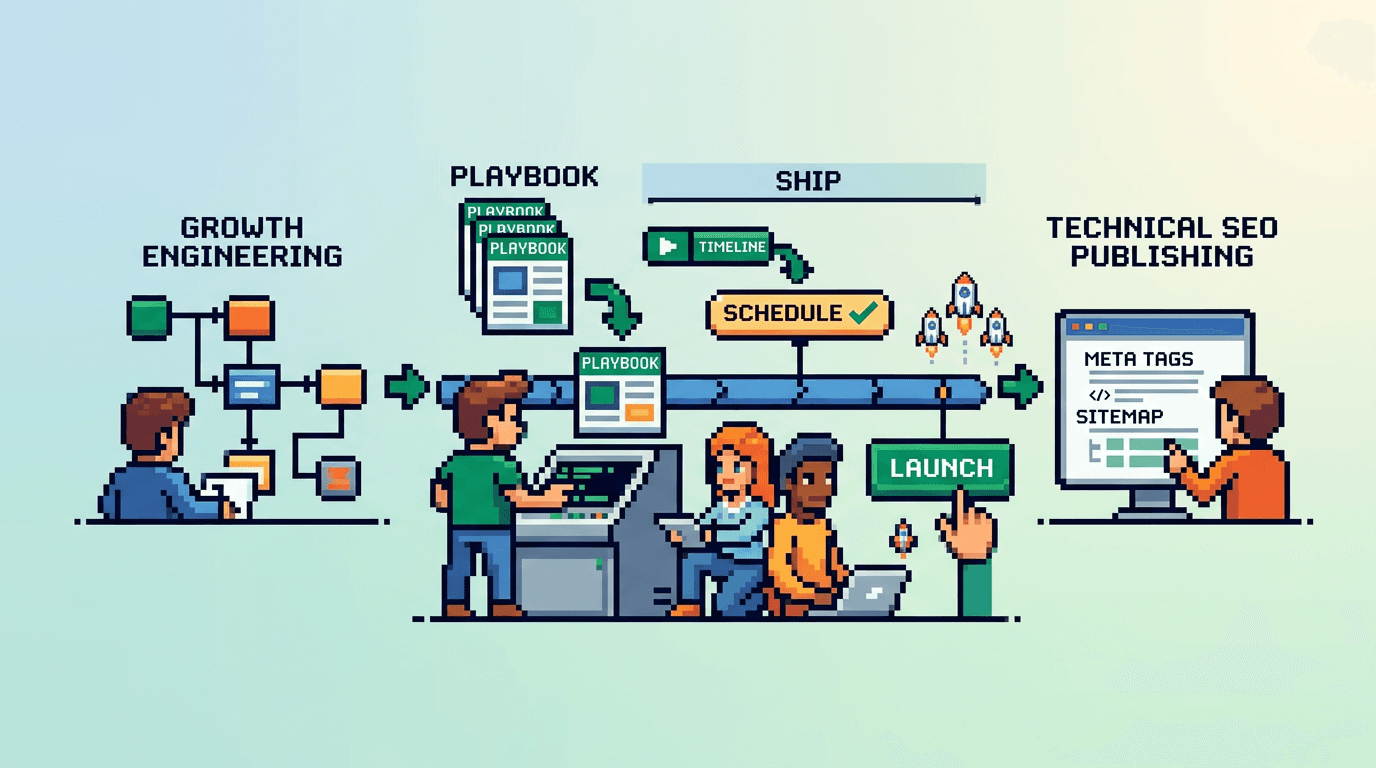
Growth teams stall when steps live in slides and memories. Execution playbooks turn intent into shipping cadence and measurable outcomes.
This guide shows growth operators and technical marketers how to build execution playbooks that scale. It covers programmatic SEO, automation workflows, distribution loops, and experiment loops. The key takeaway: standardize inputs, automate handoffs, and add QA gates so teams ship faster with higher quality.
What is an Execution Playbook and Why It Matters
An execution playbook is a repeatable, versioned workflow that ships outcomes on a schedule. It assigns owners, tools, inputs, and acceptance checks. It removes ambiguity.
Use a playbook when work repeats, cross functional handoffs cause slips, or quality varies. It enforces a single source of truth and a shared definition of done.
Benefits:
- Faster cycle times and fewer blockers
- Predictable quality with defined QA
- Clear ownership and escalation paths
- Easier onboarding and coverage during absences
Core Components of a Playbook
A durable playbook includes seven parts. Treat each as required.
Goal and Metrics
State the target outcome in one line. Set success metrics and leading indicators.
Example:
- Goal: Publish 50 programmatic SEO pages with 95 percent template pass rate in 30 days
- Metrics: pages shipped, QA pass rate, indexed pages, clicks from Search Console
Inputs and Artifacts
List all inputs. Link to sources. Control versions.
- Data sources: product catalog, locations, features
- Templates: SSR React components, metadata, schema
- Briefs: query patterns, content slots, internal links
- Repos and dashboards: code, ETL, QA reports
Roles and Owners
Define a single owner for each step. Include backups and SLAs.
- Data engineer: model and feed data daily by 10 AM
- Developer: ship SSR template changes behind flags
- SEO lead: approve query pattern and internal link map
- Editor: review copy blocks against style and legal
Steps and Handoffs
Break the flow into atomic steps. Include acceptance checks and failure modes.
- Step: Generate page list from data model
- Check: dedupe keys and ensure canonical uniqueness
- Failure: collisions or thin rows; rollback by filtering low intent rows
- Step: Render pages in staging with SSR
- Check: metadata and schema present; Time to First Byte under 500 ms in staging
- Failure: latency spike; rollback by disabling non critical widgets
QA Gates
Insert gates before merge and before publish. Use automated tests when possible.
- Linting for metadata completeness
- Link checker for 404s and redirect loops
- Schema validator for required properties
- CLS and LCP checks on key templates
Runbook and Rollbacks
Write run commands, health checks, and rollback steps.
- Deploy: feature flag on cohort of 10 percent pages
- Health: error budget for 5xx and LCP thresholds
- Rollback: revert flag, clear cache, notify owners
Review Cadence
Schedule weekly reviews and 30 day retros. Track actions to closure.
- Weekly: velocity, blockers, QA rates
- Monthly: organic clicks, index coverage, conversion trails
Choosing a Primary Workflow: Execution Playbooks
Use execution playbooks as your default pattern for growth delivery. Apply them across search, content, lifecycle, and experiments.
Why this keyword matters: execution playbooks match how operators search for frameworks that ship. It aligns with intent to implement, not just learn.
Fit Criteria
Pick execution playbooks when:
- The task repeats at least weekly
- Two or more functions hand off work
- Quality decay is visible over time
- On call coverage is inconsistent
Anti Patterns
Do not create a playbook when:
- One off research or strategy sprint
- Unknown problem space with no repeat inputs
- Early exploration without clear acceptance checks
Programmatic SEO Playbook Blueprint
Programmatic SEO lets technical product teams ship hundreds of useful pages from structured data. It needs a strict playbook to protect quality.
Inputs
- Data model: entities, attributes, relations
- Query patterns: modifiers, intents, locales
- Templates: SSR page shells, modular components
- SEO rules: canonical logic, hreflang, schema types
Process
1) Model keywords into entity patterns
2) Map patterns to templates and content slots
3) Generate page inventory and priorities
4) Render SSR pages in staging with flags
5) Run SEO QA and performance tests
6) Publish in cohorts and monitor
Outputs
- Shipped pages with clean metadata and schema
- Internal link graph updates
- Indexation and click growth by cohort
Acceptance Checks
- Unique title and H1 alignment
- Canonical points to preferred URL
- No orphan pages; at least two inbound internal links
- LCP under 2.5 seconds on median
Technical SEO for Product Teams: Architecture First
Technical SEO for product teams means code owners own templates and delivery. Treat SEO as part of the build pipeline.
SSR React Templates
Use SSR to control metadata, schema, and first paint. Keep templates slim and cache aware.
- Server render critical content
- Stream HTML where possible
- Hydrate only interactive regions
Metadata and Schema Automation
Generate titles and descriptions from data fields. Validate lengths and uniqueness before merge.
- Compose titles from entity + modifier
- Fill description from benefits and constraints
- Add schema based on content type
Automation Workflows That Remove Bottlenecks
Manual steps slow growth. Automations move work to machines and free operators.
High Impact Automations
- Data sync: nightly ETL that validates keys and freshness
- Metadata lint: CI check that blocks missing fields
- Link graph build: script that updates sitemaps and nav modules
- Screenshot QA: diff visual regressions per cohort
Tooling Stack
- Repo CI for templates and tests
- Data pipelines with scheduled jobs
- Lighthouse CI for performance budgets
- Search Console API for index and click pulls
Distribution Loops for Every Release
Shipping is not the end. Create a loop that turns each release into cross channel reach.
Channel Kit
- Email: announce new sections and top entities
- Social: 5 snippets per release with clear hooks
- Community: post practical examples and code notes
- Partners: share pages that feature them
Cadence and Metrics
- Weekly: two channels minimum per release
- Metrics: referral clicks, assisted conversions, share rate
Include your service partners when scope exceeds in house capacity. For full service help, review this services page: https://www.baylinedigital.com/services. For a focused SEO engagement, see https://www.baylinedigital.com/services/seo. For new or custom templates and site builds, see https://www.baylinedigital.com/services/custom-websites.
Experiment Loops That Compound Learning
Each playbook should include a test slot. Run small, inspect signals, promote winners.
Test Design
- Hypothesis: changing intro block increases CTR by 5 percent
- Variant: new intro pattern on 10 percent of pages
- Measure: clicks, scroll depth, time on page
Promotion Rules
- Promote when lift is statistically reliable and repeatable
- Roll back when error budget or content quality drops
Example Timeline and Owners
Use this 30 day schedule for a first cohort.
Weeks 1 to 2
- Finalize data model and query patterns
- Build SSR templates and metadata system
- Set up CI and QA gates
Weeks 3 to 4
- Generate 200 page list and stage
- Run QA and fix issues
- Publish first 50 pages and start distribution
Minimal Playbook Template
Copy this into your repo and fill it.
Header
- Playbook: Programmatic SEO, Location Pages v1.0
- Owner: SEO lead
- Metrics: 100 pages, 95 percent QA pass, LCP under 2.5 s
Inputs
- Data: locations.csv, features.json
- Templates: LocationPage.tsx, Card.tsx
- Rules: canonical.md, schema.md
Steps
1) Generate page list
2) Render staging
3) Run SEO QA
4) Ship cohort behind flag
5) Monitor and iterate
QA and Rollback
- Checks: metadata, schema, links, perf
- Rollback: disable flag, purge cache, open incident
Governance and Versioning
Keep playbooks versioned. Treat them as code.
Change Control
- Open PRs for updates
- Require two approvals
- Tag with semantic versions
Audit and Logs
- Log deploy times, cohorts, and outcomes
- Store QA reports with artifacts
Common Failure Modes and Fixes
You will hit friction. Plan the fixes.
Thin Content
- Symptom: short pages and low engagement
- Fix: add comparison blocks or FAQs with structured answers
Duplicate Targets
- Symptom: cannibalization in rankings
- Fix: merge or re scope patterns; update canonicals and redirects
Slow Pages
- Symptom: poor LCP and crawl budget issues
- Fix: cut JS, optimize images, move non critical scripts to after paint
Vendor Options Compared
If you lack in house bandwidth, consider partners. This table outlines fit.
Below is a quick comparison to help decide how to staff your build.
| Option | Best For | Speed to First Ship | Depth of Technical SEO | Ownership |
|---|---|---|---|---|
| In house team | Ongoing program with roadmap | Medium | High if dev engaged | Full |
| Specialist agency | Fast ramp and repeatable scope | Fast | High | Shared |
| Generalist agency | Broad channel mix | Medium | Medium | Shared |
| Freelancers | Small, scoped tasks | Fast | Varies | Fragmented |
For specialist support that blends technical SEO, custom site work, and growth execution, review:
- Services overview: https://www.baylinedigital.com/services
- SEO services: https://www.baylinedigital.com/services/seo
- Custom websites: https://www.baylinedigital.com/services/custom-websites
How to Measure Success and When to Iterate
Define clear thresholds. Iterate when trends miss targets two weeks in a row.
- Leading metrics: QA pass rate, publish velocity, crawl stats
- Lagging metrics: indexed pages, clicks, conversions
- Health: error rates, performance budgets, incident counts
Key Takeaways
- Standardize repeat work with execution playbooks and clear QA gates
- Use programmatic SEO with SSR templates and automated metadata
- Automate handoffs to remove bottlenecks and speed shipping
- Run distribution and experiment loops for each release
- Review weekly and iterate based on leading and lagging signals
Ship the first cohort, measure, then scale with confidence.