
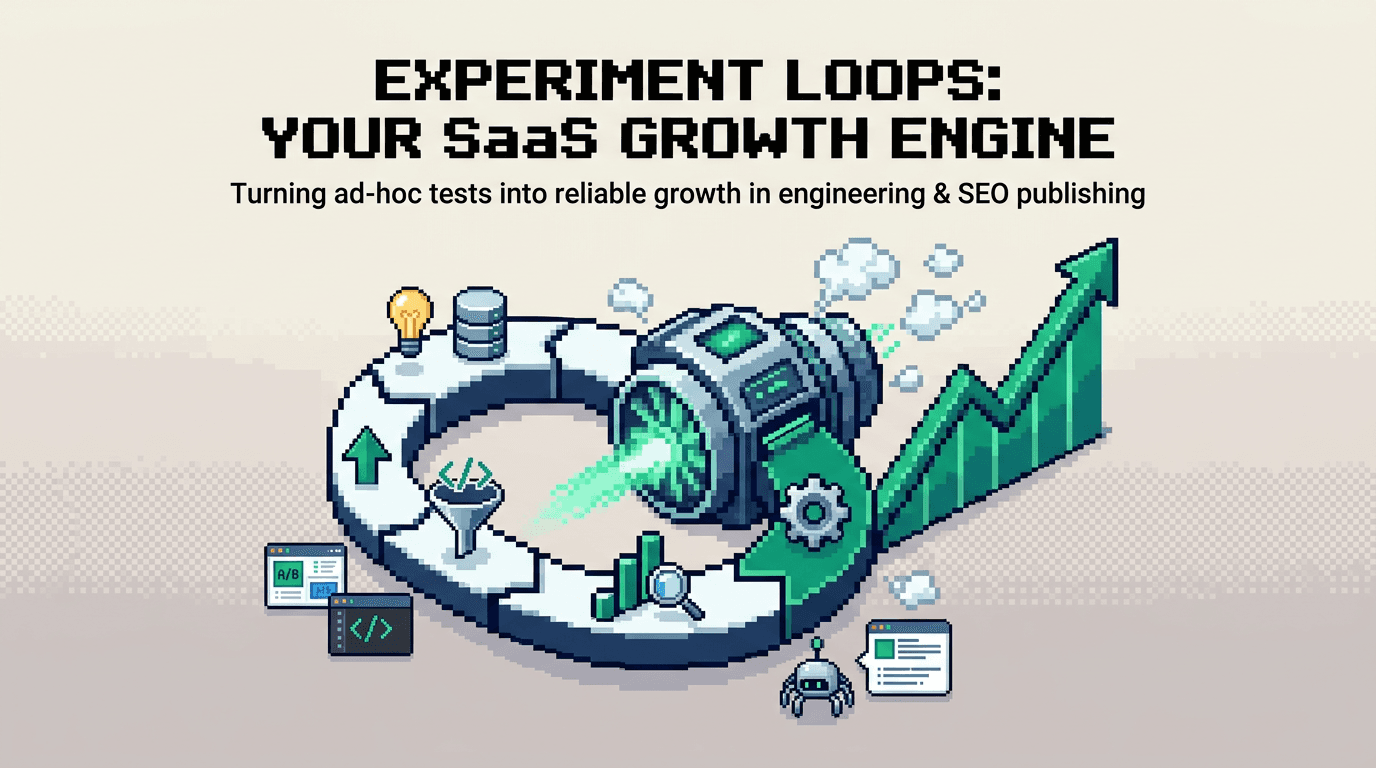
Product growth stalls when experiments are ad hoc. Experiment loops turn tests into a compounding system that ships learnings on a schedule.
This post shows operators how to design experiment loops that connect insights to code and distribution. It covers scope, workflow, automation, and metrics for technical teams. Key takeaway: a repeatable loop compounds impact across product, SEO, and go to market.
What an Experiment Loop Is and Why It Wins
A loop is a closed system that converts inputs into decisions and ships changes. Unlike sporadic tests, experiment loops reduce variance and increase signal quality.
Core components
- Inputs: hypotheses, user data, search demand, instrumentation gaps
- Process: prioritize, design, implement, ship, measure, archive
- Outputs: shipped changes, learnings, reusable assets
Loop properties
- Cadence: a fixed weekly or biweekly cycle
- Bounded scope: max WIP and time boxes per stage
- Evidence standard: pre agreed metrics and MDE thresholds
The Minimal Experiment Loop for Technical Teams
You can run this loop with a small product squad. Keep the steps stable and the artifacts lightweight.
Stage 1: Intake and triage
- Collect hypotheses from product analytics, support, and SEO opportunity models
- Score by reach, impact, confidence, effort (RICE)
- Enforce WIP: top 5 only advance to design
Stage 2: Design and guardrails
- Define user action, success metric, and MDE
- Pick method: AB test, switchback, pre post with synthetic control
- Write a test brief with acceptance checks
Stage 3: Build and instrument
- Add feature flags and event schemas
- Set exposure, assignment, and sampling rules
- Validate logging with canary traffic
Stage 4: Run and monitor
- Enforce minimum sample size and run length
- Track power, variance, and novelty effects
- Freeze scope until end criteria hit
Stage 5: Decide and ship
- Use pre registered decision thresholds
- If win: roll to 100 percent and document playbook
- If neutral or loss: archive learnings and add follow ups
Programmatic SEO Inside the Experiment Loop
Programmatic SEO benefits from controlled iteration. Treat each template and query model as a testable unit.
Inputs for SEO experiments
- Keyword universe from programmatic discovery
- SERP feature map by intent and device
- Crawl budget and render constraints for SSR React
Testable levers
- Template modules: H2 hierarchy, internal link blocks, related entities
- Query builders: facet ordering, synonym groups, long tail expansion
- Render modes: SSR for first paint, edge cache TTL, hydration timing
SEO Architecture and SSR React Considerations
Technical choices shape outcome sensitivity. Bake architecture decisions into the loop.
SSR React patterns that help
- Route level data fetching to precompute critical SEO fields
- Structured data components with strict schemas
- Static plus on demand revalidation for freshness
Failure modes to watch
- Client only components that delay content
- Inconsistent canonical and pagination signals
- Mis sized image assets that inflate CLS
Automation Workflows That Remove Manual Bottlenecks
Automate the loop steps that create delays. Keep humans on hypothesis and decision.
Intake and scoring automation
- Sync analytics anomalies into a backlog via webhook
- Auto score with rules based on reach and recent variance
- Flag duplicates and conflicts
Instrumentation and QA automation
- Generate tracking schemas from event DSL
- Lint experiments for exposure leaks and sample ratio mismatch
- Trigger canary dashboards on first 1k exposures
Distribution Loops for Faster Signal
Distribution affects experimental power. Ship a companion loop that increases qualified exposure.
Owned channel amplification
- Publish release notes that map to the experiment
- Route eligible users via in app prompts and email
- Use onboarding tours to surface the variant area
Search and social routing
- Update internal links to the tested templates
- Syndicate snippets to social to accelerate crawls
- Submit refreshed sitemaps after deploy
Execution Playbooks and Artifacts
Codify the loop into templates and checklists. Reuse them across experiments.
Required artifacts
- Experiment brief: hypothesis, metric, MDE, risks
- Implementation PR: flags, events, rollout plan
- Results memo: effect size, diagnostics, decision
Acceptance checks
- Event parity between control and treatment
- Stable assignment distribution by key segments
- No performance regressions in core vitals
Metrics That Matter and How to Compute Them
Choose metrics that tie to revenue and compound learning.
Primary and guardrail metrics
- Primary: activation rate, retention delta, qualified sessions
- Guardrails: error rate, latency p95, SEO impressions
- Diagnostic: click maps, query mix, content engagement
Estimation and diagnostics
- Use CUPED or pre period covariates to reduce variance
- Compute lift with stratification by device and cohort
- Investigate novelty decay and saturation windows
Governance, Risk, and Ethics in Experiment Loops
Good loops prevent p hacking and user harm. Set rules that hold under pressure.
Pre registration and evidence rules
- Lock hypotheses and metrics before launch
- Define stopping rules and peeking policies
- Require counterfactual reasoning in memos
User protection and fairness
- Exclude sensitive cohorts from risky tests
- Monitor disparate impact across segments
- Provide user opt out when treatments affect control
Tooling Stack Reference
Pick tools that integrate cleanly. Favor APIs and reproducibility.
Core stack
- Flags and rollouts: feature flag service with experimentation
- Analytics: event pipeline plus warehouse
- SEO monitoring: crawler, log analyzer, rank and GSC puller
Automation glue
- Orchestrator: scheduled workflows to move artifacts
- Linter: experiment schema checks in CI
- Dashboards: templated notebooks for analysis
Comparison: Experiment Platforms Fit by Use Case
Here is a concise view of common platform options for technical teams.
| Platform | Best for | Strengths | Limitations | Team size |
|---|---|---|---|---|
| Optimizely | Mature web AB | WYSIWYG, stats engine, flags | Cost, JS reliance | Mid to large |
| LaunchDarkly | Flags at scale | Robust SDKs, governance | Native stats basic | Mid to large |
| GrowthBook | Dev friendly | Open source, warehouse native | DIY setup | Small to mid |
| VWO | Marketing tests | UI tests, heatmaps | Limited backend focus | Small to mid |
| Homemade stack | Custom needs | Full control, cost control | Build and maintain | Any with devs |
Cadence, Roles, and RACI
Clarity on ownership speeds cycles. Limit stakeholders and define handoffs.
Cadence
- Weekly intake and decisions
- Rolling starts for build stage
- Monthly review of win rate and backlog health
Roles
- PM or operator: prioritization and decision log
- Dev lead: implementation and performance guardrails
- Analyst: design, diagnostics, and memo
Blueprint: 90 Day Experiment Loop Rollout
Use this plan to stand up a loop from zero.
Days 1 to 30: Foundations
- Define metrics, schemas, and logging standards
- Implement flags and event DSL
- Ship two low risk tests to validate pipeline
Days 31 to 60: Scale and SEO integration
- Add programmatic SEO templates to backlog
- Introduce SSR React checks in CI
- Run three concurrent tests with guardrails
Days 61 to 90: Optimize and automate
- Automate scoring and canary dashboards
- Publish public playbooks and internal wiki
- Set quarterly targets for win rate and TTL to ship
Failure Modes and Rollbacks
Expect misses. Pre plan exits that reduce blast radius.
Common failure modes
- Sample ratio mismatch and allocation drift
- Underpowered tests that never converge
- Confounded metrics due to seasonality
Rollback patterns
- Immediate kill switch on error or vitals breach
- Ramp down with backfills for SEO caches
- Postmortem with action items and owners
Reporting and Knowledge Compounding
Make learnings easy to find and reuse.
Reporting structure
- Single page memo with charts and SQL refs
- Tagged archive with taxonomy by lever and metric
- Quarterly digest that groups themes
Knowledge reuse
- Promote wins to default templates and components
- Package playbooks with code snippets
- Train new hires on top five experiments
The Bottom Line
- Experiment loops convert tests into a reliable shipping system.
- Programmatic SEO gains most when templates and queries are testable units.
- Automation workflows remove manual bottlenecks and improve data quality.
- Distribution loops accelerate exposure and statistical power.
- Governance and guardrails protect users and trust.
Close the loop, then turn the crank every week. Compounding starts on the second cycle.