
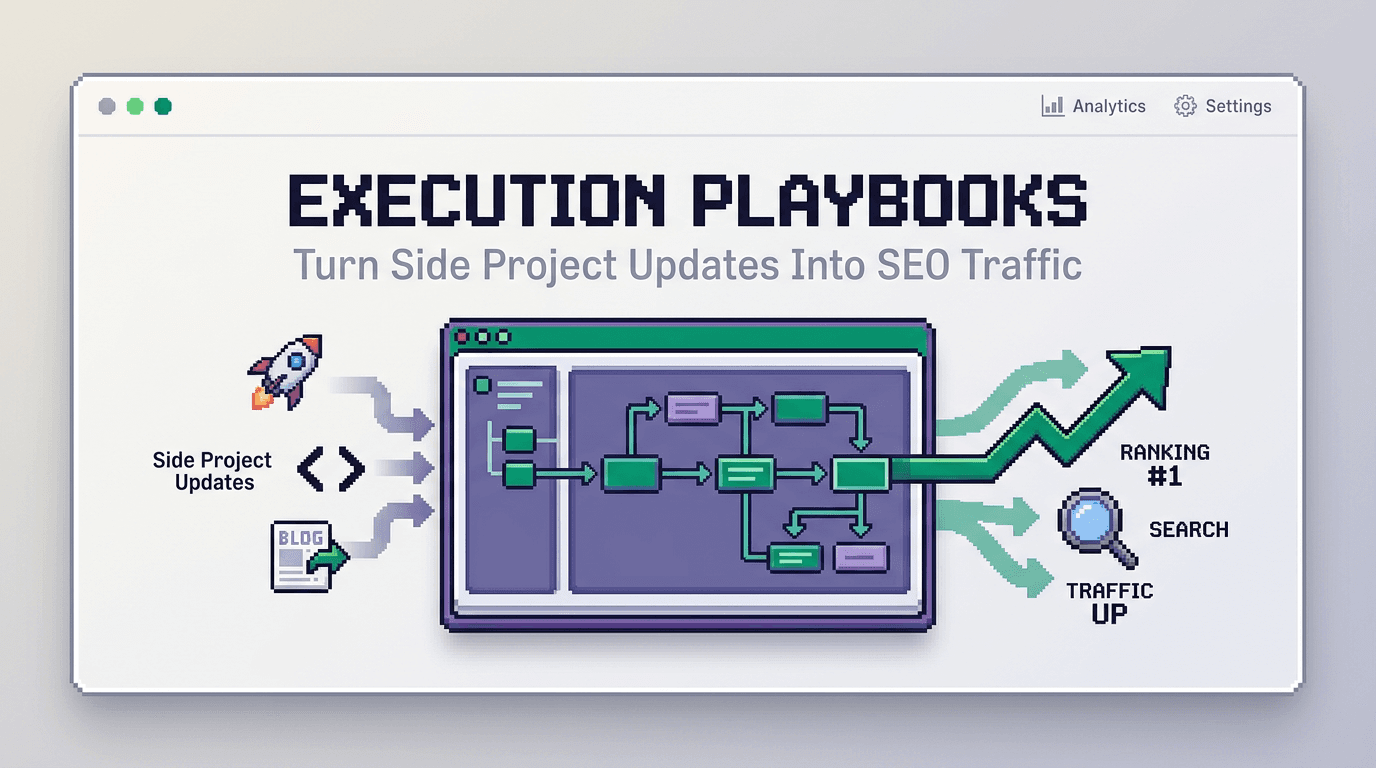
Side projects die in silence when updates never reach users. Execution playbooks convert your build notes into discoverable assets that compound.
This post shows product operators how to turn incremental side project updates into recurring SEO traffic using execution playbooks. You will get a repeatable system with programmatic SEO structure, automation workflows, and distribution loops. The key takeaway: ship a lightweight content pipeline that maps every code change to a searchable artifact and a distribution routine.
What an Execution Playbook Is and Why It Works
An execution playbook is a codified sequence that turns a trigger into outputs with owners, tools, and acceptance checks. For side projects, the trigger is a change event. The outputs are indexed pages, social snippets, and links.
Core components
- Triggers: commits, releases, issues closed, or feature flags toggled
- Inputs: PR description, changelog lines, screenshots, metrics deltas
- Process: enrich, templatize, publish, distribute, measure
- Outputs: scoped pages, feed items, and share objects
- Constraints: low overhead, reversible, observable
Why it compounds
- Consistency: every change becomes a discoverable URL
- Relevance: fresh content mapped to real product behavior
- Distribution: each artifact spawns channel-ready snippets
- Feedback: search queries reveal demand for next changes
Architecture: Map Updates to Programmatic SEO Surfaces
Programmatic SEO yields predictable, indexable pages at scale. You define a schema, generate routes, and keep editorial quality high.
Page types to template
- Changelog entries: one page per release with semantic fields
- Feature deep dives: canonical explainer per capability or integration
- How to articles: task oriented guides linked to features
- Comparison nodes: alternative methods and tradeoffs
- Issue learnings: postmortems or fixes for specific errors
URL and metadata schema
- Route pattern: /changelog/yyyy-mm-dd-title, /features/{slug}, /how-to/{task}
- Title pattern: {feature} update in {month yyyy} with {benefit}
- H2 blocks: problem, change summary, impact, steps, rollback
- Structured data: Article, Breadcrumb, and FAQPage when appropriate
- Canonicals: dedupe variants; ensure one primary per topic
SSR React SEO Setup for Fast Indexing
SSR React helps search engines parse content without hydration issues. Keep the stack simple and observable.
Rendering strategy
- SSR or SSG for all programmatic pages
- Incremental static regeneration for changelog routes
- Edge caching with short TTLs for freshness
Technical checklist
- Generate sitemap daily; include lastmod
- Preload critical CSS; avoid render blocking fonts
- Add Open Graph and Twitter tags for all pages
- Validate with Lighthouse and HTML validator
- Monitor indexation via Search Console API
Source of Truth and Content Enrichment
You do not write from scratch. You enrich structured inputs from your dev workflow.
Inputs to capture at commit or PR merge
- PR title and body
- Linked issue IDs and labels
- Before and after screenshots or GIFs
- Metrics delta if applicable: performance, accuracy, CTR
- Breaking change flags and migration notes
Enrichment rules
- Summarize in 2 sentences: what changed and why it matters
- Add one measurable impact or acceptance test
- Include one how to reproduce or activate section
- Link to docs, repo, and related features
Automation Workflows That Remove Manual Bottlenecks
Automate extraction, generation, and publishing. Keep human edits focused on accuracy.
Workflow overview
1) Event trigger: merged PR to main with label release-note
2) Extract fields: title, body, files changed, labels, linked issues
3) Generate draft: changelog markdown and feature note via templates
4) Human edit: product owner approves or adds details
5) Publish: push to CMS or repo and rebuild programmatic routes
6) Distribute: queue social, newsletter, and community posts
7) Measure: capture clicks, indexed status, and queries
Tools to wire
- GitHub or GitLab webhooks for events
- A small worker (Cloudflare Workers, AWS Lambda) for parsing
- Templates in your repo for deterministic output
- CMS or flat file publishing with CI
- Zapier, n8n, or custom scripts for distribution cues
Templates: Changelog and Feature Deep Dive
Templates reduce variance. Keep them short and scannable.
Changelog template (markdown)
- H2: What changed
- H2: Why it matters
- H2: How to use it
- H2: Impact and metrics
- H2: Rollback and known limits
- H2: Links and references
Feature deep dive template (markdown)
- H2: Problem
- H2: The approach
- H2: Setup and configuration
- H2: Performance and benchmarks
- H2: Edge cases and failure modes
- H2: Next steps and roadmap
Distribution Loops That Reinforce Search
Distribution loops push your artifacts into channels that drive links and demand. Pair organic search with direct reach.
Owned channels
- Newsletter: weekly digest of updates with benefits first
- In app feed: highlight relevant updates by user segment
- Docs changelog: cross link to feature pages
Earned and social
- Developer communities: share fixes and lessons in context
- X and LinkedIn: post the benefit and one metric
- Partner integrations: co announce for shared backlinks
Experiment Loops and Measurement
You must test titles, structures, and distribution order. Keep the loop tight.
Metrics to track
- Indexation rate per page type
- Clicks from search and top queries per artifact
- CTR deltas from title variants
- Time to publish from merge to live URL
- Conversion events tied to feature use after reading
Experiment cadence
- Weekly: title and meta description tests on 10 percent of pages
- Biweekly: test new H2 structure on changelog posts
- Monthly: add or prune a page type based on traffic share
- Quarterly: refactor schema and internal linking
Minimal Blueprint: System, Owners, Tools, Metrics
This blueprint compresses the above into a runnable plan.
System definition
- Goal: convert every meaningful update into SEO traffic and activation
- Scope: changelog, features, how to, and comparisons
- Constraints: under 2 hours of human time per week
Owners and roles
- Product owner: approve drafts and quality
- Developer: provide inputs and screenshots
- Growth engineer: maintain templates and automation
- Operator: run distribution and reporting
Tools and repos
- Repo: /content with templates and data files
- CI: build programmatic routes on commit
- Worker: webhook listener and generator
- Dashboards: Search Console, analytics, link tracker
Success metrics
- 80 percent of releases produce a page within 24 hours
- 60 percent indexation within 14 days
- 3 percent CTR on update pages for target queries
- 10 percent uplift in feature activation post update
Failure Modes and Rollbacks
Expect breaks. Plan rollbacks that keep quality high.
Common failure modes
- Thin pages with no unique value
- Duplicate titles across similar updates
- Broken SSR builds from malformed front matter
- Over posting to channels and fatigue
Rollback actions
- Merge duplicate updates into canonical feature pages
- Add disallow or noindex for low value fragments
- Validate content schema in CI to block bad deploys
- Reduce posting frequency and focus on top channels
Internal Linking and SEO Architecture
Link architecture boosts discovery and context. Use deterministic rules.
Linking rules
- Every changelog links to its parent feature page
- Feature pages link to 2 to 3 how to guides and comparisons
- How to guides link back to features and relevant changelog entries
- Add breadcrumb schema and visible breadcrumbs
Anchor text policy
- Use task oriented anchors like set up SSO in 3 steps
- Avoid repeating exact match across multiple links
- Keep anchors under six words when possible
Quality Control and Editorial Standards
Quality wins over volume. Formalize checks in code and in review.
Acceptance checks
- Each page states problem, change, and action in first 120 words
- At least one metric, screenshot, or code sample present
- Grammar and clarity pass; no passive voice in headlines
- Links resolve and canonical is set
Review cadence
- Daily bot run: broken links and sitemap freshness
- Weekly human pass: sample 10 percent of pages
- Monthly clean up: merge thin pages and refresh top performers
Comparison: Manual Updates vs Execution Playbooks
Here is a quick comparison to help teams choose their approach.
Manual updates vs systemized execution playbooks:
| Approach | Setup time | Weekly effort | Index consistency | Quality control | Scalability |
|---|---|---|---|---|---|
| Manual updates | None | High and variable | Low | Ad hoc | Poor |
| Execution playbooks | Low and finite | Low and predictable | High | Codified | Strong |
Example Pipeline With Tools
A concrete tool chain makes adoption easier. Swap equivalents as needed.
Event to draft
- GitHub webhook to Cloudflare Worker
- Worker parses PR payload and issues
- Worker writes markdown to /content/changelog
Draft to publish
- Git push triggers CI
- CI runs template validator and lints front matter
- SSG builds routes and updates sitemap
Publish to distribute
- After deploy hook posts to queue
- n8n flows format social cards and community posts
- Newsletter digest compiles top changes from the week
Owner Playbooks By Team Size
Map the same system to solo builders or small teams.
Solo builder
- One template for all updates
- Weekly batch publish
- Single distribution channel prioritized
2 to 5 person team
- Separate templates for changelog and features
- Rotate reviewer role weekly
- Two distribution channels maintained
Governance, Privacy, and Security Notes
Respect privacy and avoid leaking secrets through automation.
Guardrails
- Exclude sensitive file paths from diffs in public notes
- Strip tokens from logs and screenshots
- Maintain a private changelog for internal only updates
- Log all automation actions with user and timestamp
From SEO Traffic to Product Outcomes
Traffic is only step one. Tie visits to activation and retention.
Tie search to behavior
- UTM parameters on all internal links
- Feature flags that record activation after view
- Cohort analysis on users who read updates
- Survey prompts embedded in update pages
Maintenance and Cost Control
Keep costs low and performance high as content grows.
Cost levers
- Static hosting with CDN for most pages
- On demand image processing with caching
- Minimal serverless compute for webhooks
- Avoid heavy CMS unless truly needed
Performance levers
- Pre render above the fold
- Split long pages with table of contents and anchors
- Lazy load non critical images and embeds
Roadmap and Iteration Plan
Start small, then layer sophistication where impact is clear.
Phase 1: foundation
- One trigger, one template, one channel
- Basic sitemap and SSR
- Weekly reporting on indexation and clicks
Phase 2: expansion
- Add feature deep dives and comparisons
- Two title variants tested per week
- Introduce partner co announcements
Phase 3: optimization
- Query clustering to spawn new how to pages
- Automated internal links from entity graph
- Quarterly schema refactor and content refreshes
Fit for Technical SEO for Product Teams
This approach is built for operator bandwidth and technical stacks.
Why product operators benefit
- Minimal overhead with high signal
- Aligns engineering cadence with search cadence
- Clear ownership and measurable outcomes
Technical notes that matter
- SSR React plays well with programmatic SEO surfaces
- Automation workflows preserve accuracy with human edits
- Distribution loops compound reach over time
Key Takeaways
- Treat execution playbooks as the layer that converts changes into SEO assets
- Use programmatic SEO templates and SSR React for fast, reliable pages
- Automate extraction and publishing, then distribute with consistent loops
- Measure indexation, clicks, and activation to guide iteration
- Prune low value pages and refresh winners on a fixed cadence
Ship the system once, then let each update compound reach and learning.