
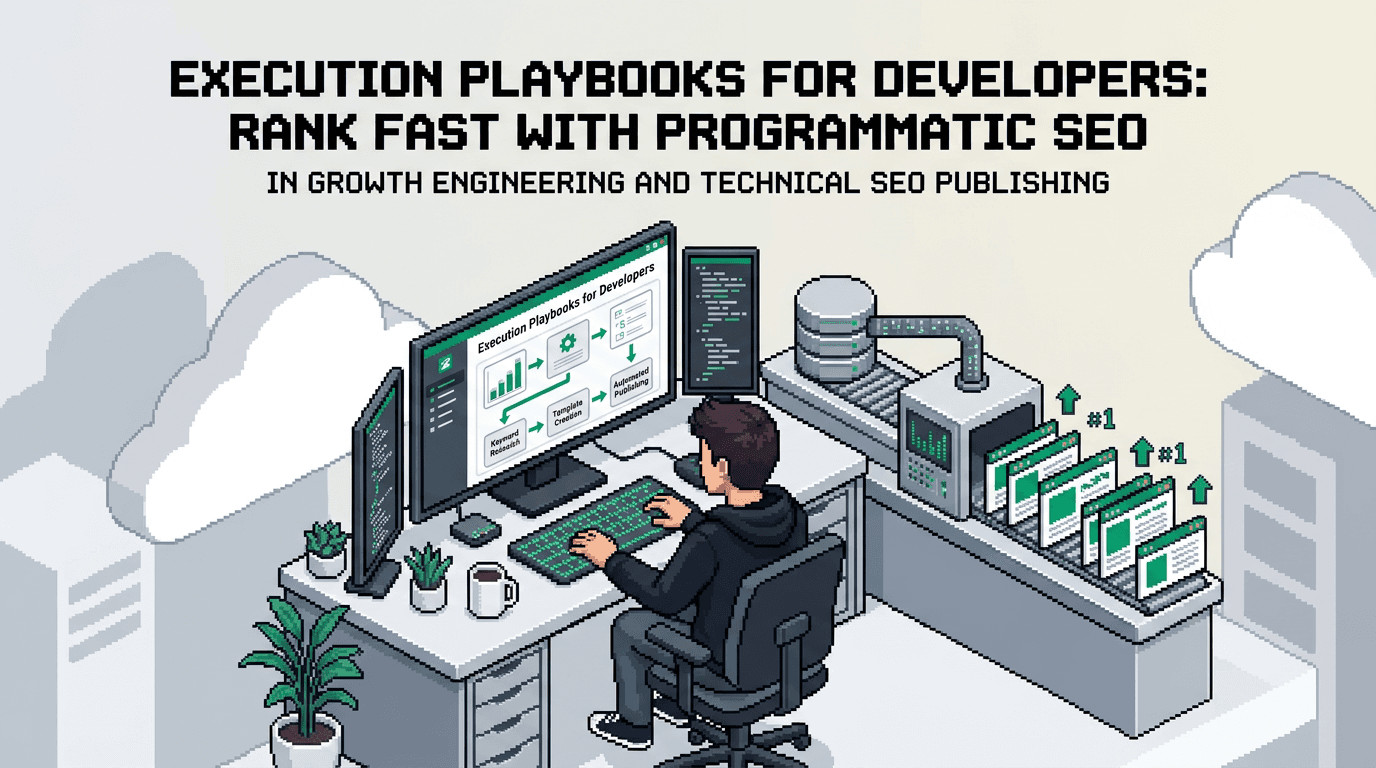
You can ship search growth like software. Start with a compact execution playbook, wire automation, and iterate weekly. This post shows how to operationalize programmatic SEO without bloat.
This guide covers execution playbooks for developers and product operators who want measurable organic growth. You will learn programmatic SEO architecture, SSR React content systems, automation workflows, distribution loops, and experiment loops. Key takeaway: build a small, testable pipeline first, then compound wins with automation and tight feedback.
Define the execution playbook and the north star
Set scope, metrics, and constraints before you touch code. This reduces rework and anchors tradeoffs.
Outcomes and guardrails
- Primary metric: qualified organic signups or demo requests.
- Secondary metrics: impressions, non-branded clicks, indexed pages, conversion rate from organic.
- Guardrails: max 5 content types, max 3 automation lanes, weekly iteration cadence.
- Constraints: 2 devs, 1 content operator, 6 weeks runway.
Acceptance criteria
- 100 programmatic pages shipped by end of week 3.
- Index coverage over 80 percent by week 5.
- At least one conversion per 1k organic sessions by week 6.
- Error budget: less than 1 percent broken pages in crawl.
Programmatic SEO architecture
Design a schema that maps product value to search demand. Keep the system transparent and testable.
Information model
- Entities: product features, use cases, industries, integrations.
- Attributes: problem statements, metrics, steps, FAQs, CTAs.
- Relationships: feature x solves use case y in industry z with integration i.
- Output templates: list pages, detail pages, comparisons, how to workflows.
Template blueprint
- URL pattern: /use-cases/{industry}/{use-case}/
- Title pattern: {Use Case} for {Industry}: {Feature}
- Meta pattern: Solve {Use Case} in {Industry} with {Feature}. Steps, tools, metrics.
- Body slots: intro, steps, code block, checklist, related links, CTA.
SSR React content system
Server render first paint for speed and crawl. Hydrate only where interaction adds value.
Rendering strategy
- SSR for all programmatic routes.
- Static for evergreen pages; ISR for data backed pages.
- Critical CSS inlined; defer non critical bundles.
- Canonicals on all variants; strict one URL per intent.
Component contracts
- <PageShell> handles head tags and schema.
- <EntityHeader> assembles title, summary, breadcrumbs.
- <Steps> takes ordered steps with timestamps.
- <Metrics> renders KPIs with JSON schema.
Automation workflows
Automate inputs and checks. Keep humans on narrative and acceptance.
Data intake lane
1) Pull seed entities from product docs and CRM.
2) Normalize entities to schema with a transform script.
3) Enrich with search data from the API.
4) Store in a versioned content registry.
Generation and QA lane
1) Generate drafts from templates with parameterized prompts.
2) Lint content for length, duplicates, and broken tokens.
3) Run a link resolver to ensure internal links exist.
4) Queue for editor review with diffs and warnings.
Distribution loops
Ship content where your users work. Close the loop with signals that improve rankings.
Owned channels
- RSS to email digest weekly.
- Docs cross links from relevant feature pages.
- Product in app tips pointing to how to pages.
External channels
- Developer communities with solution walkthroughs.
- GitHub README links for related repos.
- Partner marketplaces with structured listings.
Experiment loops
Run small tests with clear stop rules. Log results and roll forward wins.
Test design
- Hypothesis: adding step level code blocks improves time on page by 10 percent.
- Variant: enable code blocks on 50 percent of eligible pages.
- Duration: 14 days or 1k sessions per variant.
- Decision rule: adopt if metric lift is over 8 percent with p under 0.1.
Metrics and dashboards
- Crawl coverage and error trends.
- CWV: LCP, CLS, INP on programmatic pages.
- Indexation and query growth by template.
- Assisted conversions from organic.
Tooling and environment setup
Keep a minimal stack that a small team can maintain.
Repos and packages
- mono repo with apps web and jobs.
- Content registry in a versioned store.
- Shared types for entities and templates.
- E2E tests for core templates.
CI and release flow
- PR checks: type safety, unit tests, content lints, route diffs.
- Preview deploy per PR with password.
- Canary publish to 10 percent of routes.
- Full release after telemetry is clean.
Execution playbooks by phase
Work in three focused sprints. Each ends with a shippable artifact.
Sprint 1: foundation
- Deliver schema, templates, and SSR routes.
- Ship 20 pages to production.
- Baseline CWV and crawl.
Sprint 2: scale
- Automate data intake and draft generation.
- Expand to 100 to 200 pages.
- Start distribution loops.
Sprint 3: optimize
- Launch experiment loops on key levers.
- Improve internal links and related modules.
- Harden QA and error budgets.
Governance, quality, and risk
Guard quality with objective checks and a small editorial surface.
Editorial rules
- One intent per page. No near duplicates.
- Each page must show a specific workflow and metric.
- Plain language. Short sentences. Active voice.
Failure modes and rollbacks
- Thin pages: add steps and artifacts or remove from index.
- Crawl traps: tighten route matcher and add robots rules.
- Performance regressions: ship rollback tag and freeze deployment.
Comparative options for programmatic systems
Below is a quick comparison to help choose an approach based on team skills and goals.
| Approach | Pros | Cons | Best for | Complexity |
|---|---|---|---|---|
| SSR React custom | Full control, performance, typed content | Higher build cost | Product teams with dev capacity | High |
| Headless CMS plus static | Fast authoring, preview friendly | Limited control of routing edge cases | Content heavy teams | Medium |
| No code site builder | Speed to launch, low ops | Template limits, scaling pains | Early validation | Low |
Measurement and review cadence
Lock a weekly cadence to keep momentum and catch drift.
Weekly
- Ship count, index coverage, top crawl errors.
- Top queries by template, CTR shifts.
- Experiment status and next actions.
Monthly
- Organic conversions and assisted conversions.
- Template winners and deprecations.
- Roadmap re rank by impact versus effort.
Case blueprint to adapt
Use this as a minimal template to start. Replace placeholder names with your entities.
Inputs
- Entities: Integrations, Use Cases, Industries.
- Data: search volumes, related queries, internal conversion rates.
Process
1) Map Integrations to Use Cases per Industry.
2) Create template rules for title, meta, and steps.
3) Generate 100 pages with SSR and tight internal links.
4) Distribute to owned and external channels.
5) Run two experiments on engagement.
Team roles and RACI
Assign owners so decisions move fast.
Roles
- Tech lead: architecture, performance, release.
- Content operator: narrative, accuracy, tone.
- Data lead: search inputs, metrics, analysis.
RACI snapshot
- Schema: R tech lead, A head of growth, C content, I data.
- Templates: R tech lead, A growth, C content, I data.
- Generation: R content, A growth, C tech, I data.
Next actions in one day
Move from planning to shipping within 24 hours.
Checklist
- Define entities and pick two templates.
- Implement SSR routes and head tags.
- Generate and ship 10 pages.
- Set up crawl and performance dashboards.
Key Takeaways
- Start with a small execution playbook and strict acceptance criteria.
- Use programmatic SEO with SSR React to scale speed and quality.
- Automate intake and QA, then keep humans on narrative and intent.
- Close the loop with distribution and weekly experiment cycles.
- Measure conversions first, then optimize intermediate metrics.
Ship the first pages this week. Learn fast, then scale what works.