
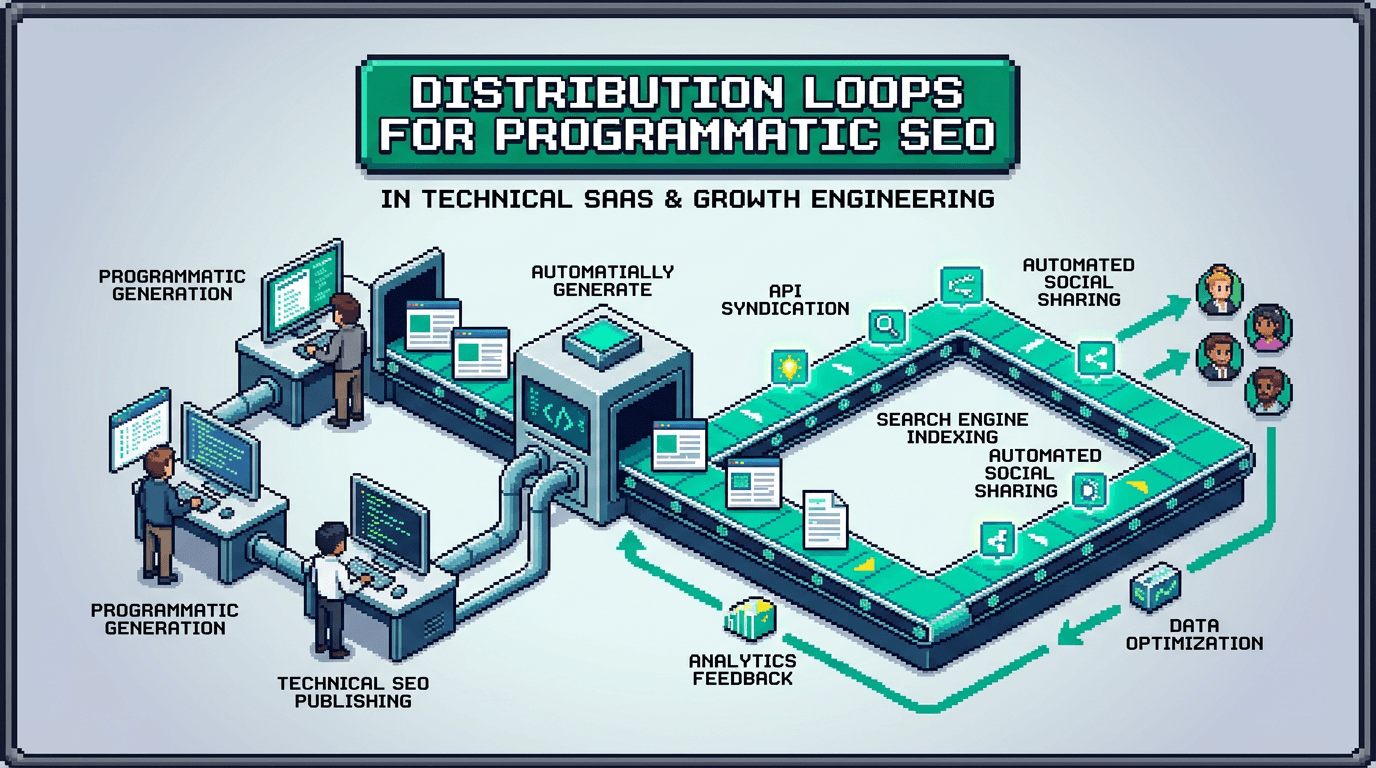
Technical SaaS growth stalls when content shipping depends on humans. Distribution loops convert a single build into repeatable reach. You design the system once, then scale.
This guide shows technical product teams how to build distribution loops with programmatic SEO, SSR React, and automation workflows. You will learn a practical architecture, a minimal schema, an execution pipeline, and acceptance checks. Key takeaway: treat content as data, automate transport, and let distribution loops compound discovery.
What distribution loops are and why they compound
Distribution loops are closed systems that turn each new asset into more reach with minimal marginal effort.
Core loop definition
- Input: structured content unit with canonical URL and metadata.
- Process: auto indexing, syndication, internal linking, and audience triggers.
- Output: visits, links, shares, and signals that feed the next iteration.
Properties of a good loop
- Deterministic: same input yields predictable distribution actions.
- Low entropy: few manual steps and clear owners.
- Observable: metrics flow to a single dashboard.
- Upgradable: swappable components without breaking the loop.
Why loops beat campaigns
- Always on. No reset between pushes.
- Compounding. Internal links and feeds grow addressable surface.
- Cheaper over time. Automation reduces marginal cost per page.
Programmatic SEO architecture for technical SaaS
Programmatic SEO turns schemas into pages that answer specific intents at scale.
Scope and constraints
- Audience: developers, operators, and technical buyers.
- Constraint: accuracy over volume. Avoid thin or duplicate intent.
- Goal: generate high intent pages that support docs, integration, and use case discovery.
Data model as the source of truth
Design a minimal schema that can produce pages, snippets, and feeds.
Example fields:
- entity_id, entity_type, name, slug
- problem_statement, solution_outline, code_sample
- integration_vendor, versions, compatibility
- metrics: difficulty_score, search_intent, freshness_ts
- seo: title, description, canonical, noindex_flag
Page types to generate
- Integration pages: Vendor x Your product how to guides.
- Comparator pages: Your approach vs common method, with benchmarks.
- Pattern pages: Jobs to be done with repeatable steps.
- Location or stack variants only when intent is unique and useful.
SSR React with Next.js and MDX
SSR improves crawl, renders metadata server side, and enables stable routes.
Routing and rendering strategy
- Use app router with file based routes.
- Generate static params from your content index.
- Prefer SSG with incremental regeneration for stable templates.
- Fallback to SSR for frequently changing data.
Pseudo code sketch:
// app/[entity_type]/[slug]/page.tsx
export const revalidate = 86400;

export async function generateStaticParams() {
  const docs = await contentIndex.list({ published: true });
  return docs.map(d => ({ entity_type: d.entity_type, slug: d.slug }));
}

export async function generateMetadata({ params }) {
  const doc = await contentIndex.get(params);
  return {
    title: doc.seo.title,
    description: doc.seo.description,
    alternates: { canonical: doc.seo.canonical },
    robots: doc.seo.noindex_flag ? 'noindex' : 'index,follow'
  };
}

export default async function Page({ params }) {
  const doc = await contentIndex.get(params);
  const MDX = await getMDX(doc.body_mdx);
  return <Article doc={doc}><MDX /></Article>;
}
MDX for modular content blocks
- Compose repeatable blocks: Callouts, Benchmarks, CodeBlock, CTA.
- Store block props in the schema and render from MDX shortcodes.
- Validate blocks in CI to avoid broken imports or missing props.
Performance and crawl controls
- Add preload hints for critical fonts.
- Ship image dimensions and next gen formats.
- Control indexation with robots and canonical fields in the schema.
Building the distribution loop
Your loop should ship every published page to all owned surfaces and syndication targets without manual steps.
Loop stages
- Publish: write to content index and trigger a build.
- Generate: build pages, sitemaps, RSS, and JSON feeds.
- Distribute: push to channels via webhooks.
- Observe: capture metrics and write back to the index.
- Reinforce: internal links and related blocks update automatically.
Minimal automation workflow
- Event: content.published
- Actions:
- Rebuild sitemap sections for the entity type.
- Post to Slack channel with deep link and key tags.
- Tweet or post to social via API with UTM.
- Submit URL to index via Indexing API where supported.
- Trigger newsletter queue if qualifies for threshold.
Example event contract:
{
  "event": "content.published",
  "entity_type": "integration",
  "slug": "vercel-deploy-previews",
  "title": "Deploy previews with Vercel",
  "intent": "how-to",
  "score": 0.78,
  "canonical": "https://example.com/integration/vercel-deploy-previews"
}
Internal linking as reinforcement
- Maintain a related_content index keyed by entity_type and tags.
- Rebuild link blocks when a new page enters the graph.
- Place links in two slots per page: mid body and end.
- Cap links to 5 per slot and exclude self or close variants.
Acceptance checks for loop health
- Sitemap delta equals published delta within 1 build.
- Index API return 200 for submission events.
- Feeds contain the latest 20 items per entity type.
- Internal link graph degree increases for new nodes.
Keyword selection and intent mapping
Distribution loops fail when intent is vague. Map each page to a defensible query cluster.
Inputs and constraints
- Pull seed terms from product taxonomy, integration partners, and logs.
- Constrain volume by difficulty and business fit.
- Prefer tasks and error strings over generic head terms.
Cluster method
- Normalize queries to canonical intents.
- Assign entity_type templates.
- Set acceptance thresholds: volume, CTR potential, solution uniqueness.
- Freeze slugs. Generate titles and descriptions from deterministic templates.
Title template example:
- Integration: {{task}} with {{vendor}} using {{product}}
- Comparator: {{approach_a}} vs {{approach_b}} for {{metric}}
- Pattern: How to {{job}} in {{framework}}
Editorial guardrails
- Each page must provide runnable steps or a testable outcome.
- Include a code or config sample when technical intent.
- Add version constraints and last verified date.
Execution playbook and roles
Define owners and SLAs. Keep the loop lean.
Team roles
- Owner: Growth engineer. Maintains schema and pipelines.
- Editor: Technical writer. Reviews accuracy and voice.
- Analyst: PM or ops. Monitors metrics and sends fixes.
- DevOps: Ensures CI, builds, and webhooks stay reliable.
Weekly cadence
- Ship 15 to 30 pages depending on data quality.
- Review anomalies: index gaps, 404s, template errors.
- Rotate one improvement: template CTR test or link model update.
Acceptance and rollback
- If build errors exceed 2 percent of pages, pause publish.
- If indexation rate drops below 60 percent in 7 days, submit batch to API and inspect robots.
- If CTR falls 20 percent week over week, test new titles on 10 percent sample.
Automation lanes to remove manual bottlenecks
Create lanes per action class. Each lane contains a trigger, job, and safeguards.
Lane 1: Feed generation
- Trigger: content.published
- Job: rebuild RSS, Atom, JSON feeds by entity_type.
- Safeguard: if feed validation fails, retry with previous snapshot.
Lane 2: Social syndication
- Trigger: content.ready_for_social
- Job: generate post copy from schema and MDX summary.
- Safeguard: profanity and length checks. Fallback to template.
Lane 3: Index submission
- Trigger: content.url_live
- Job: push to search indexing API where applicable, enqueue sitemap ping elsewhere.
- Safeguard: exponential backoff with dead letter queue.
Lane 4: Internal links refresh
- Trigger: content.graph_update
- Job: recalc related nodes using embeddings or rules.
- Safeguard: cap changes per deploy to limit churn.
Metrics and dashboards
Measure loop throughput, quality, and outcome. One dashboard per entity_type.
Throughput metrics
- Pages shipped per week
- Build duration and failure rate
- Time to live URL after publish event
Quality metrics
- Indexation rate by day 3 and day 7
- Lighthouse score buckets for new pages
- Link graph degree and clustering coefficient
Outcome metrics
- Clicks and CTR by template
- Assisted signups or trial starts by page type
- New referring domains per 30 days
Minimal SQL examples
Pages shipped:
select date_trunc('week', published_at) as wk, count(*)
from pages
where status = 'live'
group by 1
order by 1 desc;
Indexation rate:
select p.slug,
  max(case when gsc.indexed = true then 1 else 0 end) as indexed
from pages p
left join gsc_urls gsc on gsc.url = p.canonical
where p.published_at > now() - interval '7 days'
group by 1;
Comparison: distribution loop channels and fit
Use this matrix to decide where to automate first.
Here is a quick comparison of common channels and their automation fit.
| Channel | Effort to automate | Signal potential | Best for | Notes |
|---|---|---|---|---|
| Sitemap plus Index API | Low | High | New pages | Fast crawl and stable URLs |
| RSS to email | Medium | Medium | Dev audiences | Works with MDX summaries |
| Social posting | Medium | Low to Medium | Launches and updates | Needs templates and guardrails |
| Partner feed | Medium | High | Integrations | Requires vendor schema mapping |
| Internal link blocks | Low | High | All | Compounds discovery across site |
Common failure modes and fixes
Loops break silently. Add detection and quick fixes.
Thin or duplicate intent
- Fix: collapse clusters and redirect variants to a single canonical.
- Add: stricter acceptance criteria and similarity checks.
Build flakiness
- Fix: cache MDX compile step. Freeze content index versions per build.
- Add: circuit breaker that pauses publish on error spike.
Indexation gaps
- Fix: verify robots, canonical, and server status. Resubmit via API.
- Add: split sitemaps by entity_type for faster diffs.
Link graph stagnation
- Fix: rerun related content job. Seed links from top performers.
- Add: require 2 slots per page and monitor link degree.
Implementation blueprint in 30, 60, 90 days
Timebox delivery and review at each milestone.
Days 0 to 30: baseline loop
- Ship schema, Next.js scaffolding, and content index API.
- Generate SSG pages, sitemaps, and RSS.
- Automate internal link blocks with a rules based model.
- Dashboard throughput and indexation.
Days 31 to 60: scale and harden
- Add social and email lanes with templates.
- Implement Index API submissions and retries.
- Introduce template experiments for titles and CTAs.
- Add CI validators for schema completeness.
Days 61 to 90: optimize and expand
- Embed based related content. Improve link recommendations.
- Add partner feed syndication with mapping tests.
- Automate changelogs and docs to join the loop.
- Tie outcome metrics to signups and trials.
Case structure for technical SaaS pages
Make each page decisive and useful.
Required blocks per page
- Problem statement with inputs and constraints.
- Steps with commands or UI paths.
- Validation checks and expected output.
- Rollback instructions.
- Version and environment notes.
Example MDX snippet
<Callout title="Goal">Provision a sandbox on pull request</Callout>

### Steps
1. Add GitHub App with required scopes.
2. Configure preview environments in vercel.json.
3. Set secrets for API_URI and TOKEN.

<CodeBlock lang="json">{
  "github": {"autoJobCancelation": true},
  "env": {"API_URI": "https://api.example.com"}
}</CodeBlock>

<Benchmarks items="[{\"metric\":\"cold start\",\"value\":\"1.2s\"}]" />
Governance and quality gates
Do not let volume outpace quality.
Pre publish gates
- Lint schema completeness and MDX validity.
- Check for duplicate intent using embeddings or shingles.
- Validate titles and descriptions against templates.
Post publish gates
- Confirm indexation and performance budgets.
- Run link graph update and re render related blocks.
- Route anomalies to the owner with playbook steps.
Key Takeaways
- Build distribution loops once, then let automation ship every page.
- Use programmatic SEO with a strict schema and SSR for crawl stability.
- Wire feeds, social, and index APIs into a single event driven pipeline.
- Reinforce discovery with internal links and measurable experiments.
- Guard quality with acceptance checks, dashboards, and rollbacks.
Loops turn content into a system. Ship the system and let it compound.