
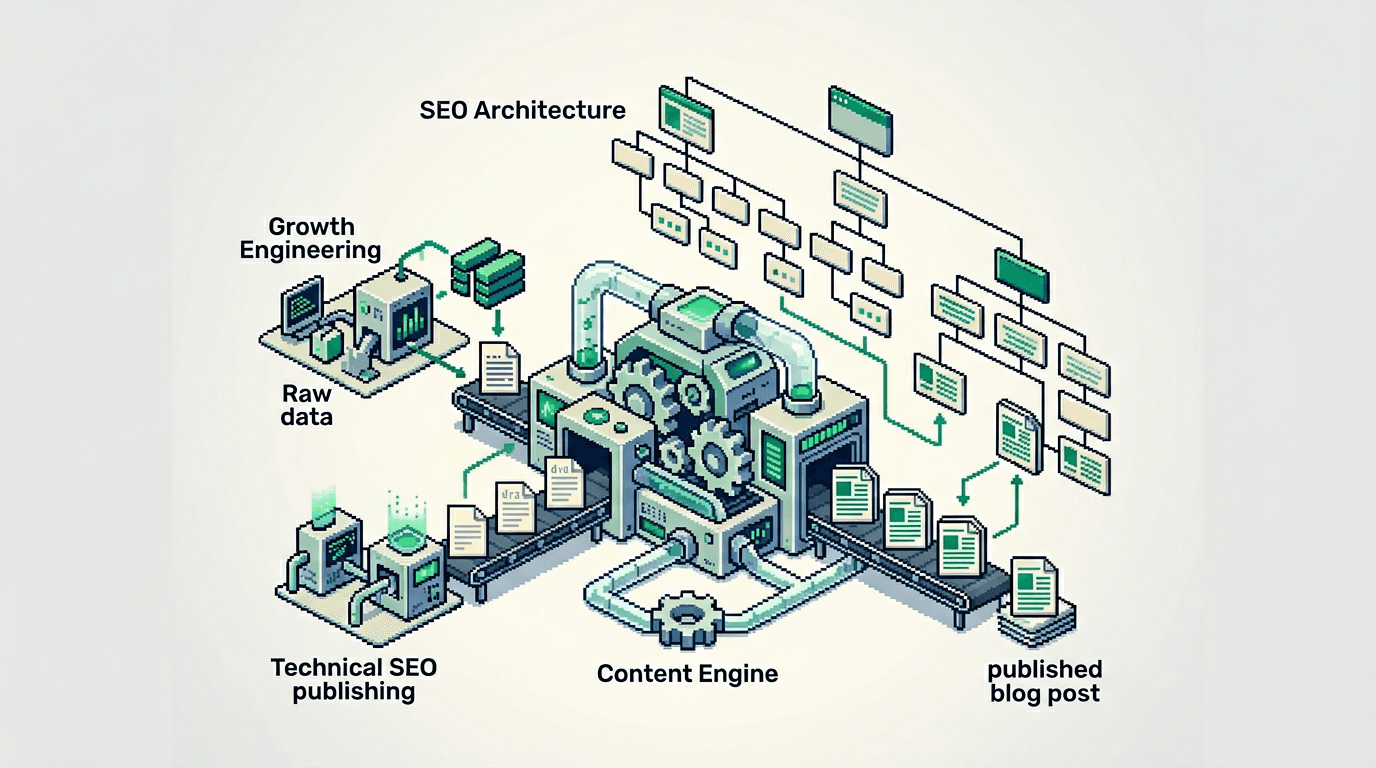
You cannot scale organic growth on opinions. You scale it with systems that turn inputs into ranked pages and measurable demand.
This guide shows technical product teams how to design a content engine that operationalizes SEO architecture. You will learn data models, automation workflows, SSR React patterns, distribution loops, and experiment loops. The key takeaway: treat SEO as a system with schemas, pipelines, and feedback, not as a queue of blog posts.
Define the SEO architecture for your SaaS
A clear SEO architecture aligns search intent, information design, and crawl paths with your product model.
Map intent to your product graph
- Inventory product entities: features, integrations, industries, use cases, personas.
- For each entity, map intents: informational, navigational, transactional, comparative.
- Define node types and edges. Example: Feature connects to Use Case and Integration.
- Produce a canonical URL pattern per node type. Keep slugs predictable and unique.
Choose page types and templates
- Core templates: feature pages, use case pages, integration pages, industry pages, comparison pages, glossary, playbooks.
- Assign query classes to templates. Example: comparison pages target vs queries.
- Specify required components: intro, benefits, specs, FAQs, CTAs, schema, internal links.
Establish internal link rules
- Parent to child: use case links to feature and integration.
- Sibling context: integration pages link to related integrations by platform.
- Hierarchy depth: keep critical money pages within three clicks from home.
- Add nav components: related articles, next steps, and upgrade paths.
Data model and content schema
Structure beats ad hoc writing. Create a source of truth that any tool or agent can use.
Define the content entity schema
- Fields: title, slug, meta, summary, H2s, sections, FAQs, pros and cons, specs, metrics, CTAs.
- SEO fields: primary keyword, secondary keywords, canonical, robots, structured data block.
- Ops fields: status, owner, review date, last refreshed, performance metrics.
Model relationships in a graph or relational store
- Option A: Neo4j for entities and edges; store content blocks as properties.
- Option B: Postgres with tables per entity type and junction tables for relations.
- Option C: Headless CMS with references; export to a data warehouse for analytics.
Create prompts and constraints for generation
- Guardrails: tone, target length, required H2s, link targets, brand phrases to include or avoid.
- Acceptance tests: keyword in first 100 words, at least two internal links, schema.org coverage.
- Failure modes to catch: duplicate slugs, empty sections, missing alt text, weak titles.
Automation workflows that remove bottlenecks
Build a minimal pipeline that turns inputs into reviewed, shippable pages with low manual effort.
Source and enrich opportunities
- Inputs: GSC queries, competitor gaps, docs, tickets, CRM notes, product taxonomy.
- Enrichment: cluster queries, map to entity types, score by potential and ease.
- Output: prioritized backlog with page type, primary keyword, supporting queries.
Generate first drafts with templates
- Use prompt templates tied to page type and schema.
- Insert structured facts from your data model. No hallucinated specs.
- Produce: outline, draft, internal link plan, meta, schema block.
Editorial and compliance checks
- Lint the draft: readability, banned words, passive voice threshold.
- Fact check: compare claims to product docs and pricing source.
- Legal review: claims, integrations, and trademark usage.
Ship and index monitoring
- Preflight: links resolve, canonical correct, schema validates, CLS under target.
- Deploy with SSR React and streaming to reduce TTFB.
- Monitor: indexation status, crawl rate, impressions, and rank shifts.
SSR React patterns for SEO at scale
Rendering determines crawl efficiency and content freshness for technical SaaS sites.
Rendering strategy selection
- SSR for indexable content with query demand and frequent updates.
- SSG for stable, long tail pages that change rarely.
- ISR for catalogs that update daily with minor diffs.
- Client components only for non indexable UI.
Routing, slugs, and canonical logic
- One canonical per entity. Redirect alternates to canonical.
- Derive slug from name plus disambiguator. Example: /integrations/slack-chatops.
- Encode locale in path, not query. Use hreflang when localized.
Performance budgets and metrics
- TTFB under 200 ms on cache hit, under 600 ms on miss.
- LCP under 2.5 s on mobile with real user monitoring.
- CLS under 0.1. Avoid layout shifts from images and ads.
- Measure with Web Vitals and Search Console.
Structured data and componentization
- Use schema.org: Product, SoftwareApplication, FAQPage, HowTo where relevant.
- Wrap components with data attributes to generate JSON-LD at render.
- Validate with the Rich Results Test in CI.
Distribution loops that compound reach
Publishing is step one. Distribution unlocks compounding effects.
Owned distribution
- Email digest: ship new pages weekly with clear CTAs.
- In-app education: surface relevant docs and pages by feature usage.
- Docs cross linking: link from API or guides to SEO pages and back.
Earned and partner distribution
- Partner integration pages: co-marketed content with reciprocal links.
- Community posts: concise summaries with canonical links.
- Digital PR: pitch data studies derived from your product telemetry.
Paid amplification for data and lift
- Use paid to gather early engagement data on new templates.
- Promote cornerstone pages to seed links and mentions.
- Cap spend with target CPC and quality thresholds.
Experiment loops and measurement
Iterate with small, testable changes tied to search outcomes.
Hypothesis design
- Template change example: add comparison table to integration pages.
- Expected outcome: CTR up 0.5 points, time on page up 10 percent.
- Guardrails: no index drop, no CLS increase.
Test execution
- Split by section variant or by page cohort.
- Run for two index cycles or until power threshold met.
- Track confounders: seasonality, deployments, competitor moves.
Metrics and dashboards
- Leading: impressions, average position, crawl requests.
- Lagging: clicks, assisted signups, pipeline created.
- Quality: scroll depth, copyable code interactions, doc referrals.
Execution playbooks and ownership
Define who does what, when, and with which tools.
Roles and RACI
- Growth engineer: owns pipeline, rendering, metrics.
- Content lead: owns editorial standards and briefs.
- PMM: owns positioning and claims.
- Rev ops: connects content to CRM outcomes.
- Legal: approves risk areas.
Weekly cadence
- Monday: backlog triage and scoring.
- Tuesday: draft generation and edits.
- Wednesday: QA, schema checks, performance tests.
- Thursday: ship and distribute.
- Friday: review dashboards and decide next tests.
Tooling stack
- Headless CMS or Git based content with MDX.
- Data warehouse for GSC, analytics, CRM.
- CI that lints content and validates schema.
- Orchestration with queued jobs and webhooks.
Minimal blueprint to launch in 30 days
Day 1 to 7
- Build entity model for features, integrations, and use cases.
- Select page templates and define required fields.
- Stand up SSR React routes for three templates.
Day 8 to 14
- Create prompt templates and acceptance tests.
- Ingest GSC and competitor data. Cluster and score.
- Generate ten draft pages. Run editorial checks.
Day 15 to 21
- Wire JSON-LD and meta logic into components.
- Add internal link modules and breadcrumbs.
- Ship five pages. Monitor crawl and index.
Day 22 to 30
- Add distribution: email, partner, community.
- Launch first template experiment.
- Review metrics. Plan next month backlog.
Example internal linking map
Design a repeatable pattern. Avoid dead ends and orphan pages.
Feature page links
- Up: product overview, pricing, case studies.
- Across: related features and use cases.
- Down: docs, guides, API references.
Integration page links
- Up: integrations hub, solution overviews.
- Across: competitor integrations by category.
- Down: setup guides and troubleshooting.
Programmatic SEO guardrails for quality
Automation accelerates scale. Guardrails preserve trust and rankings.
Content quality controls
- Cite only internal sources or verified partner docs.
- Ban superlatives without proof. Link to evidence.
- Require examples, code, or step lists for every how to.
Index management
- Noindex low confidence drafts and thin variants.
- Use canonical for close duplicates across locales.
- Block facets and UTM parameters in robots.
Refresh rules
- Refresh when impressions drop 20 percent over 28 days.
- Refresh after product changes or pricing updates.
- Rotate updates so no key page ages beyond 120 days.
Tool comparison for content engines
The table below compares common platform choices for a technical SEO content engine.
| Option | Strengths | Risks | Best fit |
|---|---|---|---|
| Headless CMS | Editorial UI, roles, webhooks | Rigid modeling, vendor limits | Large teams with mixed skills |
| Git plus MDX | Version control, dev friendly | Non writers struggle, preview needed | Eng teams and technical content |
| Static site generator | Speed, cheap deploys | Rebuild cost at scale | Docs and long tail catalogs |
| SSR React framework | Dynamic data, streaming | Infra complexity | Product led blogs and app embedded SEO |
Governance, risk, and compliance
SEO touches claims, trademarks, and data privacy. Build review lanes.
Claims and comparisons
- Substantiate claims with links to docs or benchmarks.
- Use neutral language for competitor comparisons.
- Keep a changelog of claims with review dates.
Privacy and telemetry
- Anonymize product telemetry used in case studies.
- Provide opt out where regions require it.
- Align event naming between product and content analytics.
Reporting that business leaders trust
Translate search metrics into revenue language.
Attribution and revenue linkage
- Tag CTAs with journey stage. Map to CRM campaigns.
- Attribute assisted pipeline to top of funnel pages.
- Report net new logos influenced by search content.
Executive dashboard
- North stars: qualified organic signups, pipeline, and payback.
- Drivers: ranking coverage by intent and entity type.
- Risks: index decay, content debt, and SERP volatility.
Common failure modes and rollbacks
Anticipate breaks. Predefine corrections.
Failure modes
- Template change tanks CTR across a cohort.
- Navigation update increases CLS on mobile.
- Auto linking creates loops or spammy patterns.
Rollbacks
- Keep feature flags per template and component.
- Maintain previous schema and meta versions.
- Auto revert on metric guardrail breach.
Key Takeaways
- Treat SEO architecture as a system with schemas, templates, and links.
- Use automation workflows to draft, check, and ship content safely.
- Choose SSR React patterns that balance crawlability and speed.
- Run distribution and experiment loops to compound results.
- Tie reporting to pipeline and payback to earn buy in.
A content engine built on SEO architecture scales reliably, adapts quickly, and compounds growth for technical SaaS teams.