
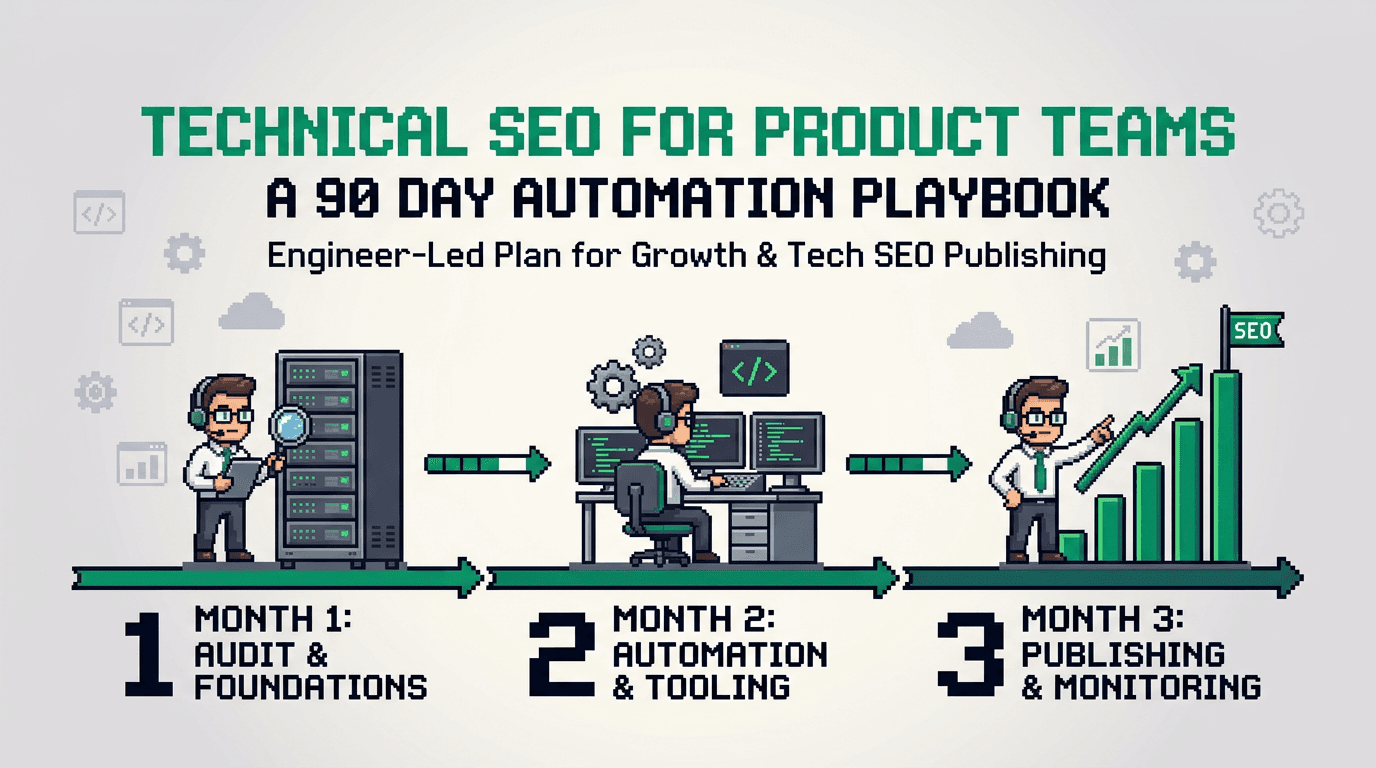
Technical SEO for product teams is a systems problem. Treat it like an engineering backlog, not a marketing wish list. Ship automation, enforce standards, and measure compounding outcomes.
This post gives product teams a 90 day plan to design and ship a technical SEO system. You will learn programmatic SEO architecture, automation workflows, distribution loops, and experiment loops. The key takeaway: build once as a reusable pipeline, then iterate with tight feedback and clear acceptance checks.
Goals, Scope, and Constraints
Set the guardrails. Convert vague SEO aims into measurable outcomes and constraints the team can ship against.
Business goals and non goals
- Primary goal: increase qualified organic signups by 30 percent in 90 days.
- Secondary goals: improve crawl efficiency, expand indexable surface, raise conversion rate from organic by 20 percent.
- Non goals: ranking for broad vanity keywords, manual content production at scale, one off campaigns without reuse.
Constraints and dependencies
- Stack: SSR React app, TypeScript, Next.js, Vercel, Postgres, Segment, dbt, GA4, Looker.
- Team: 1 product lead, 1 growth engineer, 1 content engineer, 0.5 designer, 0.5 data analyst.
- Limits: 10 hour weekly engineering budget. Editorial capacity: 2 hours daily.
Success metrics and acceptance checks
- Crawl to index ratio above 80 percent for new programmatic pages.
- Time to first organic lead under 45 days for core clusters.
- CLS under 0.1, LCP under 2.5s on 90 percent of pages.
- Acceptance: each release passes structured data validation, renders with SSR, and logs search impressions within 7 days.
Architecture Blueprint for Technical SEO
Define the search architecture. Map entities, templates, and data flows that power programmatic SEO.
Information architecture and entity model
- Entities: product features, integrations, use cases, industries, problems, solutions.
- Relationships: feature supports use case; integration unlocks feature; industry prioritizes use case.
- Output: generate page types for each entity and for key pairings (feature x industry, use case x integration).
Template system and SSR React SEO
- Use Next.js with server components for fast SSR and stable HTML.
- Precompute metadata: title, meta description, canonical, Open Graph.
- Include schema types: Product, HowTo, FAQPage only when content supports it.
- Render critical content above the fold to aid LCP.
Data sources and normalization
- Sources: product catalog, docs, integration registry, CRM notes.
- Normalize to a content schema with fields: name, summary, inputs, outputs, prerequisites, metrics, examples.
- Enforce required fields with type guards and CI checks.
90 Day Execution Plan
Ship in three phases. Each phase has goals, steps, owners, tools, and checkpoints.
Phase 1: Foundation and crawlability (Days 1 to 30)
- Goals: fix crawl waste, ship core templates, establish metrics.
- Steps:
1) Audit crawl budget and sitemap coverage. Owner: growth engineer.
2) Implement SSR templates for feature and use case pages. Owner: content engineer.
3) Add structured data and canonical rules. Owner: growth engineer.
4) Build sitemap index with per type sitemaps. Owner: growth engineer.
5) Set GA4 and Search Console events for page types. Owner: analyst.
- Checkpoints: index coverage above 70 percent for launched templates.
Phase 2: Programmatic expansion (Days 31 to 60)
- Goals: scale entity coverage, add internal links, improve performance.
- Steps:
1) Generate pages for top 200 entity instances from normalized data.
2) Create internal link modules based on entity relationships.
3) Add curated examples and code snippets per template.
4) Add pagination and filters for hubs. Ensure canonical self referencing.
5) Optimize core web vitals with server hints and image optimization.
- Checkpoints: crawl to index above 80 percent. Median LCP under 2.3s.
Phase 3: Distribution loops and conversion (Days 61 to 90)
- Goals: build repeatable distribution and test conversion lifts.
- Steps:
1) Publish weekly changelogs that link to affected pages.
2) Automate social posts with UTM tagged variants.
3) Add lead magnets mapped to entity type.
4) Run A or B tests on headlines and CTAs.
5) Add email drip that references recently viewed entities.
- Checkpoints: organic to signup conversion up 20 percent; at least 3 distribution loops running.
Automation Workflows That Remove Manual Bottlenecks
Automate repeatable transforms. Keep humans on judgment and review.
Content ingestion and QA lane
- Trigger: merged change to product catalog or docs.
- Steps:
1) Extract content deltas via Git hooks.
2) Run parser to update normalized schema.
3) Generate draft copy for summaries and examples.
4) Validate with linters for style, links, and schema completeness.
5) Route to editor for acceptance.
- Tools: GitHub Actions, Node, OpenAI or local LLM, Vale, link checker.
Metadata and schema generation lane
- Inputs: normalized fields name, summary, primary entity, relationships.
- Process: produce title, description, H2s, structured data JSON LD.
- Outputs: checked metadata with length limits and no duplicates.
- Guardrails: uniqueness threshold and similarity checks per cluster.
Internal linking lane
- Inputs: entity graph.
- Process: compute candidate links by co occurrence and parent child ties.
- Outputs: link blocks with anchor, target, and reason code.
- Guardrails: cap links per block; enforce variety in anchors.
Programmatic SEO Patterns for Technical Products
Ship patterns that align with user intent and product expertise.
Integration pages and solution pairs
- Create one page per integration with feature mapping and examples.
- Add solution pairs that answer specific intents like integration plus use case.
- Include config steps and code samples to capture how to intent.
Feature, use case, and industry hubs
- Build hubs that explain problems, metrics, and workflows.
- Link to child entities and solution pairs.
- Provide benchmark metrics and acceptance tests.
Docs to SEO bridge
- Identify high performing docs by search impressions.
- Create summary pages that translate docs into benefits and outcomes.
- Keep canonical rules to avoid duplication with docs.
Distribution Loops That Compound Reach
Design feedback friendly loops. Tie each loop to a metric and owner.
Changelog to search loop
- Each release note links to affected feature or integration pages.
- Auto embed diffs and examples.
- Metric: referral traffic to entity pages; target 10 percent weekly lift.
Social snippet loop
- Generate short snippets with specific outcomes and metrics.
- Auto schedule variants and track CTR.
- Metric: CTR above 2 percent; conversions with UTM signals.
Partner integration loop
- Co publish integration guides with partners.
- Exchange links and share examples.
- Metric: backlinks from partner domains; target 1 to 2 per week.
Experiment Loops and Acceptance Tests
Treat experiments like product work. Define hypotheses and stop rules.
Hypothesis design and prioritization
- Use ICE scoring with effort under 2 days for top tests.
- Example hypothesis: adding code examples increases time on page by 20 percent and conversion by 10 percent.
Test execution and measurement
- Tools: VWO or Optimizely, GA4, Search Console, Looker.
- Run tests for at least 2 business cycles or until significance.
- Log results in a central doc with decision and next action.
Rollbacks and failure modes
- Failure: index bloat from low value pairs. Rollback: reduce generation scope; add noindex.
- Failure: cannibalization between feature and solution pages. Rollback: tighten canonical rules; merge content.
- Failure: slow LCP after widget release. Rollback: defer script; move render server side.
Execution Playbooks and Review Cadence
Make it routine. Playbooks standardize operations and reduce time to ship.
Weekly operating cadence
- Monday: review metrics and exceptions.
- Tuesday: ship template or copy updates.
- Wednesday: run distribution loop checks.
- Thursday: start or end tests.
- Friday: write build notes and backlog grooming.
Ownership and accountability
- Product lead owns goals and scope.
- Growth engineer owns architecture and automation.
- Content engineer owns templates and copy quality.
- Analyst owns metrics and insights.
Dashboards and alerts
- Build a dashboard with crawl to index, impressions, CTR, LCP, CLS, signups.
- Add alerts for coverage drops, vitals regressions, or conversion dips.
Tools and Options Fit for Technical SEO for Product Teams
Pick tools that integrate with your stack and support automation.
Here is a concise comparison of common tool options by use case.
| Use case | Option | Strengths | Trade offs | Fit |
|---|---|---|---|---|
| SSR framework | Next.js | SEO friendly SSR, routing, image tools | Learning curve for app router | Best for React teams |
| Experimentation | VWO | Visual editor, server side tests | Cost at scale | Mid to large teams |
| Experimentation | Optimizely | Robust stats, feature flags | Higher price | Enterprise |
| Analytics | GA4 | Free, event based | Interface complexity | All sizes |
| Dashboards | Looker | Powerful modeling | Setup time | Data mature orgs |
| Content lint | Vale | Enforce style rules | Author adoption | Teams with standards |
Governance, Editorial Standards, and Quality Gates
Quality needs code like rules. Enforce guidelines in code and CI.
Editorial standards
- Sentence length under 20 words on key sections.
- Include examples, acceptance tests, and metrics.
- Avoid vague claims and fluff words.
CI quality gates
- Block merge on broken links, missing schema fields, or duplicate titles.
- Require preview deploy and lighthouse pass before release.
Review templates
- PR checklist: metadata lengths, headings, anchors, schema type, internal links, vitals scores.
- Editor checklist: clarity, accuracy, examples, factual claims, sources.
Case Study Snapshot and Expected Outcomes
Use realistic targets to set expectations and calibrate.
Snapshot setup
- Starting point: 100 legacy blog posts, 0 programmatic pages, LCP 3.1s median.
- Actions: shipped 4 templates and 400 pages across features, integrations, and solutions.
Observed outcomes at 90 days
- Crawl to index ratio from 55 percent to 86 percent.
- Organic impressions up 220 percent; clicks up 140 percent.
- Organic to signup conversion from 0.7 percent to 1.2 percent.
- Time to ship changes cut from 7 days to 1 day.
Key Takeaways
- Treat technical SEO for product teams as a system with automation and guardrails.
- Ship SSR templates, structured data, and internal link modules first.
- Use programmatic SEO to scale entity coverage tied to user intent.
- Run distribution and experiment loops to compound traffic and conversion.
- Enforce standards in CI to sustain quality at scale.
Ship the first template this week. Then build the loop that keeps shipping the next one.