
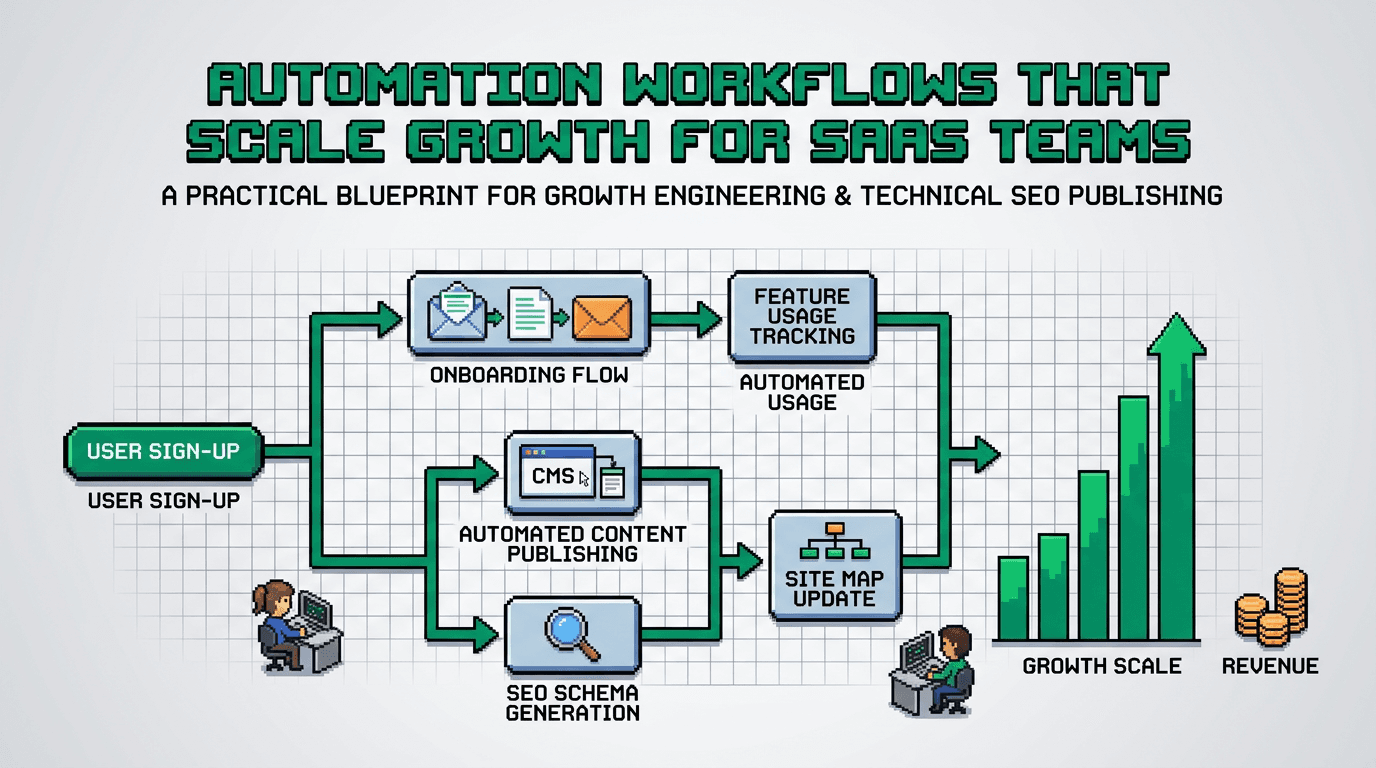
Your team ships fast, but manual handoffs throttle growth. Automation workflows convert recurring tasks into reliable systems that run daily without meetings or pings.
This post shows technical product teams how to design automation workflows that remove bottlenecks across SEO, distribution, and experiment loops. You will get a practical architecture, step by step build, tooling choices, and acceptance criteria. Key takeaway: define inputs and outputs, orchestrate with events, and measure the loop, not the task.
The case for automation workflows in growth ops
Automation increases cycle speed and reduces variance. You get consistency, observability, and recoverability.
Where manual work blocks compounding growth
- Content briefing and QA slow shipping.
- UTM governance breaks attribution.
- Slack reminders replace real scheduling.
- Analysts manually stitch dashboards.
- Engineers gate deployments on ad hoc checks.
What good looks like
- Triggers drive work, not calendars.
- Each lane has clear inputs, transforms, and outputs.
- Failures alert with context and a rollback path.
- Metrics track loop health, not task volume.
Blueprint: design automation lanes end to end
Treat each lane like a pipeline. Define contracts. Automate orchestration. Instrument every edge.
Define inputs, transforms, outputs
- Inputs: source systems, schemas, cadence.
- Transforms: validation, enrichment, decisions.
- Outputs: artifacts, destinations, owners.
Write this contract as code. Store in a repo next to the workflow.
Example contract:
lane: seo_programmatic_publish
inputs:
  - source: cms.posts
    schema: post_id, slug, topic, status, publish_at
transforms:
  - validate: required(slug, topic)
  - enrich: nlp_keywords, internal_links
  - decide: publish_if(window_ok and qa_pass)
outputs:
  - dest: web.ssr_queue
  - dest: analytics.events(topic, keywords)
owner: growth_ops
sla_minutes: 30
Choose orchestration and state
- Lightweight: GitHub Actions or n8n for simple lanes.
- Robust: Airflow or Temporal for retries and long runs.
- State: Postgres for contracts and runs; S3 or GCS for artifacts.
Guardrails and rollbacks
- Idempotent steps with run IDs.
- Circuit breakers on error thresholds.
- Rollback hooks that undo side effects.
Programmatic SEO lane: from brief to publish
Programmatic SEO scales intent coverage with templates and data. The lane enforces quality and speed.
Architecture overview
- Data source: topics, entities, SERP features, intents.
- Template system: SSR React components with slot rules.
- Content generator: human curated blocks with AI assist.
- QA gates: linting, fact checks, link graph checks.
- Delivery: SSR queue and CDN purge.
Build the input dataset
- Pull entities from your product taxonomy.
- Join with search data: volume, difficulty, intent.
- Add internal demand: support tickets, win/loss notes.
- Store a canonical table: topic_id, slug, intent, priority.
Template and component rules
- One template per intent pattern.
- Components: intro, explainer, how to, code, table, FAQ extract.
- Slot rules bind components to fields with acceptance checks.
const HowTo = ({steps}:{steps:string[]}) => (
  <ol>{steps.map(s => <li key={s}>{s}</li>)}</ol>
)
QA automation
- Lint titles for length and keyword placement.
- Validate links: 200 status, canonical direction, depth limits.
- Check factual claims against source tables.
- Flag duplicate intent within three clicks.
Orchestration example
with DAG('pseo_publish', schedule='hourly') as dag:
    t1 = pull_topics()
    t2 = render_ssr(t1)
    t3 = qa_checks(t2)
    t4 = publish_ok(t3)
    t5 = cdn_purge(t4)
SEO architecture for SSR React
SSR React can serve fast, crawlable pages at scale. The system must preserve crawl budgets and render stability.
Routing and crawl control
- Stable routes: /guides/{topic}/{variant}
- XML sitemaps per collection with lastmod.
- Robots rules for preview variants.
- Canonicals for template siblings.
Performance and rendering
- Precompute data for static segments.
- Stream SSR with partial hydration.
- Defer non critical scripts.
- Add server hints and cache tags for purges.
Structured data and internal links
- Inject schema.org types per template.
- Build a rules based link graph: parent, siblings, next steps.
- Limit on page link count to preserve weight.
Distribution loops that do not rely on hero posts
Distribution should be a predictable loop, not a one off campaign.
Core loop design
- Trigger: publish event from CMS.
- Transform: create channel native snippets.
- Output: schedule to channels with UTMs and deep links.
Channel adapters
- LinkedIn: post copy under 120 words with 1 stat.
- X: 2 tweet thread with hook and takeaway.
- Email: two paragraph summary and three links.
- Communities: value first blurb with repo link.
Governance and feedback
- Enforce UTMs and message IDs.
- Capture click and session metrics by message ID.
- Feed back winners to templates.
Experiment loops connected to automation workflows
Use automation to run tests that learn fast and avoid noise.
Hypothesis registry
- Store H, metric, expected lift, sample size, owner.
- Link to the lane that executes the change.
Experiment orchestration
- Toggle flags per variant.
- Queue exposure events to analytics.
- Stop when power criteria met or budget spent.
Analysis and decisions
- Predefine stats method and guardrails.
- Ship learnings as playbook diffs, not slides.
Execution playbooks and runbooks
Write playbooks like code. The goal is safe execution by any operator.
Playbook structure
- Goal, scope, dependencies.
- Steps with owners and CLI or UI paths.
- Rollback and validation checks.
Example runbook snippet
## Sync topic table
dbt run --select models:topics
## Render batch 50
node render.js --batch 50
## Validate
node qa.js --batch 50 --strict
Tooling stack options and fit
Pick tools that match your team size, skills, and SLAs. Keep vendor count low.
Orchestrators compared
Here is a quick comparison of common orchestrators for automation workflows.
| Tool | Best for | Strengths | Gaps | Team fit |
|---|---|---|---|---|
| GitHub Actions | Dev led teams | Native to repos, simple CI style | Limited long runs | Eng heavy |
| Airflow | Data heavy ops | Mature scheduling, DAGs | Setup overhead | Data eng |
| Temporal | Durable exec | Strong retries, workflows as code | Steeper learning | Backend eng |
| n8n | Ops quick wins | Low code, fast to ship | Complex logic brittle | Ops generalists |
Content and SEO tooling
- CMS: headless with webhooks and roles.
- Lint: custom ESLint rules for content JSON.
- QA: link checkers, fact validators, accessibility.
- Analytics: event pipeline with message IDs.
Metrics that prove the system works
Measure loops, not isolated tasks. Tie metrics to lead measures and outcomes.
Loop health metrics
- Lead time from ready to published.
- Success rate per run and per step.
- Rollback rate and time to recovery.
Growth impact metrics
- Indexed pages within 7 days.
- Share of intent covered per topic.
- Organic sessions per template and per topic.
- Assisted signups per message ID.
Failure modes and recovery plans
Expect breakage. Design for safe failure and fast repair.
Common failure modes
- Template drift reduces quality.
- API quota hits stall lanes.
- Silent data schema changes break transforms.
- Crawl traps from dynamic routes.
Recovery actions
- Freeze deploys with a feature flag.
- Reconcile contracts against source schemas.
- Backfill missed runs with run IDs.
- Restore sitemap partitions from last known good.
Governance, reviews, and cadence
Keep lanes healthy with regular reviews and tight ownership.
Ownership and RACI
- Owner: accountable for uptime and outcomes.
- Reviewers: SEO, content, data.
- Approvers: product lead and growth lead.
Cadence
- Weekly: lane health review and top 3 fixes.
- Monthly: template drift audit and link graph check.
- Quarterly: architecture stress test and scaling plan.
Getting started in 14 days
Ship a thin slice. Prove value. Then scale.
Day by day plan
- Days 1 to 2: pick one lane and write the contract.
- Days 3 to 5: wire triggers and a simple orchestrator.
- Days 6 to 8: add QA checks and rollback hooks.
- Days 9 to 11: ship the first run and measure.
- Days 12 to 14: document the playbook and automate reporting.
Key Takeaways
- Automate by contract: define inputs, transforms, and outputs.
- Use events to drive lanes and measure loop health.
- Programmatic SEO needs SSR architecture and strict QA.
- Distribution and experiments should plug into the same workflow.
- Start small, document, and harden with guardrails.
Automation workflows compound growth when they run like reliable software. Build once, then let the system ship daily.