
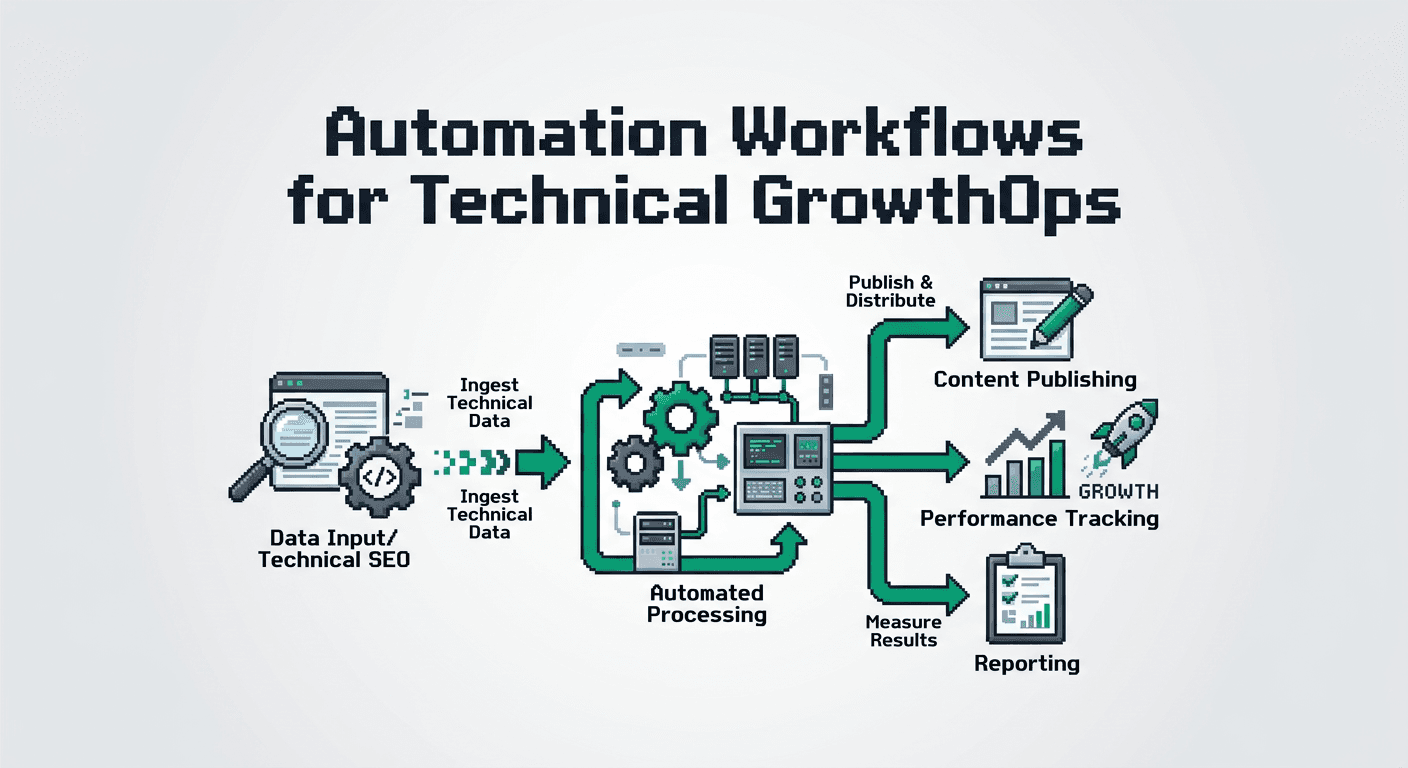
Growth teams stall when handoffs, copy-paste, and ad hoc scripts eat the week. Automation workflows turn repeatable playbooks into reliable lanes that ship daily without heroics.
This guide shows technical product teams how to design, build, and run automation workflows that remove bottlenecks, scale programmatic SEO, and tighten distribution and experiment loops. It is for product operators, growth engineers, and technical marketers. Key takeaway: model growth as systems with clear inputs, orchestrated steps, and measurable outputs.
Map the System Before You Automate
Start with a system map. Define the loop, not the task. Capture inputs, triggers, owners, and outputs.
Identify the highest leverage loop
- Pick one loop that repeats weekly and blocks outcomes.
- Examples: publish programmatic SEO pages, refresh decayed content, syndicate releases, analyze experiments.
- Score by impact potential, failure cost, and data availability.
Document inputs and acceptance criteria
- Inputs: data sources, schemas, credentials, repos, templates.
- Acceptance checks: schema validation, dedupe rules, SEO checks, QA signoff.
- Define done: artifact shipped, metrics logged, alert quiet.
Set triggers and orchestration boundaries
- Trigger types: schedule, webhook, pub sub event, manual approve.
- Orchestrator options: Airflow, Temporal, Dagster, GitHub Actions.
- Boundary rule: one orchestrator per lane to simplify failure handling.
Blueprint the Automation Workflow
Translate the map into an executable lane with clear stages and owners.
Standard stage model
- Ingest: pull data and validate.
- Transform: enrich, join, and score.
- Generate: produce content or payloads.
- Review: automated checks and human approval.
- Publish: ship to target systems.
- Observe: log metrics and raise alerts.
Define contracts and schemas
- Use versioned JSON schemas for all payloads.
- Include nullability rules and enum lists.
- Add a contract test in CI that blocks breaking changes.
Ownership and SLAs
- Assign DRI for each stage.
- Set SLA targets: run time, error budget, recovery time.
- Add on call rotation for production lanes.
Programmatic SEO Lane for Technical Products
Automation workflows shine when building and maintaining large, high quality surfaces.
Source and normalize product intent data
- Inputs: docs endpoints, API specs, SDK refs, query logs.
- Normalize to entities: feature, language, framework, version.
- Score entities by search demand and business value.
Templating and content generation
- Template types: feature guide, integration how to, comparison, troubleshooting.
- Generate outlines with deterministic prompts seeded by schema.
- Keep copy modular: sections as components with IDs.
SSR React SEO architecture
- Use file based routing with static props for stable pages.
- Server render indexable content. Hydrate only interactive blocks.
- Include canonical URLs, structured data, and precomputed meta fields.
Quality gates and review
- Lint for terminology, code fences, and link integrity.
- Run a knowledge panel check: definitions and prerequisites present.
- Human review for technical accuracy on first N of each template.
Automation Workflows for Distribution Loops
Build lanes that push content and updates to where users consume.
Channel inventory and payload specs
- Channels: email, RSS, Slack, X, LinkedIn, community, changelog.
- Define per channel character limits, image sizes, UTM schema.
- Create snippets per template with token placeholders.
Orchestrate sequence and timing
- Stagger high noise channels to avoid cannibalization.
- Use quiet hours per region.
- Backoff rules on API errors. Retry up to N with jitter.
Measurement and feedback
- Attribute with consistent UTMs and short links.
- Log impressions, clicks, signups, and assisted conversions.
- Feed performance back into entity scoring.
Experiment Loops With Automated Analysis
Automate the boring analytics so humans decide faster.
Pre register hypotheses and metrics
- Store hypothesis, success metric, guardrails, and min sample.
- Freeze variants and exposure rules in config.
- Version every experiment with a changelog entry.
Data pipeline and checks
- Stream events with schemas and PII handling.
- Validate event completeness and join keys daily.
- Auto generate power analysis and MDE checks.
Reporting and decision support
- Produce a one pager with lift, intervals, and guardrail status.
- Highlight invalid runs and recommend extension or stop.
- Archive results to a searchable registry.
Tooling Stack and Fit by Use Case
Pick tools that match your team skills, scale, and compliance needs.
Here is a concise comparison of common orchestrators used in automation workflows.
| Orchestrator | Best for | Strengths | Trade offs | Team fit |
|---|---|---|---|---|
| Airflow | Batch data lanes | Mature, broad ecosystem | Python heavy, config sprawl | Data eng orgs |
| Temporal | Long running workflows | Durable state, retries | Steeper learning curve | Platform teams |
| Dagster | Data centric pipelines | Software defined assets | Newer patterns to learn | Analytics eng |
| GitHub Actions | Dev centric tasks | Native to repos, simple | Limited state, vendor ties | Small eng teams |
Governance, Security, and Change Management
Automation fails without guardrails. Bake governance into the lane.
Access and secrets
- Centralize secrets in vault. Rotate on schedule.
- Use scoped service accounts per lane.
- Log all privileged actions with trace IDs.
Change policy and approvals
- Require PRs for config and schema edits.
- Enforce code owners per domain.
- Use canary runs and feature flags for high risk changes.
Audit and compliance
- Snapshot configs and artifacts per run.
- Retain logs and metrics per policy.
- Automate evidence packs for audits.
Observability and SLOs for Growth Lanes
Treat growth lanes like production systems.
Metrics and alerts
- Core SLOs: success rate, freshness, latency, data quality.
- Emit structured logs with correlation IDs.
- Alert on burn rates, not single failures.
Runbooks and rollbacks
- Document failure modes with steps and owners.
- Prebuild rollback actions: revert content, pause publishes, clear cache.
- Run game days quarterly to test recovery.
Cost controls
- Track unit costs per artifact and per channel.
- Cap compute and API spend with budgets and alerts.
- Decommission stale entities and templates.
Execution Playbook: 90 Day Timeline
This is a minimal plan to stand up a programmatic SEO and distribution lane.
| Phase | Weeks | Outcomes | Owners | Tools |
|---|---|---|---|---|
| Scope | 1 to 2 | System map, schemas, SLAs | PM, Eng, SEO | Docs, diagramming |
| Build | 3 to 6 | Orchestrator, pipelines, templates | Eng, SEO | Airflow or Temporal, DB |
| Pilot | 7 to 9 | 50 pages, QA gates, distrib v1 | Eng, Content | CMS, queues |
| Scale | 10 to 12 | 500 pages, alerts, review SLAs | Eng, Ops | Observability, flags |
Acceptance Checks and Success Metrics
Define success before the first commit.
Acceptance checks per run
- Data schemas validate with zero critical errors.
- Pages render server side with correct meta.
- Distribution posts meet channel specs.
- Metrics log to the registry with no gaps.
Success metrics per quarter
- Organic sessions per entity increase by target percent.
- Index coverage and CWV pass rates improve.
- Time to publish reduces by target percent.
- Error budget stays within SLO.
Risks, Failure Modes, and Safeguards
List and mitigate known risks up front.
Common failure modes
- Stale or missing source data.
- Prompt drift in content generation.
- Throttling on third party APIs.
- Template changes that break rendering.
Safeguards
- Data freshness monitors with alerts.
- Version locked prompts and golden tests.
- Backpressure and circuit breakers on API calls.
- Visual diff tests for page templates.
Next Actions and Review Cadence
Ship a small slice and iterate.
Next actions
- Pick one loop and draft the system map.
- Define schemas and acceptance checks.
- Select an orchestrator and scaffold the repo.
- Build the pilot lane and run a canary batch.
Review cadence
- Weekly: lane health, backlog, and SLAs.
- Monthly: metrics deep dive and cost review.
- Quarterly: refactor templates and deprecate low value entities.
Key Takeaways
- Automate loops, not tasks, to remove bottlenecks.
- Use schemas, gates, and SLOs to keep lanes reliable.
- Apply automation workflows to programmatic SEO and distribution.
- Close the loop with experiment analysis and feedback.
- Treat growth lanes like production with observability and runbooks.
Strong systems compound. Start small, automate the boring, and let the lanes run while your team ships the next bet.