
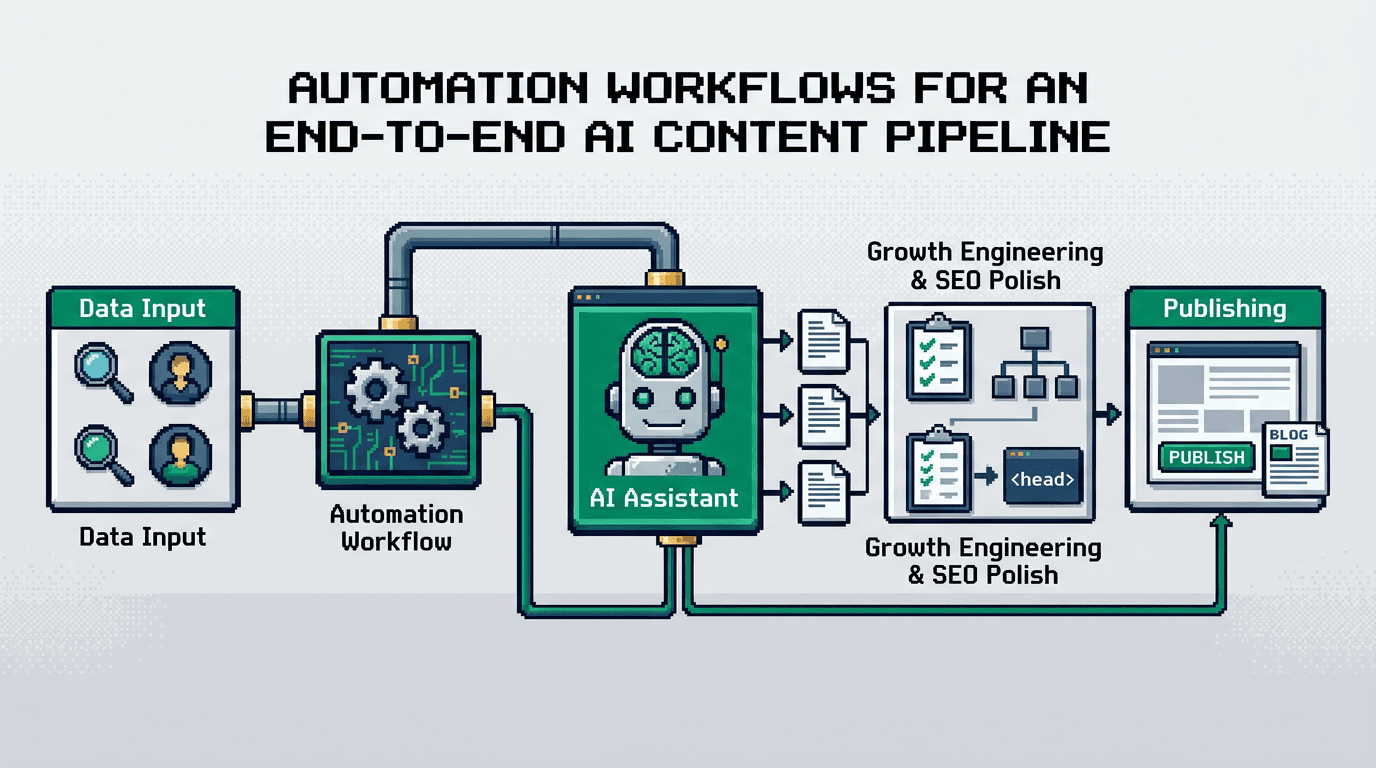
High growth teams automate the content pipeline to ship quality at scale. You can turn briefs, drafts, edits, and distribution into a reliable system with clear inputs, checks, and handoffs.
This guide shows technical product teams how to build automation workflows that connect ideation, programmatic SEO, drafting, review, publishing, and distribution loops. You will get a blueprint with steps, owners, tools, guardrails, and metrics. Key takeaway: treat content as a build pipeline with versioned artifacts and acceptance tests.
Architecture Overview for Automation Workflows
Set the system before adding tools. Model the pipeline as discrete stages with contracts.
Goals and Constraints
- Goal: Increase qualified organic sessions and activation with predictable throughput.
- Scope: Net new content and updates for technical SaaS.
- Constraints: Maintain brand voice, accuracy, and legal compliance. Support programmatic SEO at scale.
- Success metrics: Organic sessions, SERP coverage per template, publish lead time, edit cycles per piece, activation conversions.
Core Stages
- Research and prioritization
- Brief creation and approval
- Draft generation and refinement
- Fact and quality checks
- Publish and index control
- Distribution loops and experiment loops
- Analytics and feedback ingestion
System Contracts
- Each stage receives a structured artifact and emits a validated artifact.
- Validation gates prevent low quality output from moving forward.
- Version control and observability exist per artifact and per stage.
Research and Prioritization at Scale
Convert market signals into demand maps and a prioritized backlog.
Inputs and Data Sources
- Search data: keywords, SERP features, questions, trends
- Product and customer data: activation events, support tickets, sales notes
- Competitor pages and topic clusters
- Link graph and internal content inventory
Workflow Steps
1) Generate a demand map from search and product data.
2) Cluster keywords by intent and template fit for programmatic SEO.
3) Score clusters by opportunity, difficulty, and product fit.
4) Create issues for top clusters with acceptance criteria.
5) Assign owners and due dates; auto label by intent and funnel stage.
Tools and Automation Options
- BigQuery or Snowflake for data joins
- Python notebooks for clustering and scoring
- LLM prompts to propose outlines for top clusters
- Project board with API access to sync scores and statuses
Acceptance Checks
- Each prioritized topic has clear search intent and product tie in.
- A target keyword and related terms are mapped to each brief candidate.
- Duplicates with existing content are resolved or merged.
Brief Creation and SEO Architecture
Use briefs as the spec. Encode SEO architecture and editorial rules.
Brief Template Fields
- Primary keyword and secondary entities
- Search intent and user job to be done
- Target reader, stage, and problem statement
- Outline with H2 and H3 hierarchy
- Evidence sources and citations list
- Product positioning and CTAs
- Acceptance tests and metrics
Programmatic SEO Blueprints
- Identify templates that repeat: integrations, comparisons, how to guides, use cases, industry pages.
- Create a JSON schema per template that defines URL pattern, title rules, meta patterns, H2 blocks, table slots, and CTA placements.
- Store schemas in a repo; version them. Link each brief to a schema.
Automation Workflow
1) Generate draft briefs via an agent that consumes the demand map.
2) Validate headings against schema. Block if levels are missing or misordered.
3) Insert example data, code, or tables as placeholders.
4) Route to human editor for 5 minute sanity pass.
Acceptance Checks
- Brief meets schema. No H1 in body. H2 and H3 only.
- Primary keyword present in title, intro, and at least one H2.
- Sources and SME list included.
Draft Generation and Refinement
Produce a strong first draft quickly, then converge with facts and voice.
Drafting Steps
1) Agent generates a structured markdown draft from the brief.
2) Agent inserts lead hook, opening summary, and section scaffolding.
3) Agent proposes 1 table where comparison helps scanning.
4) SME annotates facts, adds proprietary examples, and removes fluff.
5) Editor enforces voice, clarity, and length targets.
Voice and Quality Guardrails
- Short sentences. One idea per sentence.
- Use concrete nouns and measurable claims.
- Keep examples product relevant and testable.
- Avoid hype. Prefer systems and proof.
Failure Modes and Rollbacks
- Hallucinated facts: require citation tags and a fact check task.
- Keyword stuffing: enforce density limits in lint rules.
- Broken headings: run a heading validator before review.
- Off brand voice: compare to style embeddings; request rewrite.
Fact Checking, Compliance, and Editorial QA
Make truth the default. Automate checks, but keep a human sign off.
Fact Check Pipeline
1) Extract all factual claims with a claim extraction prompt.
2) For each claim, fetch sources from your knowledge base and trusted domains.
3) Score claim support and flag unsupported items.
4) Write inline citations or remove claims.
Compliance and Brand Checks
- Legal phrases and disclaimers as patterns per category.
- Prohibited terms list enforced via linter.
- CTA language approved variants only.
- Readability score target and sentence length caps.
Acceptance Checks
- All claims cited or removed.
- Readability and structure validated.
- Brand and legal checks passed.
Publishing, Index Control, and SSR Considerations
Ship with clean markup, fast pages, and deliberate indexing.
CMS and Repo Integration
- Store markdown in a git repo with front matter.
- Use CI to build pages with SSR React or a static site generator.
- Preview deploy for each PR; reviewers comment inline.
Index and Crawl Controls
- Generate sitemaps on merge.
- Control indexation with robots meta and XML filters.
- Defer indexing until QA passes performance budgets.
Performance and Schema
- Optimize LCP with image presets and streaming SSR.
- Add Article and FAQ schema when appropriate.
- Validate canonical, hreflang, and pagination.
Distribution Loops and Experiment Loops
Do not stop at publish. Distribute and test until you learn.
Distribution Workflow
1) Generate channel specific snippets from the post.
2) Queue posts for LinkedIn, X, communities, and email.
3) Create a short demo or code gist where relevant.
4) Track UTM and capture lift per channel.
Experiment Loop Design
- Hypotheses: title variants, intro hooks, CTA placements, table formats.
- Tests: on page A B, snippet copy A B, timing windows.
- Metrics: CTR, scroll depth, CTA clicks, signup conversion.
- Cadence: weekly review and roll forward wins.
Repurposing Patterns
- Turn sections into standalone posts.
- Convert tables into comparison landing pages.
- Build a running doc of insights to feed future briefs.
Observability, SLAs, and Operating Cadence
Treat the pipeline as a service with uptime and SLAs.
Dashboards and Alerts
- Throughput: pieces started, in review, shipped.
- Lead time: idea to publish, publish to rank.
- Quality: edit cycles, fact check failures, rejection rate.
- Outcome: traffic, signups, assisted revenue.
SLAs and Ownership
- Research SLA: 72 hours from idea to brief.
- Draft SLA: 48 hours per 1500 words.
- Fact and QA SLA: 24 hours.
- Publishing SLA: same day after approval.
- Owner per stage with a clear escalation path.
Postmortems and Continuous Improvement
- Run a five minute post ship review for each piece.
- Log issues and link to corrective actions.
- Update schemas and prompts monthly.
Tooling Stack and Fit by Use Case
Choose tools that respect your architecture. Map to your constraints.
Recommended Roles and Tools
- Data and research: warehouse, notebooks, SEO APIs
- Drafting and editing: LLMs, style linters, markdown editors
- Fact checks: retrieval augmented generation, citation scanners
- Build and publish: git, CI, SSR or SSG, CMS API
- Distribution: scheduler, UTM builder, analytics
Here is a simple comparison of stack patterns by team size.
| Team size | Research stack | Drafting stack | Publish stack | Distribution |
|---|---|---|---|---|
| Solo operator | SEO API plus Sheets | LLM editor plus style linter | Static site generator | Native schedulers |
| Small team | Warehouse plus dbt | LLM plus retrieval and QA bots | SSR React with CI | Scheduler with analytics |
| Growth org | Data platform plus ops | Custom agents plus policy layer | Headless CMS with SSR | Orchestrator with tests |
Implementation Blueprint in 30 60 90 Days
Ship value early. Tighten the loop each month.
Days 0 to 30
- Stand up the research pipeline and backlog.
- Define brief schema and guardrails.
- Automate first draft generation.
- Set up QA checks and basic CI to publish.
- Publish 4 posts and measure lead time.
Days 31 to 60
- Add programmatic SEO templates with version control.
- Integrate fact checking and legal patterns.
- Launch distribution workflows with UTMs.
- Start experiment loops for titles and CTAs.
- Publish 8 posts plus 10 programmatic pages.
Days 61 to 90
- Add performance budgets and index controls.
- Scale repurposing to channel packs.
- Create dashboards for SLAs and quality metrics.
- Reduce edit cycles per piece by 25 percent.
Governance, Risk, and Editorial Safety Nets
Prevent silent failures. Build clear policies and audits.
Policy Library
- Data privacy and citation rules
- AI usage disclosures when required
- Image and code licensing
- Security review for embedded scripts
Audits and Logs
- Keep a log of prompts, model versions, and outputs.
- Snapshot pages before and after edits.
- Review top pages quarterly for accuracy.
Case Study Pattern for Technical SaaS
Apply the pipeline to a product led team shipping developer content.
Scenario
- Product: API first analytics tool.
- Goal: Increase signups from integration pages and tutorials.
Approach
- Research identifies 50 integration keywords and 10 tutorial clusters.
- Build two templates: integration and tutorial.
- Generate briefs, drafts, and code examples via agents plus SME review.
- Publish 20 integration pages and 8 tutorials in 60 days.
Results Metrics to Target
- 20 to 40 percent lift in organic sessions to product pages.
- 2x faster publish lead time.
- 30 percent reduction in edit cycles.
- Higher activation from tutorial CTAs.
Key Takeaways
- Model content as a pipeline with automation workflows and clear gates.
- Use programmatic SEO templates with versioned schemas and strict QA.
- Run distribution loops and experiment loops to compound results.
- Track SLAs, quality metrics, and outcomes in one dashboard.
- Improve monthly with audits, prompt updates, and schema changes.
Ship small, measure fast, and scale the parts that work.