
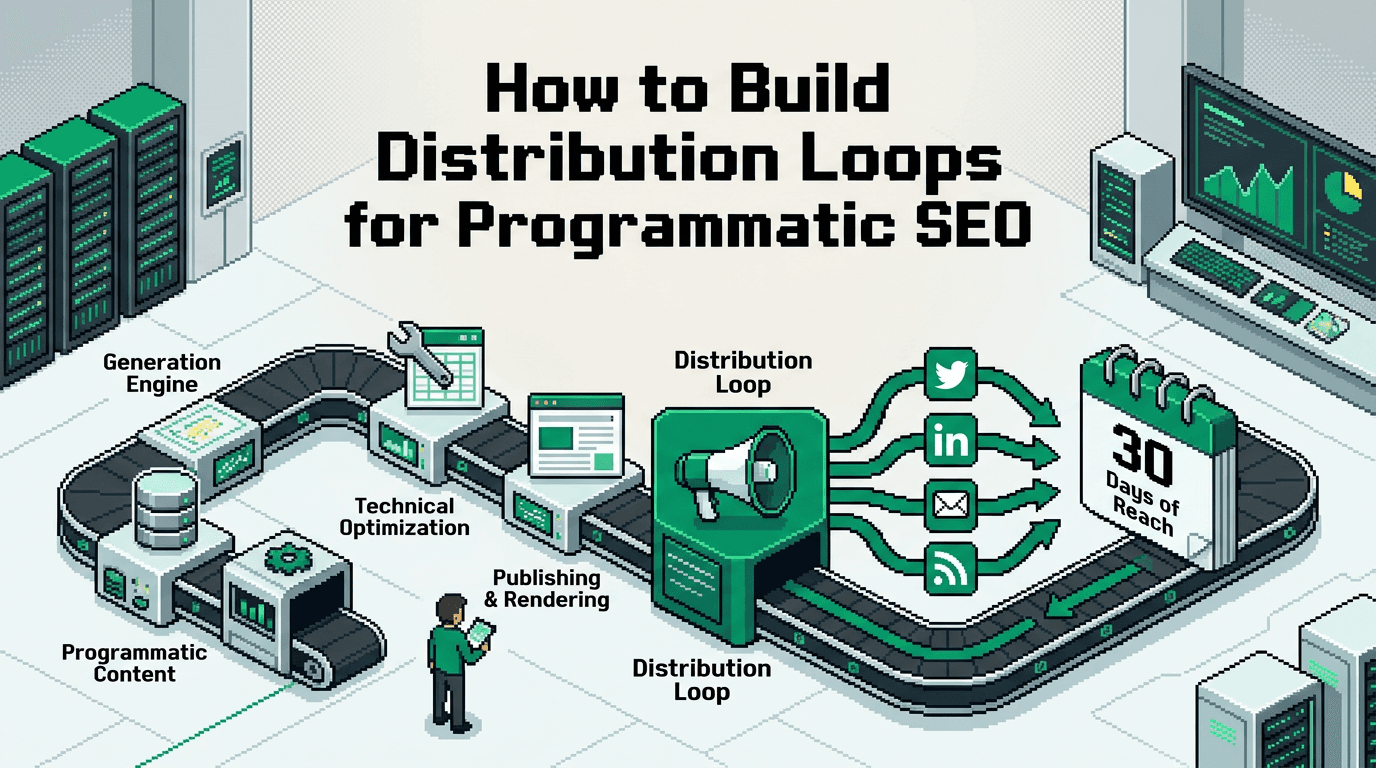
You ship great content, but most posts stall after week one. Distribution loops fix that by turning one post into recurring reach across channels with minimal manual effort.
This guide shows technical product teams how to design and run distribution loops for programmatic SEO. You will learn the system, workflows, and QA gates to scale reach with automation. The key takeaway: treat distribution as a looped pipeline with templates, schedules, and feedback that compounds with each publish.
What Are Distribution Loops and Why They Matter
Distribution loops are repeatable workflows that turn each asset into multi channel outputs, schedule runs, and feedback inputs. The loop compounds visibility and learning over time.
- Outcome: predictable reach and engagement per asset within 30 days.
- Owners: growth engineer, content lead, channel managers.
- Inputs: canonical post, structured metadata, channel templates.
- Outputs: snippets, threads, emails, partner pitches, refreshed internal links.
- Metrics: CTR, click depth, referral mix, assisted signups.
How Loops Differ From One Off Promotion
- Loops run on a calendar with SLAs. One offs stop after a single blast.
- Loops produce artifacts by template. One offs hand craft each post.
- Loops capture responses and update next runs. One offs ignore feedback.
Loop Anatomy at a Glance
- Trigger: publish event or weekly batch.
- Transform: parse post to structured objects.
- Generate: create channel specific snippets.
- Schedule: stage across a 30 day cadence.
- Listen: collect performance signals.
- Adapt: tweak snippets and timing.
Choose the Primary Asset and Structure It
Start with a flagship post anchored in programmatic SEO. Structure it so machines and humans can reuse it.
Define the Single Source of Truth
- Store the post as markdown with front matter.
- Include title, summary, H2 list, key quotes, stats, entities, target queries.
- Add canonical URL, UTM base, and image references.
Example front matter:
title: Programmatic SEO for SSR React
summary: Data models, templates, QA gates, and loops
primary_keyword: programmatic SEO
entities: [SSR React, sitemap, canonical, QA]
ctas: [demo, docs]
Break Content Into Addressable Blocks
Create a block map so automation can select parts.
- H2 sections as topics.
- H3 subsections as subtopics.
- Pull quotes with 120 character limit for social.
- Code or schema blocks flagged as technical snippets.
Store the map as JSON next to the post.
Design the Distribution Loop for 30 Days
You need a consistent, high signal cadence. Aim for 30 days with two weekly refresh checks.
Cadence and Channel Map
- Week 1: high density. Announce everywhere.
- Week 2: repurpose with angle shifts.
- Weeks 3 to 4: evergreen rotations, partners, and internal linking.
Use this baseline schedule:
- Day 0: post published, email announce, LinkedIn thread, X thread, community drop.
- Day 2: short video clip or screen capture walkthrough.
- Day 4: carousel or image summary.
- Day 7: partner pitch and syndication inquiry.
- Day 10: Q and A post, internal link passes to related posts.
- Day 14: update snippets based on CTR and comments.
- Day 21: repost with new hook citing reader questions.
- Day 28: recap post linking back to canonical.
Roles, SLAs, and Acceptance Checks
- Growth engineer: pipeline and templates. SLA 1 day to stage assets.
- Content lead: approve hooks and tone. SLA same day.
- Channel managers: schedule and moderate. SLA 24 hours.
Acceptance checks:
- Each snippet includes a hook, benefit, proof, and CTA.
- Links carry UTM parameters and canonical points to original.
- Images meet size and contrast standards.
Build the Automation Workflow
Automation reduces manual bottlenecks and ensures consistency.
Inputs and Data Contracts
- Inputs: markdown, block map JSON, asset folder, channel templates.
- Contract: every output object must include text, media path, tags, publish window, URL with UTM.
Example output object:
{
  "channel": "linkedin",
  "hook": "Ship SEO pages without manual slug edits",
  "body": "Use a data model...",
  "media": "./assets/slug-pipeline.png",
  "publish_window": "2026-04-15T10:00:00Z",
  "url": "https://example.com/post?utm_source=linkedin&utm_medium=social&utm_campaign=dist-loop"
}
Generation Steps
1) Parse markdown to blocks. Extract H2, H3, quotes, code.
2) Select two angles per channel. One technical, one outcome.
3) Generate 3 variants per angle. Vary hook and CTA.
4) Attach media. Use key diagram or 20 second screen capture.
5) Apply channel constraints. Character limits, line breaks, tags.
Scheduling and Throttling
- Stagger posts to avoid same hour blasts.
- Respect channel best times for your audience.
- Batch schedule for 14 days. Hold back a reserve of variants.
Feedback Collection
- Pull metrics daily for week 1, then twice weekly.
- Fields: impressions, CTR, comments, saves, referral traffic, assisted conversions.
- Tag comments by theme. Create a question backlog.
Channel Blueprints With Templates
Each channel needs a minimal, repeatable template. Use the blocks and angles.
LinkedIn Thread Template
- Hook line with outcome focus.
- 3 to 6 bullets with system steps.
- 1 image or carousel.
- Soft CTA to canonical with UTM.
Example hook: Stop rewriting SEO titles. Use a title template map and push from data.
X Thread Template
- 1 hook tweet under 240 characters.
- 4 to 6 follow ups. Each holds one step or check.
- End with TLDR and link.
Example TLDR: Use block maps, QA gates, and 30 day cadence. Link inside.
Email Announcement Template
- Subject: Outcome in 5 to 7 words.
- Lead: one sentence benefit.
- Body: 3 bullets with specifics.
- CTA button to canonical.
Community and Partner Drop
- Post includes value summary, not just a link.
- Answer a common question from that community.
- Offer a snippet or diagram as a direct upload.
Programmatic SEO Integration
Distribution should reinforce search architecture. Plan internal links and schema updates that increase crawl depth and topical authority.
Internal Link Pass
- In week 1, add 3 to 5 links from older posts to the new post.
- Use context lines that match the new post topics.
- Update sitemaps and recrawl requests where needed.
Schema and Entity Reinforcement
- Add Article schema with sameAs and about entities.
- Ensure consistent naming across posts for key entities.
- Track impressions for target queries in Search Console.
Metrics, QA Gates, and Review Cadence
You cannot improve what you do not measure. Bake checks into the loop.
Metrics That Predict Compounding Reach
- Snippet CTR per channel within 48 hours.
- Save rate and reshares by post type.
- Referral traffic by UTM and day.
- Assisted conversions and free trials from distribution touchpoints.
QA Gates Before Scheduling
- Link check: 200 status and canonical target.
- Image alt text and contrast ratio pass.
- UTM params present and correct.
- Hook clarity: states benefit in under 12 words.
Review and Adaptation Cadence
- Week 1: daily skim for comments and friction.
- Week 2: swap underperforming hooks with variant B.
- Week 4: compile learnings, update templates.
Failure Modes and Rollbacks
Plan for breaks. A small issue can cascade across channels if not contained.
Common Failure Modes
- Broken UTM links across multiple snippets.
- Hooks that promise outcomes not delivered in the post.
- Over posting that tanks reach due to throttling.
- Media mismatch or missing alt text causing accessibility flags.
Rollback and Fix Protocol
1) Pause the queue for the affected channel.
2) Patch the template or link source, not only the instance.
3) Revalidate with a smoke test post.
4) Resume schedule and monitor for 48 hours.
Tooling Stack and Option Tradeoffs
Choose tools that integrate with your content source and provide APIs.
Here is a concise comparison of common tool categories and tradeoffs.
| Category | Option | Strength | Weakness | Fit |
|---|---|---|---|---|
| Calendar and Scheduling | Buffer | Simple UI | Limited workflow rules | Small teams |
| Calendar and Scheduling | Hootsuite | Many channels | Costly for seats | Mid to large |
| Automation Glue | Zapier | Fast to set up | Can be brittle at scale | Prototyping |
| Automation Glue | n8n | Self hosted control | Maintenance overhead | Eng teams |
| Content Source Control | GitHub | Versioned truth | Non marketer friendly | Dev led orgs |
| Analytics | GA4 + BigQuery | Data depth | Setup time | Teams with data help |
Pick one per category that matches your constraints.
Minimal Blueprint You Can Ship This Week
Ship a thin slice. Prove the loop drives reach before expanding.
1) Convert your latest post to markdown with front matter and block map.
2) Generate 2 LinkedIn variants, 2 X thread variants, and 1 email.
3) Schedule Day 0, Day 2, Day 4. Tag UTMs.
4) Log metrics for 7 days in a sheet.
5) Replace the lowest CTR variant with a new hook.
6) Add three internal links from older posts.
Acceptance when CTR improves 20 percent on the replaced variant and referral clicks exceed baseline by 30 percent.
Who Owns What in a Technical Product Team
Assign clear ownership to prevent bottlenecks.
Growth Engineer
- Maintains generation scripts and data contracts.
- Ensures templates compile and pass QA gates.
- Monitors API limits and failure alerts.
Content Lead
- Sets the narrative and approves hooks.
- Reviews claims for accuracy and tone.
- Owns partner outreach priorities.
Channel Managers
- Schedule posts and moderate replies.
- Escalate account issues or throttling signs.
- Report weekly highlights and lowlights.
Example Snippet Variants You Can Copy
Use these as starting points. Edit for your voice and audience.
LinkedIn Variant A
- Hook: Your SEO pages should build themselves from data.
- Body: Map entities to templates. Push titles and slugs from the model. Add QA gates. Publish in batches.
- CTA: Read the blueprint.
LinkedIn Variant B
- Hook: Stop manual meta titles at scale.
- Body: Use a title template matrix bound to entity type and state. Validate with preview diffs before deploy.
- CTA: See examples.
X Thread Variant A
- Hook: Programmatic SEO fails when titles drift.
- Steps: model, template, preview, QA gates, release.
- TLDR: Treat titles like code.
X Thread Variant B
- Hook: Ship 100 pages without 100 hours.
- Steps: data model, template tests, internal link pass.
- TLDR: Automate the boring parts.
Governance, Ethics, and Brand Safety
Guardrails matter. Automation can amplify mistakes.
Claims and Evidence
- Avoid unverified stats. Use qualitative trends if unsure.
- Link to docs, repos, or demos as proof points.
Brand and Accessibility
- Keep tone consistent across channels.
- Provide alt text for every image.
- Use readable contrast and font sizes on carousels.
Extending the Loop With Experiment Loops
Use distribution as a feed into experimentation. Convert feedback into tests.
Turning Feedback Into Tests
- Cluster comments by confusion points.
- Draft a follow up post addressing the top cluster.
- Test new hooks or content blocks in snippets before editing the canonical.
Measuring Compound Impact
- Track topic coverage growth across your cluster.
- Monitor average rank lift for related queries.
- Attribute assisted conversions to touchpoints in the loop.
Key Takeaways
- Treat distribution as a 30 day loop with templates, schedules, and QA gates.
- Generate channel ready variants from a structured source and block map.
- Use UTMs, daily checks, and swaps to improve CTR and reach.
- Reinforce programmatic SEO with internal links and consistent entities.
- Start with a thin slice, then scale owners, channels, and automation.
Close the loop every week. Review results, update templates, and compound reach on the next publish.