
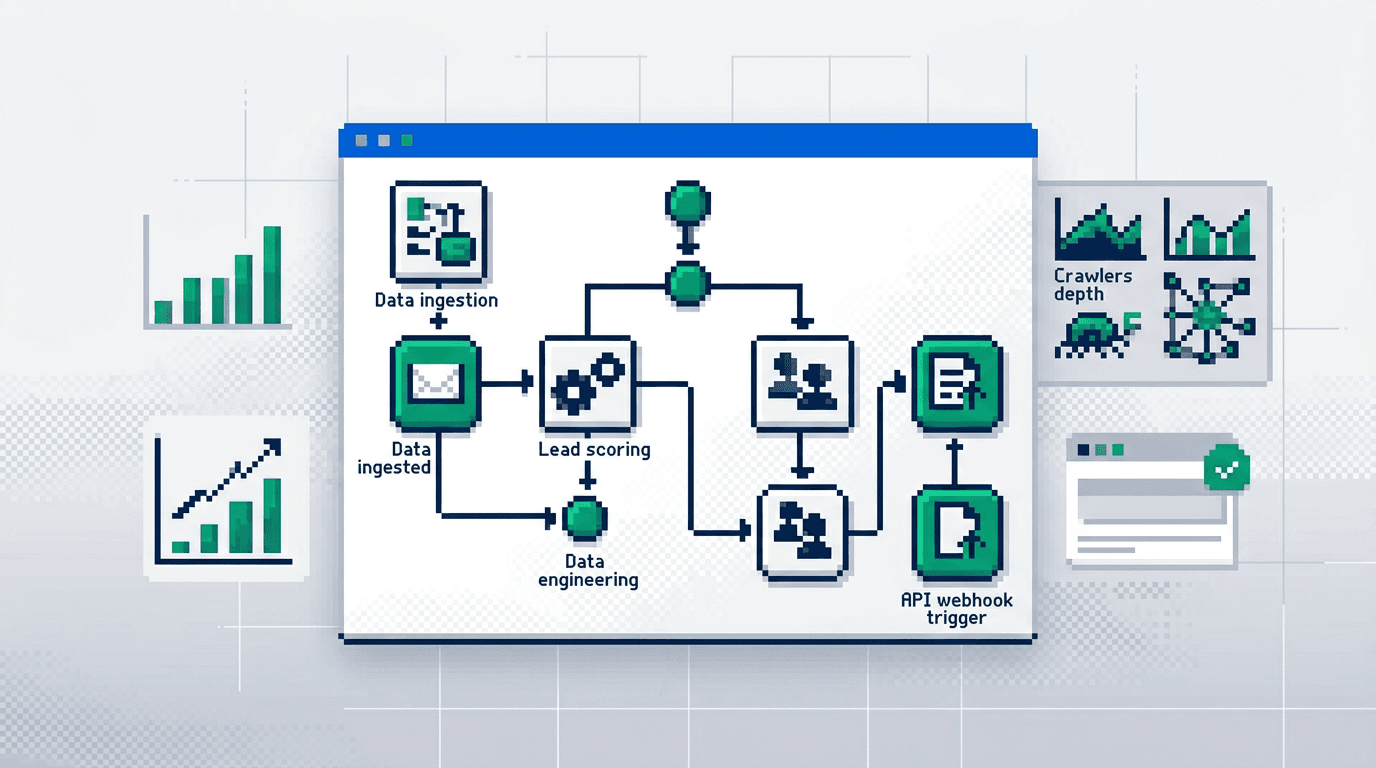
Growth teams stall when handoffs, copy-paste, and ad hoc checks pile up. Automation workflows remove these bottlenecks and move signals to action.
This post shows product operators and technical growth teams how to design automation workflows that scale. You will learn a system for intake, routing, programmatic SEO, distribution loops, and experiment loops. The key takeaway: ship a measurable pipeline with clear triggers, owners, and QA gates that compounds outcomes over time.
What Are Automation Workflows and Why They Matter
Automation workflows are repeatable sequences that use triggers, rules, and actions to move data and tasks without manual effort. They matter because they reduce latency, improve data quality, and free operator time for higher leverage work.
Core components
- Trigger: event or schedule that starts the flow.
- Rules: conditions that branch paths.
- Actions: operations like create, update, notify, enrich, or publish.
- State: payload plus metadata for idempotency and retries.
- Observability: logs, metrics, and alerts.
Value for SaaS growth
- Faster content to publish time for programmatic SEO.
- Consistent metadata and schema for search architecture.
- Higher post-campaign reuse via saved playbooks.
- Lower error rates and clearer accountability.
Choose the Primary Pipeline to Automate First
Start with one pipeline that touches revenue signals and repeats weekly. Scope small. Prove value in two sprints.
Candidate pipelines
- Programmatic SEO publishing for templates and data feeds.
- Lead routing and enrichment from website to CRM.
- Content snippet generation and multi-channel distribution.
- Experiment setup from hypothesis to variant launch.
Selection criteria
- Volume: at least 20 events per week.
- Impact: measurable lift in traffic, leads, or activation.
- Complexity: 5 to 10 steps with 1 to 2 systems of record.
- Data availability: clean source with schema defined.
System Design for Automation Workflows
Design the workflow like a small service. Define inputs, transformations, outputs, and acceptance checks before you build.
Inputs and contracts
- Define event shape: fields, types, and required keys.
- Add source ownership and contact for escalations.
- Document SLAs for availability and update cadence.
Process and state
- Use a queue for decoupling and retries.
- Store run metadata: run_id, step, status, started_at, ended_at.
- Keep payload versioning for backward compatibility.
Outputs and acceptance checks
- Outputs write to a single system of record.
- Add acceptance tests: schema valid, unique key, required assets present.
- Log success and failures with correlation IDs.
Blueprint: Programmatic SEO Automation Workflow
This workflow turns structured data into indexed pages with SSR templates and QA gates. Primary keyword used: automation workflows.
Data modeling and templates
- Source: product catalog, integrations, pricing, or docs.
- Model: table with slug, title, h1, meta_title, meta_description, canonical, body_blocks, images.
- Template: SSR React page with slots for blocks and components.
Build steps
1) Ingest source data nightly to a staging table.
2) Validate schema and required fields.
3) Generate slugs and canonical rules.
4) Create draft pages with default metadata.
5) Run content linting and internal link suggestions.
6) Create PRs for template changes if diffs exceed thresholds.
7) Publish batches behind a feature flag.
QA gates and rollbacks
- QA gate A: schema pass and image dimensions valid.
- QA gate B: meta length checks and duplicate title checks.
- Rollback: unpublish last batch, revert template version, requeue payloads.
Workflow: Distribution Loops That Compound Reach
Turn each flagship page into a month of distribution with stable cadence and inputs.
Assets and channels
- Assets: title, abstract, 10 snippets, 3 visuals, 1 short video.
- Channels: blog, newsletter, LinkedIn, X, community, partner update.
Steps and cadence
1) Generate snippets with a prompt library and human review.
2) Map snippets to channels and time zones.
3) Schedule posts and UTM tags.
4) Collect performance: clicks, CTR, saves, comments.
5) Feed top performers back to snippet library.
Acceptance checks
- Each post must include UTM and canonical link.
- Image ratio correct for channel.
- No channel duplicates inside 48 hours.
Workflow: Experiment Loops From Hypothesis to Learning
Ship tests weekly. Close the loop with decisions, not dashboards left open.
Hypothesis intake
- Template: problem, hypothesis, metric, expected lift, exposure, guardrails.
- Owner: one DRI with start and end dates.
Run and decide
1) Create variants and QA the instrumentation.
2) Launch with exposure caps and guardrails.
3) Monitor stopping rules.
4) Decide: ship, iterate, or archive.
5) Write one learning note and tag components touched.
Metrics and artifacts
- Metrics: primary metric change, sample ratio, runtime.
- Artifacts: PRs, dashboards, and decision doc linked to ticket.
Tools and Stack Fit for Automation Workflows
Pick tools that integrate well and have clear ownership. Avoid hidden state across many SaaS apps.
Core categories
- Data: warehouse, event bus, queue, and scheduler.
- App: CMS with API, SSR framework, and headless assets.
- Ops: secrets, logging, monitoring, alerting, and run history.
Example stack options
Below is a sample comparison to guide selection. Fit by team skills and constraints.
| Layer | Option A | Option B | Notes |
|---|---|---|---|
| Queue | SQS | RabbitMQ | SQS is managed. RabbitMQ gives fine control. |
| Scheduler | Airflow | Temporal | Temporal adds durable workflows and retries. |
| CMS | Headless CMS | In house service | Headless reduces build time. |
| Web | Next.js SSR | Remix SSR | Both support SSR and dynamic routes. |
| Monitoring | Datadog | OpenTelemetry + Grafana | Pick one. Coverage over features. |
Governance, Ownership, and Review Cadence
Without clear ownership, workflows drift and break silently.
Roles and RACI
- DRI: one owner per workflow.
- Builders: engineers and ops who maintain code and playbooks.
- Reviewers: SEO lead and growth PM for acceptance checks.
Cadence and rituals
- Daily: error triage and retries.
- Weekly: performance review and backlog grooming.
- Monthly: playbook refactor and deprecation review.
Failure Modes and How to Prevent Them
Design for failure. Assume bad inputs, partial outages, and schema drift.
Common issues
- Schema drift breaks publishing.
- Rate limits throttle external APIs.
- Partial publishes create orphaned pages.
- Silent failures hide in missed alerts.
Preventive controls
- Contract tests between sources and workflow.
- Backpressure and exponential backoff.
- Idempotent writes with upsert keys.
- Heartbeats and alert on zero throughput.
Metrics That Prove Automation Works
You need a small set of metrics tied to growth outcomes.
Leading indicators
- Time to publish for programmatic pages.
- Error rate per 100 runs.
- Manual touch count per run.
Lagging indicators
- Organic sessions to programmatic pages.
- Index coverage and valid page ratio.
- Lead volume and activation rate.
Minimal Implementation Plan in Two Sprints
Ship a thin slice. Prove value in 14 days.
Sprint 1
- Define workflow contract and owners.
- Build ingestion, validation, and draft generation.
- Ship QA gate A and logging.
- Publish to a staging environment.
Sprint 2
- Add metadata generation and internal linking.
- Integrate scheduler and alerting.
- Enable distribution loop scheduling.
- Release to production behind a flag.
Documentation and Playbooks
Write what you built. Keep it close to the code and the runs.
Artifacts to maintain
- README with inputs, steps, outputs, and rollback.
- Runbook with alerts, dashboards, and on call steps.
- Playbook for snippet creation and channel mapping.
Acceptance and deprecation
- Accept new sources only with schema contracts.
- Deprecate flows with no owner or low usage.
Key Takeaways
- Start with one high impact pipeline and define contracts.
- Build with queues, QA gates, retries, and clear ownership.
- Automate programmatic SEO, distribution, and experiment loops.
- Measure time to publish, error rate, and organic impact.
- Review weekly and refactor monthly to keep quality high.
Ship the first slice fast. Then compound by adding sources, channels, and tests.