
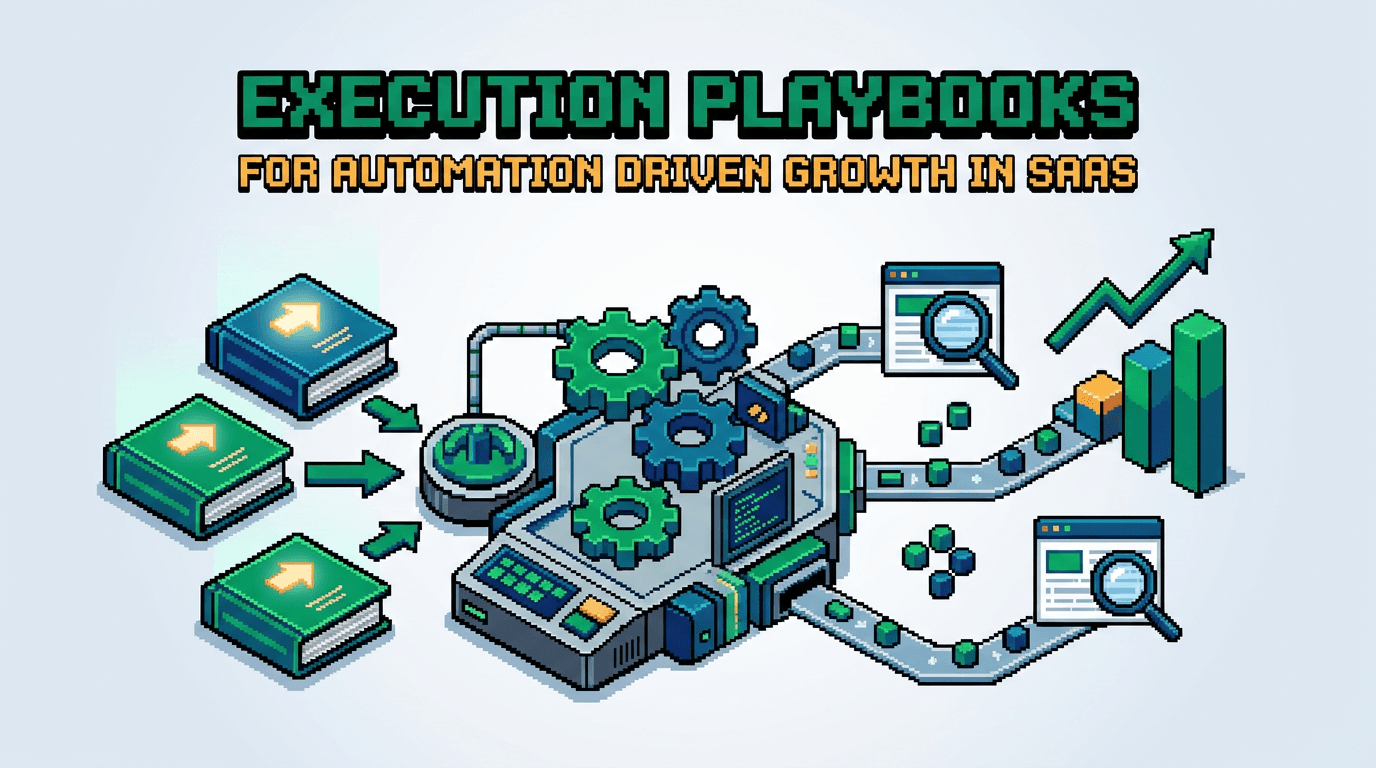
High growth SaaS teams do not scale by effort. They scale by systems. Execution playbooks turn recurring growth work into reliable automation that compounds.
This post shows technical operators how to design, ship, and iterate execution playbooks for automation driven growth. You will get patterns, workflows, and templates to remove bottlenecks, align teams, and measure lift. Key takeaway: systematize work into playbooks with clear triggers, steps, owners, and metrics.
What is an execution playbook
An execution playbook is a repeatable workflow that turns a growth goal into steps, tools, and metrics. It runs on triggers, not opinions. It ships outcomes on a schedule.
Core components
- Goal: the measurable outcome the playbook must hit
- Triggers: events that start a run
- Inputs: data, prompts, and assets
- Steps: ordered tasks with tools and owners
- Outputs: artifacts and state changes
- Metrics: success and guardrails
- Cadence: when it runs and how it resets
Why playbooks outperform ad hoc work
- Lower variance across runs
- Faster onboarding for operators
- Fewer handoffs and approvals
- Built in metrics and review loops
- Easier automation and scaling
Architecture for automation driven growth
You need a simple, observable architecture that can evolve. Keep services small and interfaces explicit.
Layered system
- Source layer: product analytics, CRM, docs, code
- Decision layer: rules, thresholds, models
- Action layer: API calls, content generation, publishing, alerts
- Observability layer: logs, metrics, traces, run books
Data contracts and versioning
- Define input schemas with JSON Schema
- Version prompts and rules with Git tags
- Add acceptance tests for sample payloads
Programmatic SEO as a flagship playbook
Programmatic SEO fits execution playbooks well. The process is structured, data rich, and repeatable.
Inputs and discovery
- Keyword seeds from product surfaces and logs
- Entity graphs from docs and support tickets
- Competitive gaps from SERP and link graphs
Generation and QA
- Template driven outlines by intent and entity
- Retrieval augmented writing from docs and PRDs
- Static checks for tone, coverage, and facts
Publishing and feedback
- Batch publish with SSR React for speed and control
- Track indexation, CTR, and conversions per template
- Roll back low performers and iterate prompts
SEO architecture for SSR React
SSR React lets you control metadata, speed, and internal links at scale. Treat SEO as an application, not a byproduct.
Routing and metadata
- Precompute canonical routes with slugs
- Hydrate title, meta, and structured data on the server
- Generate sitemaps per content family daily
Internal linking and crawl budget
- Build programmatic link modules by entity type
- Use priority queues for sitemap inclusion
- Cap depth and maintain stable URL patterns
Automation workflows across the growth stack
Execution playbooks extend beyond SEO. Use the same design to automate distribution, activation, and retention.
Distribution loops
- Trigger: new post merged to main
- Steps: slice assets, post to channels, schedule reshares
- Metrics: reach, clicks, assisted signups
Experiment loops
- Trigger: hypothesis approved
- Steps: ship variant, run exposure, collect results
- Metrics: lift, confidence, time to decision
Blueprint to design your first execution playbook
Start small. One outcome, one path, no branches. Prove value, then scale.
Step 1: define the outcome
- One sentence goal with metric and time window
- Example: Increase organic signups from docs pages by 15 percent in 60 days
Step 2: map triggers and inputs
- Triggers: schedule, new data, threshold breach, manual release
- Inputs: schemas, repositories, prompts, environment variables
Step 3: draft the steps
- List tasks in order
- Assign owners and tools
- Add acceptance checks after each major step
Step 4: wire automation
- Use a runner: Airflow, Dagster, Temporal, or a lightweight queue
- Add idempotency keys and retries
- Log each step with structured events
Step 5: instrument metrics
- Leading: runs, latency, pass rate
- Lagging: traffic, CTR, conversion, revenue
- Guardrails: error budgets, content quality scores
Step 6: review and iterate
- Weekly retro: failures, rollbacks, changes
- Monthly checkpoint: metric deltas and scope updates
Minimal template for execution playbooks
Use this template to standardize playbooks across teams.
Playbook header
- Name
- Owner
- Goal and metric
- Triggers
- Cadence
Steps block
- Step id and description
- Tool and command
- Owner
- Acceptance check
- Rollback action
Metrics and alerts
- Dashboards and queries
- Alert thresholds and channels
- SLA and error budget
Tooling choices and fit by use case
Pick tools that match your data volume, team skills, and latency needs.
Here is a quick comparison to guide selections.
| Use case | Orchestrator | Content engine | Storage | Notes |
|---|---|---|---|---|
| Programmatic SEO | Airflow or Dagster | SSR React + RAG | Postgres | Batch friendly, strong lineage |
| Distribution queue | Temporal | Webhooks + API calls | Redis | Durable retries, human in the loop |
| Experiment loop | Dagster | Feature flag SDK | BigQuery | Fast analytics and audit trails |
Example playbook: programmatic SEO for a technical product
This example shows one full path from discovery to publish.
Goal and scope
- Goal: Grow qualified organic signups by 20 percent in 90 days
- Scope: Entities from API features and integration surfaces
Triggers and inputs
- Triggers: weekly schedule, new API endpoint detected
- Inputs: endpoint docs, usage logs, keyword seeds
Steps
1) Mine entities and intents from docs and queries
2) Build outlines from templates by intent
3) Generate drafts with retrieval augmented content
4) Run checks for coverage, claims, and style
5) Stage posts, request human spot checks on risk items
6) Publish via SSR React with internal link modules
7) Submit sitemaps and ping index
Metrics and review
- Leading: draft pass rate, time to publish, crawl rate
- Lagging: CTR, signups per template, LTV to CAC
- Review: weekly failures, monthly template refactors
Governance and quality gates
Automation needs guardrails. Define them early and test often.
Policy and risk
- Sensitive claims require human approval
- Hallucination budget set to zero for specs and pricing
- All facts must map to a source URL
Checks and rollbacks
- Pre publish: lint, links, schema, facts, tone
- Post publish: 404 scans, SERP drift, regressions
- Rollback: unpublish and remove from sitemaps within 5 minutes
Metrics that prove compounding value
Track both the machine and the business. Do not guess.
System health metrics
- Run success rate and latency
- Backlog size and retry count
- Coverage of entities and intents
Business outcome metrics
- Assisted signups and activation rate
- Revenue per content family
- Payback period by playbook
Operating model and roles
Clarity on owners prevents stalls and scope creep.
Core roles
- Operator: runs and maintains the playbook
- Editor or PM: sets goals and approves changes
- Engineer: builds pipelines and tests
- Analyst: validates impact and reports
RACI per step
- Responsible: operator
- Accountable: editor or PM
- Consulted: engineer and analyst
- Informed: leadership and support
Common failure modes and fixes
Plan for things to break. Design quick detection and cheap recovery.
Typical issues
- Flaky triggers cause missed runs
- Silent prompt drift reduces quality
- Index bloat hurts crawl and CTR
Fixes
- Add dead letter queues and alerts
- Version prompts and add canary checks
- Prune pages and tighten internal links
Roadmap to scale execution playbooks
Add scope only after you stabilize the base path and metrics.
Scale by breadth
- New entities and templates
- New channels and formats
- More countries and languages
Scale by depth
- Personalization by segment
- Adaptive internal linking by behavior
- Budget aware crawling and rendering
Key Takeaways
- Ship execution playbooks to turn goals into triggers, steps, and metrics
- Use programmatic SEO with SSR React as a flagship automation
- Instrument leading and lagging metrics to prove lift
- Add guardrails, versioning, and fast rollbacks to control risk
- Scale only after stability and positive unit economics
Execution compounds when systems run on schedule and learn each week. Start small, measure, then widen the lane.