
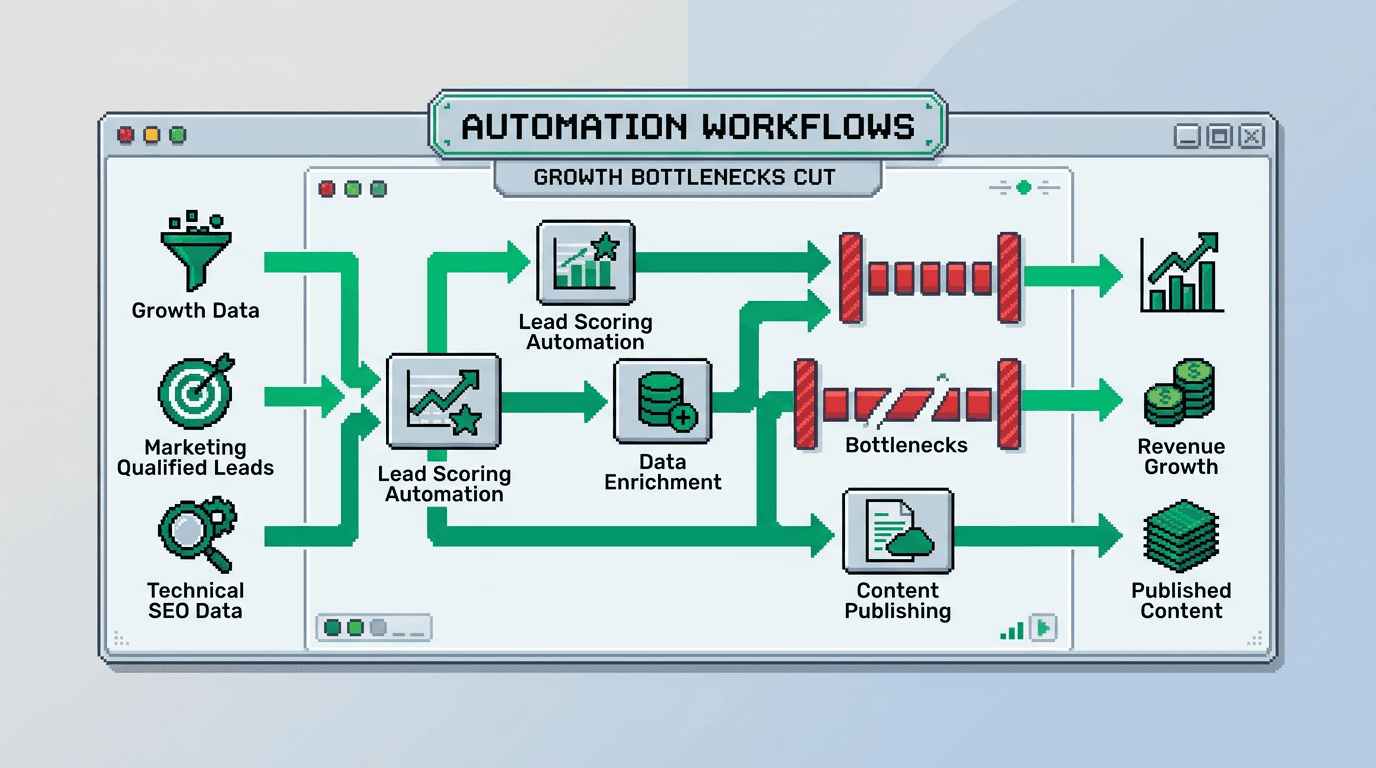
You can remove 60 percent of manual growth toil with a small set of automation workflows. The payoff is compound leverage across content, SEO, and distribution.
This post gives product operators a concrete system to design, build, and run automation workflows that unlock compounding growth. You will learn a repeatable architecture, programmatic SEO tactics, experiment loops, and distribution loops with acceptance checks and metrics. The key takeaway: ship narrow lanes that automate the highest frequency tasks, then expand by measured ROI.
The Automation Lane Model for Growth
An automation lane is a scoped workflow that takes a defined input, runs a deterministic process, and ships an owned output. Treat it like software.
Inputs, Process, Outputs
- Inputs: structured briefs, keyword clusters, source docs, product data, and events.
- Process: validations, transforms, generation, QA, approval, publish, distribution.
- Outputs: indexed pages, social posts, email sends, dashboards, tickets.
Owner, SLA, and Acceptance Checks
- Owner: one DRI for the lane. No shared ownership.
- SLA: time from input to shipped output. Start with 24 to 72 hours.
- Acceptance checks: schema valid, links resolved, lint passes, zero broken images, indexable.
Metrics and Review Cadence
- Leading metrics: tasks completed, error rate, cycle time, review depth.
- Lagging metrics: organic clicks, signups, activation, assisted revenue.
- Cadence: weekly lane standup, monthly ROI review, quarterly refactor.
SEO Architecture That Scales With Automation Workflows
Your SEO system must accept machine generated content without losing quality. Build for programmatic SEO with strong guardrails.
Information Architecture and URL Strategy
- Create modular collections: topics, templates, and entities.
- Use clean, stable slugs. Avoid dates in URLs for evergreen assets.
- Map templates to intents: how to, comparison, glossary, patterns.
Data Model and Schemas
- Define JSON schemas for briefs, outlines, and content blocks.
- Capture entities: product features, industries, jobs to be done.
- Store as versioned records. Every change is diffable and reviewable.
Rendering and SSR for Technical Products
- Use SSR to ensure fast first paint and reliable indexing.
- Precompute meta tags, canonical, and structured data.
- Cache per route with revalidation on content publish.
Programmatic SEO With Templates and Guardrails
Programmatic SEO amplifies coverage. Guardrails protect quality.
Template Patterns That Work
- Feature pages by industry
- Comparison matrices by use case
- Integration directories with specs and guides
- Glossaries with internal linking to deep guides
Content Blocks and Variables
- Blocks: intro, value prop, steps, code, table, FAQ hint, CTA.
- Variables: product, persona, problem, proof points, pricing.
- Rules: minimum word count per block, link density targets, and reading grade.
Quality Gates and Human in the Loop
- Automated checks: grammar, link integrity, factual anchors, unique ngrams.
- Human review: facts, positioning, tone, and examples.
- Rollback: versioned publish. Revert in one click on failed metrics.
Build the Core Automation Workflows
Start with three lanes. Each lane is small, measurable, and expandable.
Lane 1: Keyword to Brief
Goal: produce a usable brief for a target cluster in under 30 minutes.
Steps:
1) Ingest seed keywords and competitor URLs.
2) Cluster by intent and difficulty.
3) Generate outline, angle, entities, and internal links.
4) Validate with schema. Push to Briefs store.
5) Notify editor in Slack with diff and SLA.
Tools: search API, embeddings for clustering, rules engine, Slack webhook.
Metrics: briefs per week, acceptance rate, average time to approve.
Lane 2: Brief to Draft
Goal: convert approved briefs into publish ready drafts with 95 percent structure compliance.
Steps:
1) Pull approved brief by ID.
2) Expand sections using block templates and style rules.
3) Insert internal links and citations.
4) Run lints: style, links, reading grade, entity coverage.
5) Save draft, create PR in repo. Assign reviewer.
Tools: LLM with constrained decoding, content linter, repo bot, CI pipeline.
Metrics: draft cycle time, lint pass rate, edits per draft, reviewer load.
Lane 3: Draft to Publish and Distribute
Goal: ship live content with automatic distribution loops.
Steps:
1) Merge PR after approval. Trigger build.
2) Generate meta, Open Graph, and schema.
3) Post to social, send email snippet, queue syndication.
4) Create UTM tagged links. Update sitemap and ping search engines.
5) Log publish event and set revalidation window.
Tools: CI, CMS API, distribution scheduler, email service, analytics.
Metrics: time to live, distribution coverage, clickthrough, index time.
Execution Playbooks for Technical SEO Teams
Turn lanes into runbooks with ownership, rituals, and rollback.
Roles and Responsibilities
- Operator: owns lanes and SLAs.
- Editor: approves briefs and tone.
- Engineer: maintains CI, templates, and performance.
- Analyst: monitors metrics and leads experiments.
Rituals and Reviews
- Daily checks: failed jobs, lints, publishing queue.
- Weekly: velocity, error patterns, and backlog grooming.
- Monthly: template performance and pruning.
Rollbacks and Incident Handling
- Define severity levels for quality breaches.
- Disable lane on repeated failure. Route to manual mode.
- Postmortem entries with fix owners and deadlines.
Distribution Loops That Compound Reach
Distribution loops attach to publish events and recycle content into multiple channels.
Primary Loop: Owned Channels
- Email: send abstract and CTA to read more.
- Social: post thread and image summary.
- Community: share highlights with value first framing.
Secondary Loop: Earned and Embedded
- Outreach to partners for roundup features.
- Submit to relevant newsletters.
- Embed charts or snippets in public docs with links.
Recycling Loop: Derivatives
- Convert sections into short videos or slides.
- Create glossary entries that link back to the article.
- Add a how to snippet for developer docs.
Experiment Loops and Measurement
Treat lanes as experiments. Iterate on the highest leverage variables.
Define the Experiment Unit
- Unit: a page, a template, or a lane change.
- Window: 28 days for indexing and 14 days for signals.
- Baseline: historical control or sibling template.
Metrics and Dashboards
- SEO: impressions, clicks, average position, index coverage.
- Engagement: read time, scroll depth, CTA clicks.
- Growth: signups, activation, assisted conversions.
Decision Rules
- Ship if uplift exceeds preset threshold with stable error rate.
- Rollback if quality or engagement drops below baseline.
- Pause and rework if signals are inconclusive after two cycles.
Tooling Stack and Architecture
Pick tools that are composable, observable, and scriptable.
Core Services
- Versioned content store with schema validation.
- Queue and workers for lane jobs.
- CI pipeline for previews and tests.
- Observability for job states and logs.
Suggested Stack
- Content: headless CMS or Git with front matter.
- Build: SSR framework with incremental static regeneration.
- Jobs: serverless functions with retries and dead letter queues.
- QA: link checker, style linter, schema validator.
Observability and Alerts
- Emit structured logs per job step.
- Alert on failure rate spikes and SLA breaches.
- Trace job duration from input to shipped output.
Comparison of Common Approaches
Here is a quick comparison of manual, semi automated, and lane based systems.
| Approach | Speed | Quality Control | Scalability | Best For |
|---|---|---|---|---|
| Manual | Low | High with effort | Low | Early validation |
| Semi automated | Medium | Medium | Medium | Growing teams |
| Lane based automation | High | High with gates | High | Operator led growth |
Case Blueprint: From Zero to Working Lanes in 30 Days
Scope a narrow target and grow by iteration. Use this plan to stand up automation workflows quickly.
Week 1: Foundations
- Define goal metric and baseline.
- Model schemas for briefs and drafts.
- Build Lane 1 with clustering and outline generation.
- Set dashboards and alerts.
Week 2: Drafting
- Implement Lane 2 with block templates and lints.
- Establish editorial acceptance rules.
- Run five pilot briefs to drafts. Measure errors.
Week 3: Publishing
- Wire Lane 3 with CI, metadata, and distribution.
- Publish three pilot articles. Track index time.
- Fix performance or schema issues.
Week 4: Scale and Review
- Expand templates and internal links.
- Tune prompts and rules to reduce edits.
- Ship eight articles. Review ROI and next scope.
Risk Management and Compliance
Automation fails without clear limits. Contain risk with explicit rules.
Guardrails to Enforce
- No publish without human approval on net new assets.
- Block publishing if link checker or schema validator fails.
- Require citations for technical claims and benchmarks.
Compliance and Brand Safety
- Maintain content provenance with IDs and logs.
- Redact sensitive data in prompts and outputs.
- Version all edits. Keep a clear audit trail.
Extending Lanes Beyond Content
Once stable, apply the lane pattern to adjacent growth tasks.
Lead Routing and Enrichment
- Auto enrich leads on form submit.
- Score by firmographic and behavior data.
- Create tasks with owners and due dates.
Activation and Onboarding
- Trigger in app checklists based on role.
- Send playbook emails aligned to jobs to be done.
- Measure time to first value and reduce steps.
Customer Expansion Signals
- Detect usage thresholds and trigger success outreach.
- Auto generate case study briefs from product telemetry.
- Push opportunities to CRM with context.
Key Takeaways
- Automate narrow, high frequency workflows first.
- Use programmatic SEO with templates and strict QA.
- Attach distribution loops to every publish event.
- Run experiment loops with clear decision rules.
- Measure SLAs, failure rates, and ROI every month.
Ship the smallest lane that proves the model, then scale by impact and reliability.